


NATO Secretary-General speaks about threat in Arctic ahead of Canada visit

NATO Secretary-General, Jens Stotlenberg, is visiting  the Canadian Arctic Region, together with Canadian prime minister, Justin Trudeau to underline the strategic importance of the region for the Euro-Atltantic alliance.

"Russia’s brutal war on Ukraine is a game-changer for global security. It shows that we cannot take our security for granted – anywhere. NATO has responded with unity and resolve, determined to support Ukraine and keep our 1 billion people safe – everywhere", Stoltenberg wrote on Wednesday in an opinion piece for Canada's Globe and Mail newspaper.

Stoltenberg added:

"NATO is a defensive alliance. Our purpose is to prevent conflict and preserve peace. Much of the High North (Arctic territory and waters), has traditionally been an area of low tensions. But unfortunately, this is changing due to the rapidly warming climate and rising global competition. Increasing parts of the Arctic will be ice-free in summer. This is unlocking opportunities for shipping routes, natural resources and economic development. But it also raises the risk of tensions. Authoritarian regimes are clearly willing to use military intimidation or aggression to achieve their aims. At the same time, they are stepping up their activities and interest in the Arctic.

Russia has significantly increased its military activity in recent years, setting up a new Arctic Command, opening hundreds of new and former Soviet-era Arctic military sites, including airfields and deep-water ports, and using the region as test-bed for novel weapon systems. Last month, Russian President Vladimir Putin launched a new naval strategy pledging to protect Arctic waters “by all means,” including increased activity around the non-militarized Norwegian archipelago of Svalbard and hypersonic Zircon missile systems for its Northern Fleet. Just last week, Russia unveiled plans for a new strategic missile-carrying submarine cruiser for Arctic operations. Russia’s ability to disrupt Allied reinforcements across the North Atlantic is a strategic challenge to the Alliance.

China is also expanding its reach, declaring itself a “near-Arctic state” and planning a “Polar Silk Road” linking China to Europe via the Arctic. It is rapidly strengthening its navy, with plans to build the world’s biggest icebreaker vessel. China is also investing tens of billions of dollars in energy, infrastructure and research projects in the region. Earlier this year, Beijing and Moscow pledged to intensify practical co-operation in the Arctic, as part of a deepening strategic partnership that challenges our values and interests.

NATO has a clear interest in preserving security, stability and co-operation in the High North. The Arctic is the gateway to the North Atlantic, hosting vital trade, transport and communication links between North America and Europe. Ensuring freedom of navigation and unfettered access is essential to keep our economies strong and our people safe. Once Finland and Sweden join the Alliance, seven out of the eight Arctic states will be members of NATO. Finland and Sweden’s membership will significantly enhance our posture in the High North and our ability to reinforce our Baltic Allies.

NATO is already increasing our presence in the High North. A new NATO Command ensures that Atlantic sea lines of communication remain free and secure. Allies including Canada are investing in new air and maritime capabilities. NATO and NATO Allies regularly conduct Arctic and anti-submarine exercises to ensure we remain ready to operate in all conditions and defend every inch of Allied territory from any threat. Two of NATO’s largest exercises in recent years – Trident Juncture and Cold Response – were in the High North. 

In this more dangerous and competitive world, NATO is increasing our presence and vigilance across the Alliance, including in the High North. With strength and unity, we will continue to deter aggression, protect our values and interests, and keep our people safe."
commonspace.eu with the Globe and Mail (Toronto)
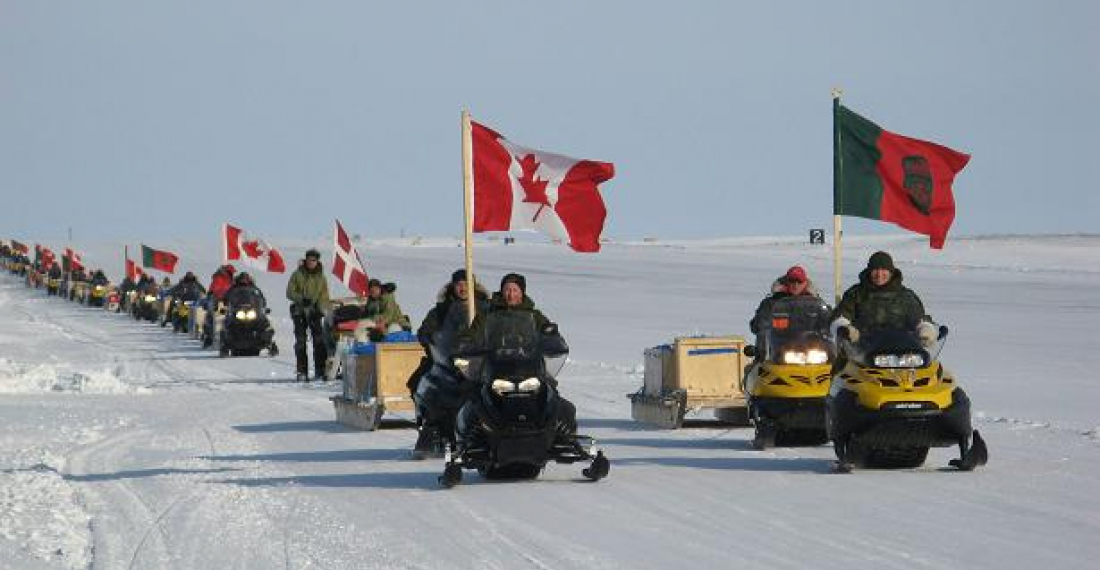
photo: Canadian and US Arctic forces conduct joint drills (archive picture)

Related articles

Editor's choice
News
Council of Europe launches new International Claims Commission for Ukraine

Council of Europe launches new International Claims Commission for Ukraine

Thirty-four countries and the European Union have signed a new convention establishing an International Claims Commission for Ukraine at a diplomatic conference co-hosted by the 46-nation Council of Europe and the Netherlands in the Hague. The diplomatic conference was attended by leaders and high-level representatives from over 50 states, including the President of Ukraine, Volodymyr Zelenskyy, the President of the Republic of Moldova, Maia Sandu, and the Prime Minister of the Netherlands, Dick Schoof.  “Today marks a major step forward in ensuring accountability for Ukraine. The International Claims Commission represents justice and hope for tens of thousands of victims—our determination that those who have suffered will not be forgotten. I call for quick ratifications so we can get the commission rapidly up and running for the people of Ukraine,” said Council of Europe Secretary General Alain Berset. Ukrainian President Volodymyr Zelenskyy said: “We expect that every mechanism for compensation from the Register of Damage and Claims Commission to the actual payments – will start working and receive strong and sufficient international support, so that people can truly feel that any kind of damage caused by the war can be compensated. This war, and Russia’s responsibility for it, MUST become a clear example – so that others learn not to choose aggression.” “Accountability is about creating the conditions for peace that endures. And therefore, accountability is a condition of security – today and for the future. But accountability is not only about Ukraine. And it is not only about one aggressor and one victim. Accountability is about Europe. About every country in Europe. It is about whether Europe, as a whole, is willing to defend its peace,” said Maia Sandu, President of the Republic of Moldova, which currently holds the Presidency of the Council of Europe’s Committee of Ministers. The Prime Minister of the Netherlands, Dick Schoof, said: “Every day Russia is deliberately bombarding homes, destroying businesses and damaging infrastructure in Ukraine. Russia must compensate Ukraine for the damage caused. That is why we have launched the International Claims Commission for Ukraine and we are honoured to host it.” The International Claims Commission will be the second part of a comprehensive compensation mechanism related to Russia’s war of aggression, building on the existing Register of Damage for Ukraine. The claims commission will be established within the framework of the Council of Europe and will also be open to other countries. The Register of Damage for Ukraine, created in 2023, collects and records compensation claims submitted by individuals, organisations and public bodies in Ukraine. Forty-four states and the European Union have so far joined the Register, which has already received 86,000 claims. The International Claims Commission will review, assess and decide upon claims submitted to the Register of Damage for Ukraine and determine the amount of compensation, if any, which is due in each case. The convention establishing the commission will enter into force once it has been ratified by 25 signatories, as long as sufficient funds have been secured to support its initial work.

Popular

Editor's choice
News
Council of Europe launches new International Claims Commission for Ukraine

Council of Europe launches new International Claims Commission for Ukraine

Thirty-four countries and the European Union have signed a new convention establishing an International Claims Commission for Ukraine at a diplomatic conference co-hosted by the 46-nation Council of Europe and the Netherlands in the Hague. The diplomatic conference was attended by leaders and high-level representatives from over 50 states, including the President of Ukraine, Volodymyr Zelenskyy, the President of the Republic of Moldova, Maia Sandu, and the Prime Minister of the Netherlands, Dick Schoof.  “Today marks a major step forward in ensuring accountability for Ukraine. The International Claims Commission represents justice and hope for tens of thousands of victims—our determination that those who have suffered will not be forgotten. I call for quick ratifications so we can get the commission rapidly up and running for the people of Ukraine,” said Council of Europe Secretary General Alain Berset. Ukrainian President Volodymyr Zelenskyy said: “We expect that every mechanism for compensation from the Register of Damage and Claims Commission to the actual payments – will start working and receive strong and sufficient international support, so that people can truly feel that any kind of damage caused by the war can be compensated. This war, and Russia’s responsibility for it, MUST become a clear example – so that others learn not to choose aggression.” “Accountability is about creating the conditions for peace that endures. And therefore, accountability is a condition of security – today and for the future. But accountability is not only about Ukraine. And it is not only about one aggressor and one victim. Accountability is about Europe. About every country in Europe. It is about whether Europe, as a whole, is willing to defend its peace,” said Maia Sandu, President of the Republic of Moldova, which currently holds the Presidency of the Council of Europe’s Committee of Ministers. The Prime Minister of the Netherlands, Dick Schoof, said: “Every day Russia is deliberately bombarding homes, destroying businesses and damaging infrastructure in Ukraine. Russia must compensate Ukraine for the damage caused. That is why we have launched the International Claims Commission for Ukraine and we are honoured to host it.” The International Claims Commission will be the second part of a comprehensive compensation mechanism related to Russia’s war of aggression, building on the existing Register of Damage for Ukraine. The claims commission will be established within the framework of the Council of Europe and will also be open to other countries. The Register of Damage for Ukraine, created in 2023, collects and records compensation claims submitted by individuals, organisations and public bodies in Ukraine. Forty-four states and the European Union have so far joined the Register, which has already received 86,000 claims. The International Claims Commission will review, assess and decide upon claims submitted to the Register of Damage for Ukraine and determine the amount of compensation, if any, which is due in each case. The convention establishing the commission will enter into force once it has been ratified by 25 signatories, as long as sufficient funds have been secured to support its initial work.

