

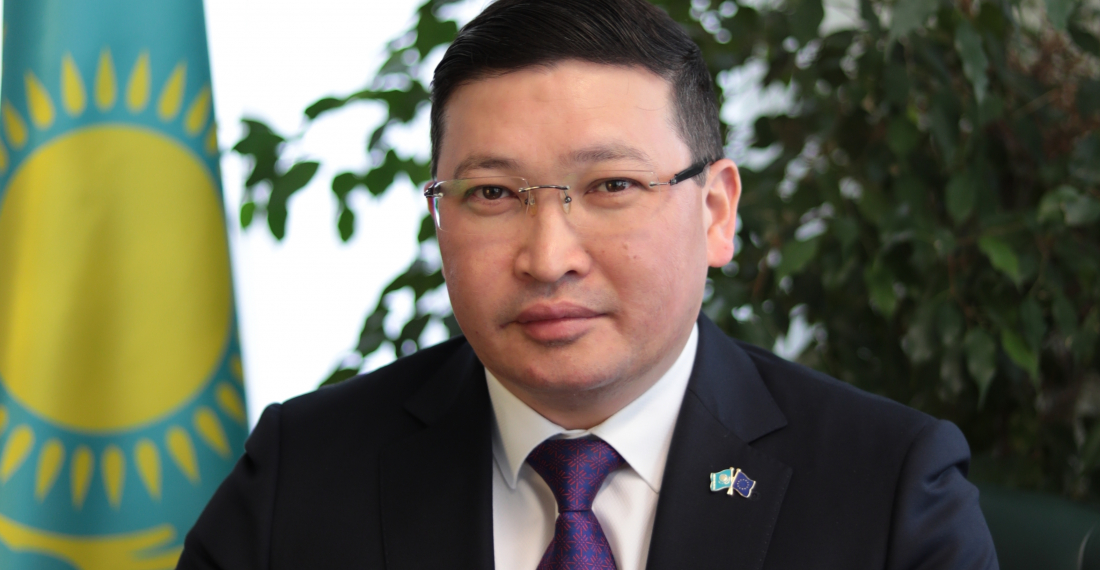
On Sunday, 5 June, the people of Kazakhstan voted overwhelmingly in favour of big changes to the country's constitution which envisage a redistribution of presidential powers to various other state organs, a system of checks and balances and a decentalisation of power. The changes complement other ongoing political and economic reforms that have been initiated by president Kassym-Jomart Tokayev over the last three years. Commonspace.eu interviewed Ambassador Margulan Baimukhan, Head of the Mission of Kazakhstan to the European Union about the importance of the Constitutional changes, the role of Kazakhstan in Central Asia and generally about the changes taking place in his country. "We have very high hopes that the results of the referendum will have deep positive consequences for the future of our country. It brings us one step closer to become a democratic state. Most importantly for me is that the referendum result paves the way for increasing the participation of the population in the governance of the country. It will nurture the culture of people in standing and defending their rights", the Ambassador said. Ambassador Baimukhan also spoke about the relations of his country with the European Union. "The European Union was, is and will be at the forefront of our foreign policy agenda".
This is the full interview:
CS: On 5 June, a constitutional referendum took place in Kazakhstan. What changes are envisaged and why are they necessary?
Since his election as President of Kazakhstan in 2019, our Head of State Mr. Kassym-Jomart Tokayev embarked on an irreversible path of political modernisation of the country. He proposed the Concept of a “Listening State” and established a “National Council of Public Trust” which advised on various key issues related to the political, economic and social aspects of the statehood. President Tokayev has proposed and started implementation of four large scale packages of political and economic reforms. The holding of a national referendum on June 5, 2022 on introducing amendments and addition of new articles to the Constitution was the next stage in the implementation of the presidential program of political reforms aimed at bettering the lives of the citizen and turning Kazakhstan into a true democratic society.
Overall, it introduces amendments to 31 articles and adds two new ones; in fact it changes a third of the Constitution. So you can see the scale of the changes that are to take place in Kazakhstan. In his televised address in May President Tokayev said “our Constitution will get an entirely new dimension. That is why I proposed to put the issue to a national referendum because such large-scale changes must be decided by the people’s will,”
The political essence of the constitutional reforms is a transition from a super-presidential to a presidential form of government based on constitutionalism. This means voluntarily redistributing the power of the President to other institutions.
President Tokayev’s vision is that the referendum on constitutional reform will create the legal basis for an effective and more balanced model of relations between the state and society.
Without going into details I would like to bring your attention to some of the major amendments that include limiting presidential powers – the President shall not be a member of a political party during his term of office, close relatives of the President shall not have the right to hold positions of political civil servants, and heads of quasi-public companies, the powers of the President to revoke or suspend in whole or in part the acts of the governors and mayors of the regions, cities of national significance and the capital are excluded.
More power will be given to the Parliament–the Senate will no longer be able to make new laws, and instead will approve or reject laws passed by Mazhlis (lower chamber of the Parliament). The number of deputies of the Mazhlis will be reduced from 107 to 98, following the abolition of 9 seats appointed by the Assembly of the Peoples of Kazakhstan, and the Assembly will get to appoint only 5 deputies. Instead of 15 members, the president will now nominate 10 members to the Senate. Six members of the constitutional court will be nominated by the parliament, three each by the national assembly and the senate, and four will be appointed by the president. Mazhilis deputies will be elected according to a mixed system:70% of Mazhilis deputies will be chosen by proportional elections, and 30% will be directly elected.
Other major changes relate to a significant decentralization of power with more competences given to regional and local authorities, thus increasing the participation of the population in the governance of the country, as well as consolidation of human rights protection mechanisms, including the Ombudsperson’s office, and the establishment of the Constitutional Court.
CS: President Kassym-Jomart Tokayev since being elected in 2019 has been introducing a number of reforms in both political and economic spheres. But some say that these reforms are moving slowly. How do you assess the process of reform, and what are the likely future milestones?
Indeed, as I mentioned earlier, President Tokayev introduced 4 large scale political and economic reforms since assuming the post in 2019. I should say that any reforms take a considerable amount of time to be implemented, especially when we are talking about a comprehensive transformation of the entire state model in the case of Kazakhstan. I do not agree that some of the reforms are too slow, instead I should emphasize that we are going relatively fast. The political modernisation of the country and the further enhancing of the democratization of society is work in progress, and require a constant attention. We know that the US or any other democratic state in EU has not become such overnight. It took centuries for some countries to become a democratic, and as for us we are only 30 years old as modern independent states, and my understanding that we are doing relatively good in this sense.
We have very high hopes that the results of the referendum will have deep positive consequences for the future of our country. It brings us one step closer to become a democratic state. Most importantly for me is that the referendum result paves the way for increasing the participation of the population in the governance of the country. It will nurture the culture of people in standing and defending their rights.
CS: A process of change is ongoing in Central Asia. How does Kazakhstan see its relations with the region and what can Kazakhstan do in the future to improve regional peace and security, especially in the face of new challenges, such as developments in Afghanistan and the current tensions between the west and Russia over Ukraine.
Relations with the Central Asian countries have always been one of the main foreign policy priorities of Kazakhstan and they remain so. Kazakhstan enjoys excellent relations with all our brotherly nations and committed to further strengthening and deepening the cooperation with all of them. Kazakhstan thinks that the deep integration is of high importance to the region in order to provide long term sustainable development.
As you have rightly mentioned all Central Asian countries are experiencing changes in their domestic and foreign policies. We are witnessing positive changes and attitudes toward more close cooperation between all countries. A true testament to this statement is the “Consultative meetings" of the leaders of the Central Asian Republics, an imitative that was first launched by Kazakhstan in 2019. The last such meeting took place in Turkmenistan in August 2021, and a joint statement of the leaders was adopted as a result of that meeting. It says that the further enhancement of ties in trade and economic, investment, industrial finance, energy, agriculture, transport, ecology and others are of high importance in order to provide a sustainable development for the region. In this regard, the parties agreed to increase mutual trade and further develop common mutually beneficial approaches to the effective solution of the problem of trade facilitation in the region. They also noted the need to intensify work to expand cooperation between business circles and regions of the Central Asian states in order to increase mutual trade, implement joint economic projects, including the development of trade and production sites in the border areas, as well as a network of wholesale distribution centers.
As for improving the issues of regional peace and stability they confirmed that one of the most important factors in maintaining and strengthening security and stability in Central Asia is the speedy settlement of the situation in neighboring Afghanistan. In this regard, the leaders of the central Asia republics expressed their readiness to provide all possible assistance for the speedy achievement of civil peace and harmony in Afghan society. We work together with our European partners in this direction. Therefore we welcome the outcome of the Almaty meeting of Central Asian and EU Special Envoys and Special Representatives that took place in May 30-31 and the great collaboration between CA-EU Envoys, the UNODC and the UNAMA leadership.
One of the main outcomes of the last Consultative Meeting was the agreement to establish a dialogue on security and cooperation in Central Asia as a permanent consultative platform to consider topical issues of the development of the region on a systematic and regular basis.
In the light of new configuration of supply chains, Central Asia leaders emphasized the importance of further deepening multilateral cooperation in the transport and transit sector in order to ensure free and unhindered transit of goods and cargo, including the creation of new and modernization of existing international routes for air, road, rail, river and sea transport, multimodal transport corridors, international multifunctional logistics, trade and tourism centers, and the implementation of other joint infrastructure projects that ensure the efficient use of the region's transit potential.
CS: How will Kazakhstan benefit from the “Middle Corridor”?
Against the background of the complex geopolitical situation, Kazakhstan is currently looking into alternative routes to prevent the disruption of transit and freight traffic through our territory. We are redirecting freight traffic through the Middle Corridor.
Among a number of projects, the Middle Corridor stands out as a symbol of genuine connectivity as it envisages an extensive network of multimodal connections that offers benefits to all stakeholders.
The Middle Corridor, functioning under the Trans-Caspian International Transport Route International Association (TITR) is a multilateral institutional development linking the containerized rail freight transport networks of China and the European Union through the territory of Kazakhstan, the Caucasus, Turkey, and Eastern Europe. The multilateral, multimodal transport institution links Caspian and Black Sea ferry terminals with rail systems in China, Kazakhstan, Azerbaijan, Georgia, Turkey, and / or the Black Sea.
Since March 2022, export cargoes were redirected to Latvian ports (Liepaja, Riga, Ventspils) and to the Middle Corridor. We reached an agreement with Azerbaijan, Georgia and Turkey on establishment of a joint venture on the route.
For Kazakhstan, the main challenge with the Middle Corridor is the adoption of a competitive unified tariff for Kazakh businesses, and the issue of cargo containerization.
Such a “container hub” is now being created on the basis of the Aktau Port. Large transnational companies like Singapore’s PSA International, Maersk, MSC and Cosco Shipping are already among potential partners of the project.
We expect that soon the volume of traffic through the sea ports of Aktau and Kuryk, the Kazakh ports along the Middle Corridor, will reach 10 million tons (including 4 million tons of re-directed export cargo).
The development of the Middle Corridor corresponds with the goals of the EU’s Global Gateway Strategy since it is a diverse and sustainable project that involves dozens of companies and countries, connecting Asia and Europe on the basis of mutual interests and trade.
To discuss these issues, together with the European Parliament, Kazakhstan Railways National Company and the «Trans-Caspian International Transport Route» Association, our Embassy is organizing a Roundtable on “Transit and Transport Cooperation Between Kazakhstan and the European Union” on 15 June 2022 in Brussels. This will be a good opportunity to showcase the “Middle Corridor” to an informed European audience.
CS: How do you characterize the current state of the EU-Kazakhstan relations? What should the two sides be focusing more to move forward?
To be brief, I should say that the relations between Kazakhstan and the EU are at their highest level. Next year, we will celebrate a milestone event in our relations – the 30th Anniversary of the establishment of diplomatic ties (February 2, 1993). Over the last three decades, we have managed to build a solid bilateral and multilateral cooperation based on trust, mutual respect and shared values. The European Union was, is and will be at the forefront of our foreign policy agenda. Kazakhstan is committed to further strengthening and deepening cooperation with the EU in the framework of the Enhanced Partnership and Cooperation Agreement.
A very strong impetus to further strengthening and widening the avenues of the cooperation was given by the visit of the President of Kazakhstan, H.E. Kassym-Jomart Tokayev to Brussels last year in November, where he met President Charles Michel and President Ursula von der Leyen.
As a result of the visit we have agreed to work together on transition to green economy under the “European Green Deal”, to intensify our trade and investments, to build better “connectivity” in energy and raw materials, transport corridors and logistics. We share similar goals in protection of environment and post pandemic recovery. And, taking into account developments in Afghanistan, regional security is identified as a priority area of cooperation for the foreseeable future.
Trade turnover in 2021 amounted to 28.9 billion US dollars, which is 21.4% higher compared to 2020 (23.8 billion US dollars). At the same time, exports amounted to 23.6 billion US dollars, imports - 5.65 billion US dollars.
The EU is the largest investor in the economy of Kazakhstan. FDI inflows from the EU in 2021 amounted to USD 10.1 billion, which is 24.3% higher than in 2020 (USD 8.2 billion). Over the 30 years of cooperation FDI to Kazakhstan from the EU amounts to 170 billion USD. The main share of FDI from EU countries is in the Netherlands, Belgium, France, Cyprus, Luxembourg and Germany.
CS: What are the most interesting developments in art, music, cinema etc in Kazakhstan?
I think that Kazakhstan is experiencing a so called cultural renaissance nowadays. There are many talented singers and artists that represent Kazakhstan with honour in the international arena. I would like to name a few of them. For example Imanbek Zeikenov, who is a self taught DJ, become very popular in the last two years and won the Grammy Awards. Now many prominent pop artist from the US and Europe are collaborating with him, including Rita Ora, Acon, David Guetta and many more. Another prominent Kazakh is Dimash Qudaibergen, who has fan clubs literally all over the world. His concerts in the US, Great Britain, Germany and Czech republic were all sold out. He is admired for creating a new genre in the music industry – so called “popera”, which is a fusion of pop and opera music. As music experts claim, Dimash has 7 octave ranges and he performs in more than 10 languages.
The cinema industry is also booming as the number of locally produced content is rising and is being franchised by foreigners. Some of the producers are collaborating with the Hollywood artists and shooting some clips for American celebrities. For example, Aisultan Seitov produced clips for American rappers that were nominated for MTV Music Video Awards.