


Washington aspires for a NATO like military alliance in Asia

Washington aspires for a formal alliance - similar to the North Atlantic Treaty Organisation (NATO) - with India, Japan, and Australia against 'a potential challenge from China' and 'to create a critical mass around shared values and interests ... ultimately to align in a more structured manner,"  according to Deputy US Secretary of State Stephen Biegun.

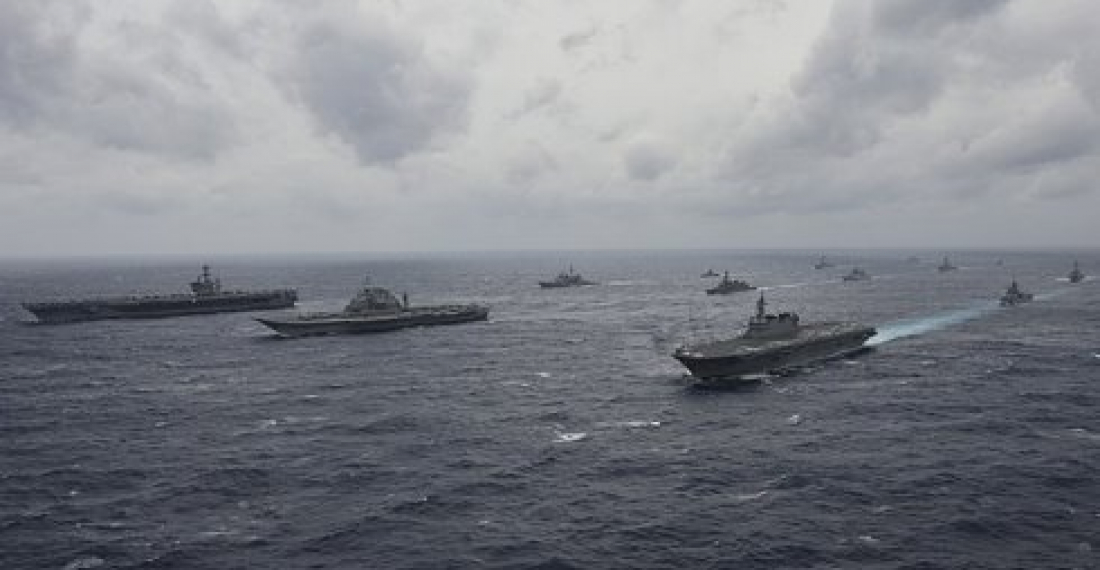
Biegun was speaking in an online discussion organised by the US-India Strategic Partnership Forum on Monday ((31 August). Biegun also said the group of four nations were expected to meet in New Delhi sometime this autumn and cited Australia's possible participation in India's Malabar naval exercise as an example of progress towards a more formal defence bloc.

The naval exercises, which take place mainly in the Bay of Bengal, have been carried out annually by the United States and India since 1992, and include Japan since 2015. In the spring, India had rejected another Australian request to participate in the joint naval exercise Malabar with the US and Japan. 

Biegun sees a formal alliance with the three countries ‘‘only happening if the other countries are as committed as the US''. India is a country with a long tradition of non-alignment and the country may not be ready to join a formal military alliance. However, recent clashes with China in the Himalayas, and accusations that China had seized territory which India considers its own, has very rapidly changed perspectives in New Delhi.

source: commonspace.eu

photo: US, Indian and Japanese ships on exercise in the Bay of Bengal (archive picture)

 

Related articles

Popular

Editor's choice
Interview
Thursday Interview: Murad Muradov

Thursday Interview: Murad Muradov

Today, commonspace.eu starts a new regular weekly series. THURSDAY INTERVIEW, conducted by Lauri Nikulainen, will host  persons who are thinkers, opinion shapers, and implementors in their countries and spheres. We start the series with an interview with Murad Muradov, a leading person in Azerbaijan's think tank community. He is also the first co-chair of the Action Committee for a new Armenian-Azerbaijani Dialogue. Last September he made history by being the first Azerbaijani civil society activist to visit Armenia after the 44 day war, and the start of the peace process. Speaking about this visit Murad Muradov said: "My experience was largely positive. My negative expectations luckily didn’t play out. The discussions were respectful, the panel format bringing together experts from Armenia, Azerbaijan, and Turkey was particularly valuable during the NATO Rose-Roth Seminar in Yerevan, and media coverage, while varied in tone, remained largely constructive. Some media outlets though attempted to represent me as more of a government mouthpiece than an independent expert, which was totally misleading.  Overall, I see these initiatives as important steps in rebuilding trust and normalising professional engagement. The fact that soon a larger Azerbaijani civil society visits to Armenia followed, reinforces the sense that this process is moving in the right direction." (click the image to read the interview in full)


