


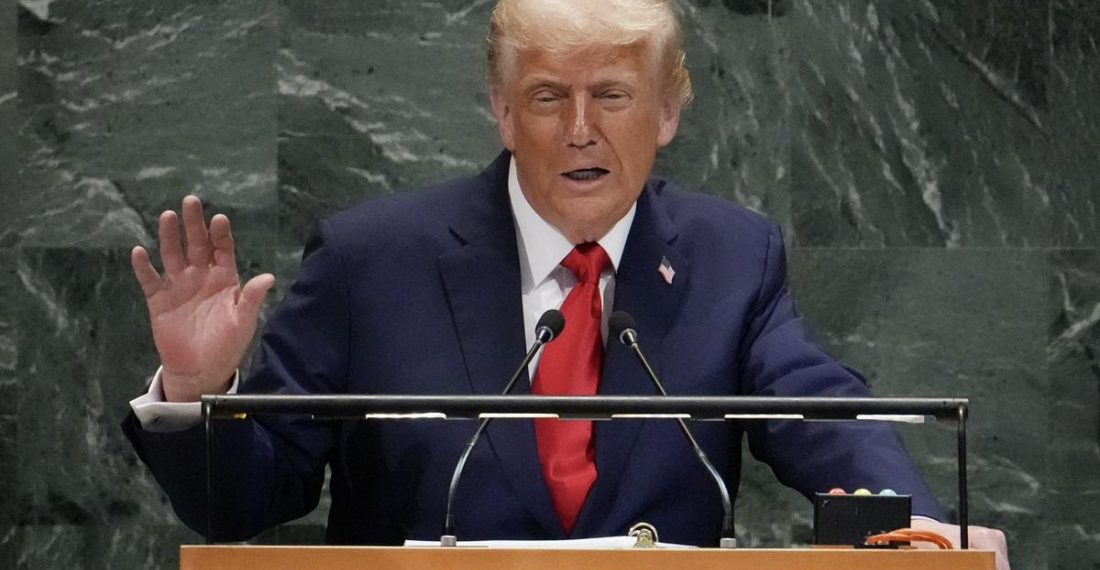
US President Trump mocks UN on peace and migration and attacks European allies

US President Donald Trump relentlessly mocked the United Nations on Tuesday 23 September  in his first address since his White House comeback, blasting it for failing to bring peace and claiming the world body encourages illegal migration. In his return to the UN General Assembly podium, Trump accused the UN of fostering an "assault" through migration on Western countries that he said were "going to hell". He likewise used the major forum to denounce efforts to reduce global warming, calling climate change concerns "the greatest con job ever perpetrated on the world". Trump also lashed out at European allies, as well as China and India, for failing to stop oil purchases from Russia, while remaining relatively restrained on Moscow even as he said Washington was ready to impose unspecified sanctions.

"What is the purpose of the United Nations?" asked Trump. "All they seem to do is write a really strongly worded letter," he said. "It's empty words, and empty words don't solve war".

The 79-year-old president even complained about a broken escalator and teleprompter at the New York headquarters of the UN, which he has repeatedly targeted during both of his presidential terms. "These are the two things I got from the United Nations, a bad escalator and a bad teleprompter," he said.

Touting what he said were his efforts to end seven wars, Trump turned to two where his outreach has produced no results – Russia's invasion of Ukraine and Israel's war in Gaza following Hamas's October 7, 2023 attack. He called recognition by a slate of Washington's allies of a Palestinian state a "reward" to armed group Hamas for "horrible atrocities" and urged the group to release hostages to reach peace.

Some of his strongest language was reserved for migration as he lambasted the UN for "funding an assault" on Western nations. "It's time to end the failed experiment of open borders," Trump said. "Your countries are going to hell," he said, also attacking London's Mayor Sadiq Khan, the first Muslim mayor of a Western capital. Trump's second term has opened with a blaze of nationalist policies curbing cooperation with the rest of the world.

He has moved to pull the United States out of the World Health Organisation and the UN climate pact, severely curtailed US development assistance and wielded sanctions against foreign judges over rulings he sees as violating sovereignty.

Opening the annual summit, UN Secretary-General Antonio Guterres warned that aid cuts led by the United States were "wreaking havoc" in the world. "What kind of world will we choose? A world of raw power – or a world of laws?" Guterres said.

President Trump also on said Tuesday that he believed Ukraine could win back all territory lost to Russia, a dramatic shift from the U.S. leader’s repeated calls for Kyiv to make concessions to end the war. Trump posted on social media soon after meeting with Ukrainian President Volodymyr Zelenskyy on the sidelines of the General Assembly.

“I think Ukraine, with the support of the European Union, is in a position to fight and WIN all of Ukraine back in its original form,” Trump wrote. “With time, patience, and the financial support of Europe and, in particular, NATO, the original Borders from where this War started, is very much an option.”

The strengthened support from Trump, if it sticks, is a departure from Trump’s previous suggestions that Ukraine would never be able to reclaim all the territory that Russia has occupied since seizing the Crimean Peninsula in 2014.
Source: commonspace.eu with AFP, France 24 and agencies. Photo: US President addresses the UN General Assembly on 23 September/Sky News

Related articles

Editor's choice
News
Key European countries back Denmark in the face of Trump's continuing insistence on taking over Greenland

Key European countries back Denmark in the face of Trump's continuing insistence on taking over Greenland

 Six major European countries have declared their support to Denmark following renewed insistence by the US that it must have control over Greenland. "Greenland belongs to its people, and only Denmark and Greenland can decide on matters concerning their relations," said the leaders of the UK, France, Germany, Italy, Poland, and Spain, in a joint statement, issued on Tuesday (6 January), together with Denmark. On Sunday, Donald Trump said the US "needed" Greenland - a semi-autonomous region of fellow Nato member Denmark - for security reasons. He has refused to rule out the use of force to take control of the territory, and Danish Prime Minister Mette Frederiksen warned on Monday that an attack by the US would spell the end of Nato. The issue of Greenland's future resurfaced in the wake of the US military intervention in Venezuela, during which elite troops went in to seize the country's President Nicolás Maduro and take him to face drugs and weapons charges in New York. Following the raid, Trump said the US would "run" Venezuela for an unspecified period of time. He also said the US was returning to an 1823 policy of US supremacy in its sphere of influence in the Western hemisphere - and he warned a number of countries the US could turn its attention to them. The US military raid in Venezuela has reignited fears that the US may consider using force to secure control of Greenland. A day after the raid, Katie Miller - the wife of one of Trump's senior aides - posted on social media a map of Greenland in the colours of the American flag, alongside the word "SOON". On Monday, her husband Stephen Miller said it was "the formal position of the US government that Greenland should be part of the US". In an interview with CNN, he also said the US "is the power of Nato. For the US to secure the Arctic region, to protect and defend Nato and Nato interests, obviously Greenland should be part of the US." Asked repeatedly whether the US would rule out using force to annex it, Miller responded: "Nobody's going to fight the US over the future of Greenland." Stressing they were as keen as the US in Arctic security, the seven European signatories of Tuesday's joint statement said this must be achieved by Nato allies, including the US "collectively" - whilst "upholding the principles of the UN Charter, including sovereignty, territorial integrity and the inviolability of borders". Greenland's Prime Minister Jens-Frederik Nielsen welcomed the statement and called for "respectful dialogue". "The dialogue must take place with respect for the fact that Greenland's status is rooted in international law and the principle of territorial integrity," Nielsen said. Trump has claimed that making Greenland part of the US would serve American security interests due to its strategic location and its abundance of minerals critical to high-tech sectors. Greenland, which has a population of 57,000 people, has had extensive self-government since 1979, though defence and foreign policy remain in Danish hands. While most Greenlanders favour eventual independence from Denmark, opinion polls show overwhelming opposition to becoming part of the US.

Popular

