


Under the auspices of Turkey and the UN, Ukraine and Russia sign agreement on grain exports

Ukraine and Russia, two countries at war since February, have signed two historic deals with Turkey and the United Nations for the creation of a secure food corridor through the Black Sea under a comprehensive plan, dubbed the Black Sea Initiative.

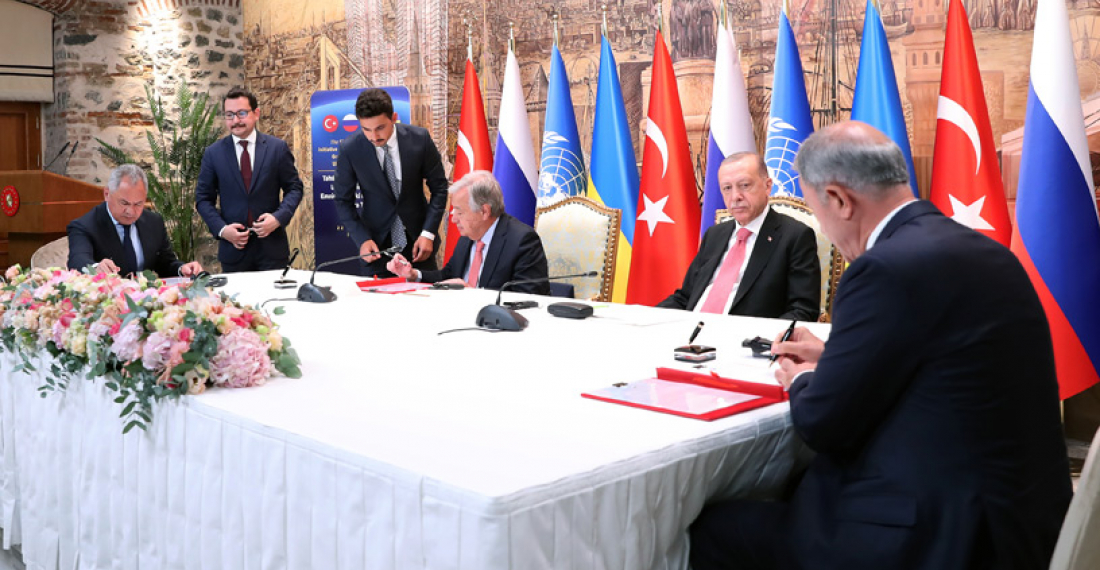
Ukraine and Russia signed two memorandums of understanding with Turkey and the U.N. on Friday, July 22, to begin exporting their grains and other food products. The agreement was signed for Ukraine was signed by Infrastructure Minister Oleksandr Kubrakov and for Russia by Defence Minister Sergei Shoigu. Defence Minister Hulusi Akar signed the memorandums of understanding on behalf of Turkey.

The ceremony held at Istanbul's Dolmabahçe Palace on the Bosporus was attended by Turkish President Recep Tayyip Erdogan and U.N. Secretary-General Antonio Guterres, along with other Turkish, Russian and Ukrainian officials. Guterres signed the deal on behalf of the U.N.

Erdogan, in his speech, expressed his gratitude to all those who contributed to making these deals possible, including Russia, Ukraine and the U.N., saying, “We are all feeling the right proud of this initiative in resolving the global food crisis.”

“The execution of this plan will be controlled through the Joint Coordination Center to be established in Istanbul in the coming days. The support of the international community is of vital importance for the success of this plan,” he said.

Erdogan also stressed his expectation that the agreement signed in Istanbul will revive hopes for ending the war in Ukraine, noting, “As we have been saying since the beginning of this conflict, the prolongation of this war will lead to continued economic losses and human casualties. It will not only hurt the warring sides and the regional countries but all the world even in the most remote corners.” “There will be no losers in a just peace,” he said, expressing his hope that these agreements will be a turning point in ending the conflict.

One of the most important aspects of the deals is the fact that the entire operation will be controlled through a coordination center to be established in Istanbul. It will host officials from Turkey, Russia, Ukraine and the U.N. so that the process and the maritime safety of the vessels from and to Ukraine can be jointly monitored.

This center will also check the cargo of vessels on their way to the world markets and to the Ukrainian ports in Odesa, Pivdennyi and Chornomorsk. Russia was concerned that Ukraine-bound empty vessels could carry weapons and military equipment.

As the demining of these ports will take time, the parties agreed that the commercial vessels will be guided by the Ukrainian navy until they reach a secured corridor in the Black Sea. While these operations continue, the two warring sides will not attack each other.

“No transport escort by Russian ships and no presence of Russian representatives in our ports. In case of provocations, an immediate military response. All inspections of transport ships will be carried out by joint groups in Turkish waters in the event of such a need,” Mykhailo Podolyak, the head advisor of Ukrainian President Volodymyr Zelensky, said on Twitter.

The deal will be valid for 120 days but will be renewed automatically. This is needed for uninterrupted shipment of food and fertilizers to the world market which has been suffering from soaring prices due to the Ukrainian war.

In the first phase, Ukraine is planning to ship around 25 million tons of wheat to the world markets. The country is one of the largest wheat producers and is in a process of harvesting new products. Many countries in Africa depend on Ukrainian and Russian wheat to escape the shortage of food.

Russia also signed a separate memorandum of understanding with the U.N. and Turkey so that its shipment of food and fertilizer can be exported without any problems stemming from the existing sanctions.

As a result of U.N. efforts, both the United States and the European Union provided assurances that there will be no sanctions on the companies and vessels transporting Russian products to the world markets. Banking and insurance procedures will also be exempted from the sanctions.

Russian President Vladimir Putin had said his country could export around 50 million tons of wheat until the end of this year.

source: commonspace.eu with Hurriyet Daily News and agencies
photo: Russian Defence Minister Shoigu signs the Istanbul MOU's on behalf of Russia on Friday, 22 July 2022 (picture courtesy of the press service of the President of Turkey).

Related articles

Editor's choice
News
Council of Europe launches new International Claims Commission for Ukraine

Council of Europe launches new International Claims Commission for Ukraine

Thirty-four countries and the European Union have signed a new convention establishing an International Claims Commission for Ukraine at a diplomatic conference co-hosted by the 46-nation Council of Europe and the Netherlands in the Hague. The diplomatic conference was attended by leaders and high-level representatives from over 50 states, including the President of Ukraine, Volodymyr Zelenskyy, the President of the Republic of Moldova, Maia Sandu, and the Prime Minister of the Netherlands, Dick Schoof.  “Today marks a major step forward in ensuring accountability for Ukraine. The International Claims Commission represents justice and hope for tens of thousands of victims—our determination that those who have suffered will not be forgotten. I call for quick ratifications so we can get the commission rapidly up and running for the people of Ukraine,” said Council of Europe Secretary General Alain Berset. Ukrainian President Volodymyr Zelenskyy said: “We expect that every mechanism for compensation from the Register of Damage and Claims Commission to the actual payments – will start working and receive strong and sufficient international support, so that people can truly feel that any kind of damage caused by the war can be compensated. This war, and Russia’s responsibility for it, MUST become a clear example – so that others learn not to choose aggression.” “Accountability is about creating the conditions for peace that endures. And therefore, accountability is a condition of security – today and for the future. But accountability is not only about Ukraine. And it is not only about one aggressor and one victim. Accountability is about Europe. About every country in Europe. It is about whether Europe, as a whole, is willing to defend its peace,” said Maia Sandu, President of the Republic of Moldova, which currently holds the Presidency of the Council of Europe’s Committee of Ministers. The Prime Minister of the Netherlands, Dick Schoof, said: “Every day Russia is deliberately bombarding homes, destroying businesses and damaging infrastructure in Ukraine. Russia must compensate Ukraine for the damage caused. That is why we have launched the International Claims Commission for Ukraine and we are honoured to host it.” The International Claims Commission will be the second part of a comprehensive compensation mechanism related to Russia’s war of aggression, building on the existing Register of Damage for Ukraine. The claims commission will be established within the framework of the Council of Europe and will also be open to other countries. The Register of Damage for Ukraine, created in 2023, collects and records compensation claims submitted by individuals, organisations and public bodies in Ukraine. Forty-four states and the European Union have so far joined the Register, which has already received 86,000 claims. The International Claims Commission will review, assess and decide upon claims submitted to the Register of Damage for Ukraine and determine the amount of compensation, if any, which is due in each case. The convention establishing the commission will enter into force once it has been ratified by 25 signatories, as long as sufficient funds have been secured to support its initial work.

Popular

Editor's choice
News
Council of Europe launches new International Claims Commission for Ukraine

Council of Europe launches new International Claims Commission for Ukraine

Thirty-four countries and the European Union have signed a new convention establishing an International Claims Commission for Ukraine at a diplomatic conference co-hosted by the 46-nation Council of Europe and the Netherlands in the Hague. The diplomatic conference was attended by leaders and high-level representatives from over 50 states, including the President of Ukraine, Volodymyr Zelenskyy, the President of the Republic of Moldova, Maia Sandu, and the Prime Minister of the Netherlands, Dick Schoof.  “Today marks a major step forward in ensuring accountability for Ukraine. The International Claims Commission represents justice and hope for tens of thousands of victims—our determination that those who have suffered will not be forgotten. I call for quick ratifications so we can get the commission rapidly up and running for the people of Ukraine,” said Council of Europe Secretary General Alain Berset. Ukrainian President Volodymyr Zelenskyy said: “We expect that every mechanism for compensation from the Register of Damage and Claims Commission to the actual payments – will start working and receive strong and sufficient international support, so that people can truly feel that any kind of damage caused by the war can be compensated. This war, and Russia’s responsibility for it, MUST become a clear example – so that others learn not to choose aggression.” “Accountability is about creating the conditions for peace that endures. And therefore, accountability is a condition of security – today and for the future. But accountability is not only about Ukraine. And it is not only about one aggressor and one victim. Accountability is about Europe. About every country in Europe. It is about whether Europe, as a whole, is willing to defend its peace,” said Maia Sandu, President of the Republic of Moldova, which currently holds the Presidency of the Council of Europe’s Committee of Ministers. The Prime Minister of the Netherlands, Dick Schoof, said: “Every day Russia is deliberately bombarding homes, destroying businesses and damaging infrastructure in Ukraine. Russia must compensate Ukraine for the damage caused. That is why we have launched the International Claims Commission for Ukraine and we are honoured to host it.” The International Claims Commission will be the second part of a comprehensive compensation mechanism related to Russia’s war of aggression, building on the existing Register of Damage for Ukraine. The claims commission will be established within the framework of the Council of Europe and will also be open to other countries. The Register of Damage for Ukraine, created in 2023, collects and records compensation claims submitted by individuals, organisations and public bodies in Ukraine. Forty-four states and the European Union have so far joined the Register, which has already received 86,000 claims. The International Claims Commission will review, assess and decide upon claims submitted to the Register of Damage for Ukraine and determine the amount of compensation, if any, which is due in each case. The convention establishing the commission will enter into force once it has been ratified by 25 signatories, as long as sufficient funds have been secured to support its initial work.

