


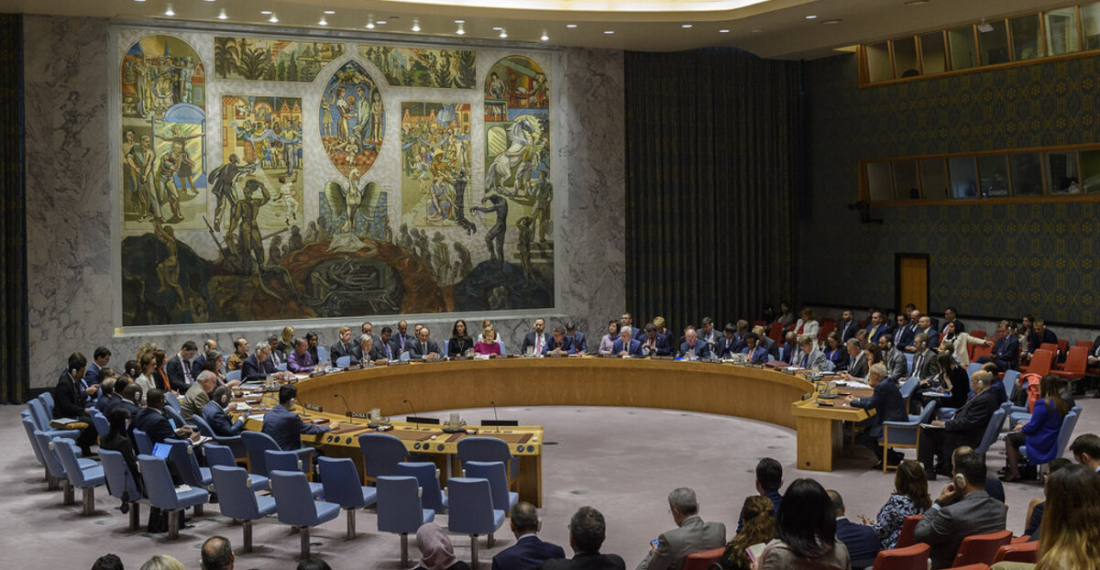
UN Security Council will discuss situation around Lachin on Wednesday

The United Nations Security Council will discuss the situation around Lachin at a meeting in New York on Wednesday, 16 August. The meeting will be open.

Under the rules of the United Nations, the Chairmanship of the Security Council moves monthly by rotation in alphabetical order, and this month the Chair is the United States. US diplomacy, with the personal participation of US Secretary of State, Antony Blinken, has over the last year been trying to assist Armenia and Azerbaijan to develop a peace treaty between them. Although some progress has been made, there remain several stumbling issues on which both sides are showing intransigence.

The meeting of the UNSC on Wednesday will focus on the situation around Lachin, where Azerbaijan has established control over a land connection between Armenia and the Armenian population in Nagorno-Karabakh. Azerbaijan insists that since everyone recognises Nagorno-Karabakh as being Azerbaijani territory, controlling access to it is its internal business. But many in the international community have been calling on Azerbaijan to respect the trilateral declaration that it signed with Russia and Armenia on 10 November 2020, which provides for unimpeded movement across the Lachin corridor. Russia has a military force close by Lachin but has so far refused to use force to unblock the bottle neck that now exists, which Armenians claim is causing a humanitarian crisis amongst the Armenian population of Nagorno-Karabakh which number up to 120,000 - although the actual number of present residents is likely considerably less.

There is speculation that the United States may use tomorrow's meeting to push for a a quicker pace in the ongoing Armenia-Azerbaijan peace negotiations, and possibly a bigger role for the UN in the issue of the future of the Armenian population of Nagorno-Karabakh. This will be fiercely resist by Azerbaijan which is hoping that its friends amongst non-aligned countries will help tone down any criticism of its actions. The current member of the United Nations Security Council are, the permanent 5: China, France, United Kingdom and United States, and ten non permanent members: Albania Brazil Ecuador Gabon Ghana Japan Malta Mozambique Switzerland United Arab Emirates.

source: commonspace.eu
photo: The Chamber of the United Security Council at UN headquarters in New York during a recent Council session (archive picture)
 

Related articles

Editor's choice
News
European leaders set out their plan for Ukraine

European leaders set out their plan for Ukraine

The leaders of Germany, Denmark, Finland, France, Italy, Netherlands, Norway, Poland, Sweden, and United Kingdom, together with the President of the European Council, and the President of the European Commission, o  Monday (15 December) issued a statement, outlining their plan for Ukraine. In their statement, Chancellor Merz, Prime Minister Frederiksen, President Stubb, President Macron, Prime Minister Meloni, Prime Minister Schoof, Prime Minister Støre, Prime Minister Tusk, Prime Minister Kristersson, Prime Minister Starmer, as well as President Costa and President von der Leyen spoke about "Peace for Ukraine". The Leaders welcomed significant progress on President Trump’s efforts to secure a just and lasting peace in Ukraine. They also welcomed the close work between President Zelenskyy’s and President Trump’s teams as well as European teams over the recent days and weeks. They agreed to work together with President Trump and President Zelenskyy to get to a lasting peace which preserves Ukrainian sovereignty and European security. Leaders appreciated the strong convergence between the United States, Ukraine and Europe. Leaders agreed that ensuring the security, sovereignty, and prosperity of Ukraine was integral for wider Euro-Atlantic security. They were clear that Ukraine and its people deserved a prosperous, independent, and sovereign future, free from fear of future Russian aggression. Both the US and European leaders committed to work together to provide robust security guarantees and economic recovery support measures for Ukraine in the context of an agreement on ending the war. This would include commitments to: Provide sustained and significant support to Ukraine to build its armed forces, which should remain at a peacetime level of 800,000 to be able to deter conflict and defend Ukraine’s territory. A European-led ‘multinational force Ukraine’ made up from contributions from willing nations within the framework of the Coalition of the Willing and supported by the US. It will assist in the regeneration of Ukraine’s forces, in securing Ukraine’s skies, and in supporting safer seas, including through operating inside Ukraine. (Click the image to read the statement in full).

Popular

