1715 CEST (1915 Baku/Yerevan)
And here is the Azerbaijani response to that story about the F16
Armenia's allegation that SU-25 was hit by F-16 is completely false. Yet another cheap piece of propoganda by Armenia. I would strongly recommend them to check their radars if they have any. Not a single SU-25 took off from the territory of Armenia.
— Hikmet Hajiyev (@HikmetHajiyev) September 29, 2020
1630 CEST (1830 Baku/Yerevan)
Situation is getting more complicated. Armenia says one of its SU-25 planes has been shot down by a Turkish plane. Earlier Armenia said it had shot down an Azerbaijani helicopter. Battles in the air as well as on land
#Armenian Su-25 was shot down by a #Turkish F-16 that took off from the Ganja airbase in Azerbaijan. @ArmeniaMODTeam
— Government of Armenia (@armgov) September 29, 2020
1600 CEST (1800 Baku/Yerevan)
OSCE Permanent Council to meet in Vienna at 1700 CEST
The Permanent Council of the OSCE will meet in Vienna in one hour's time to discuss the ongoing situation in the Nagorno-Karabakh conflict zone. The Permanent Council is made up of the 57 Ambassadors of the member states of the OSCE - essentially all the European countries together with Canada and the United States.
Both Armenia and Azerbaijan are members of the OSCE, and will attend the meeting. Under the OSCE rules they also both have a veto on all decisions, like any other member state. So dont expect any decisions coming out of the Permanent Council this afternoon - both sides will have their very different perspective on what has happened and will not allow any decision that they will not like. But one interesting point will be the fact that Andrzeij Kasperzyk, the special representative of the OSCE Chairmanship, will address the meeting to brief the Ambassadors on the situation. Kasperzyk has been in this role for more than two decades and knows a lot on the situation. But he has survived in this role for saying less, not for saying much, so his evidence is likely to be dry and short. But the Ambassadors may have many questions to ask.
After that attention than shifts to New York, where the real action is expected, although the meeting of the UN Security Council will be behind closed doors.
__________________________
1445 CEST (1645 Baku/Yerevan)
Where is Russia? Nezavisimaya Gazeta gives us a clue
A question many are asking as the conflict in the South Caucasus unfolds, is where is Russia.
The Russian media this morning gave us a small clue as to Russia's tactics.
Nezavisimaya Gazeta this morning quoted Russian experts saying that neither Armenia nor Azerbaijan is capable of achieving a significant military success.
Military analyst Leonid Nersisyan emphasized that the military capabilities of the two countries are almost equal. "Azerbaijan's Armed Forces are about 80,000 troops strong, while Armenia and the [unrecognized] Nagorno-Karabakh Republic have up to 65,000 troops. A thing to note is that both parties are mobilizing reservists," the expert said. As for military hardware, the odds are somewhat in Azerbaijan's favor.
Chief Editor of the Arsenal Otechestva (Arsenal of the Fatherland) magazine Viktor Murakhovsky points to another important detail: the terrain of Nagorno-Karabakh makes it impossible to use military equipment and weapons to full capacity. "There are mountains everywhere so tanks, multiple launch rocket systems and other equipment won't be as effective as on open terrain," he explained.
Academy of Military Sciences Professor Vadim Kozyulin believes that the most important thing is to make sure that third countries don't interfere in the situation. Russia and Turkey have been refraining from any military activities.
"In fact, there is no political, let alone military, way to resolve the Nagorno-Karabakh issue. In the 30 years of the conflict, various options were presented to Baku and Yerevan, including the possibility of exchanging territories. But it didn't work. The only thing that can be done now is to enact a ceasefire and return to political and diplomatic dialogue," Kozyulin emphasized.
So apparently, Russian experts think the best way to deal with the situation is to let the sides fight it out and exhaust themselves. So cynical! So Russian!
__________________________
1415 CEST (1615 Baku/Yerevan)
The UN Security Council will meet tonight
We have now an update on the UN Security Council meeting expected this evening to discuss the escalating conflict between Armenia and Azerbaijan.
The meeting is expected to start at 17.00 New York time (23.00 Central European Summer Time).
The formal request was made yesterday by current non permanent member of the Council Belgium, and was supported by France and Germany.
Estonia, another non-permanent member of the Security Council, had earlier also called for a meeting of the Council.
According to the same diplomatic sources, Britain joined the European request.
Diplomatic sources in New York said that the Security Council may issue a statement at the conclusion of the meeting. However, if there is no consensus, the European member states of the Council are expected to issue a statement from their side.
0915 CEST (1115 Baku/Yerevan)
There are unconfirmed reports that this morning there has been an escalation in the fighting between Armenian and Azerbaijani forces, with new violence erupting across the international border between the two countries to the north-west of the line of contact in the Karabakh conflict zone. Both sides accuse each other of shelling civilian areas. Armenia says a civilian bus has been hit in the town of Vardenis.
Commonspace.eu reports military action in the ongoing conflict from secondary sources, and is not able to confirm the accuracy of the reports
___________________
0815 CEST (1015 Baku/Yerevan)
Security Council will discuss ongoing conflict in the South Caucasus
There will be informal consultations on the ongoing conflict between Armenia and Azerbaijan in New York, in the framework of the UN Security Council, today Tuesday (29 September). This format allows the 15 members of the Council to meet without the presence of the parties to the conflict. The current fifteen members of the Security Council are the five permanent members: France, Russia, China, the United Kingdom and the United States, and ten other member states who serve a two year term. These currently are Belgium, Domenican Republic, Estonia, Germany, Indonesia, Niger, St Vincent and the Grenadines, South Africa, Tunisia and Vietnam.
This month's chairmanship of the council is with the African state of Niger..
Commonspace.eu political editor said that the intervention of the Security Council is an indication of the seriousness of the current situation. It is likely that the Council may issue a statement through its Chair at the end of the meeting if there is agreement. A formal UN Security Council resolution may come later, and only if there is enough consensus, especially among the five permanent members. But all reports suggest that it is the European countries, especially Germany that are most active in the process at present.
____________________
The United Nations Security Council is expected to hold consultations on Tuesday (29 September) on the ongoing conflict between Armenian and Azerbaijani forces in the Nagorno-Karabakh conflict zone.
On Monday there has been intensive diplomatic consultations with many world capitals in touch with both Baku and Yerevan in an effort to bring a halt to the fighting.
However, overnight, both sides reported heavy fighting, particularly in the northern and south eastern sectors of the line of contact..
This story will be updated throughout the day
source: commonspace.eu with agencies
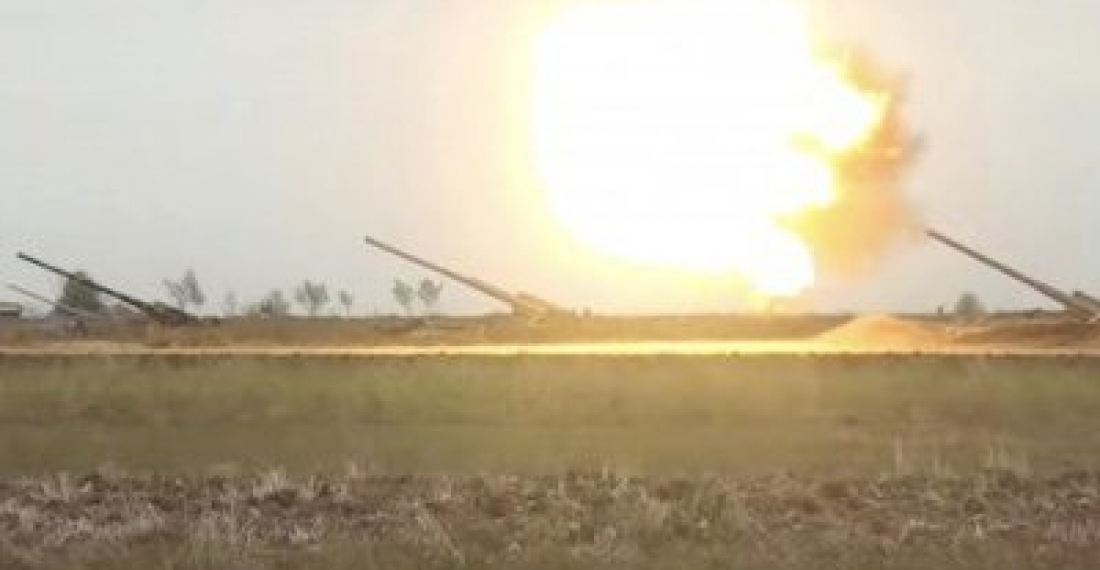
photo: Azerbaijani artillary in action in the northern sector of the line of contact on 28 September 2020 (Azerbaijan Ministry of Defence photo)