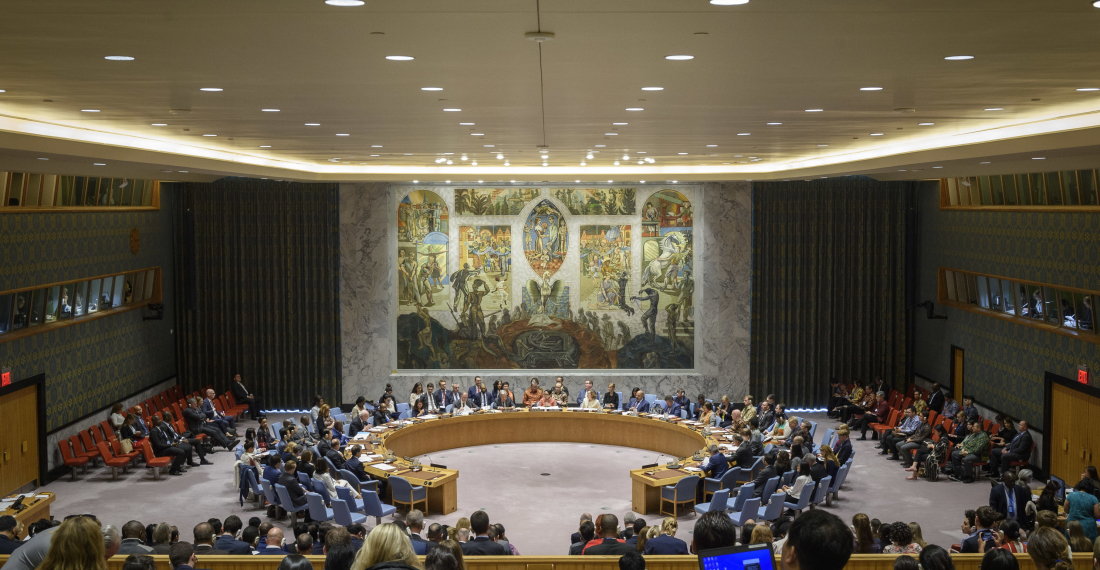
On Friday afternoon (29 August), the United Nations Security Council held an emergency open briefing on Ukraine The meeting was requested by Ukraine in a letter it sent on Thursday (28 August) following large-scale Russian aerial attacks conducted overnight on Kyiv and other cities across Ukraine. Council members Denmark, France, Greece, the Republic of Korea (ROK), Slovenia, and the UK supported the meeting request.
Assistant Secretary-General for Europe, Central Asia and the Americas Miroslav Jenča briefed the Council at the start of the two-hour meeting. Among the participants and speakers was the Ukrainian prime minister, Yulia Svyrydenko.
The European Union, and several EU member states, as well as Norway (speaking on behalf of the five Nordic countries) as well as permanent members UK, Russia and China, spoke during the meeting.
A t least 21 people, including four children, were killed and 45 individuals were injured in the latest Russian assault, which involved almost 600 drones and more than 30 ballistic and cruise missiles. The UN Human Rights Monitoring Mission in Ukraine (HRMMU) reported that the majority of casualties occurred in the Darnytskyi district in Kyiv, where a section of a five-storey residential building collapsed after being struck. In a 28 August X post, UN Resident and Humanitarian Coordinator in Ukraine Matthias Schmale said that “[h]omes, a preschool, and the premises of several humanitarian organizations were damaged” in the attack, “underscoring the constant danger faced by people living and working in Kyiv and across Ukraine”. Buildings belonging to the EU Delgatioh and to the British Council were also damaged.
This marked Russia’s largest assault on Kyiv since the 15 August summit held between US President Donald Trump and Russian President Vladimir Putin in Anchorage, Alaska.
Jenča and many Council members condemned the war’s deleterious effects on civilians. According to HRMMU figures July had the highest civilian casualties since May 2022, with at least 286 civilians killed and 1,388 injured, marking the second month in a row in which such casualties reached a new three-year high. The HRMMU attributed the sharp increase to “the intensified use of aerial bombs and short-range drones”, while also noting that over 60 percent of civilian casualties were recorded in frontline areas. Overall, since the beginning of Russia’s invasion of Ukraine in February 2022, the HRMMU has documented the deaths of at least 13,883 civilians, including 726 children, and 35,548 injured, including 2,234 children.
In his statement to the meeting, Ambassador Stavros Lambrinidis, Head of the Delegation of the European Union to the United Nations, said
As high-level talks for peace are ongoing, as European leaders work with Ukraine and our allies to stop the killing, as we are hopefully reaching, finally, a moment of truth for peace in Ukraine, Russia has once again shown us its true intentions, with another massive and brutal overnight attack against Ukrainian cities and civilians. Ordinary civilians, including children as young as two years old, have paid the ultimate price of Russia’s unprovoked, unjustified and illegal aggression. Without the effective intervention of Ukrainian air defences, who reportedly destroyed 589 out of 629 Russian drones and missiles, the civilian toll would have undoubtedly been dramatically higher.
The Head of the EU Delegation to the UN added:
The increasingly tone-deaf and hypocritical statements the Russian Federation makes in this Chamber simply underscore the calculated intentionality of their continued aggression against a sovereign country and blatant violations of international law.
Our objective remains clear: the EU supports an immediate, full and unconditional ceasefire. We also welcome the efforts by the US to seek an end to Russia’s war of aggression and to stop the killing. As EU, we contribute to these efforts in order to achieve a just and lasting peace and long-term security for Ukraine and our continent.
I urge all members of this Council to use their influence and maximize pressure on Russia to accept an immediate ceasefire and work towards a just and lasting peace in Ukraine.”
He concluded by saying that the EU will remain united in providing political, financial, economic, humanitarian, military and diplomatic support to Ukraine, as it exercises its inherent right of self-defence. We will continue to stand shoulder to shoulder with Ukraine and in defence of the UN Charter and international law. I respectfully submit that this Council, without any wavering or any hesitation, do the same, at a time when Russia intensifies its killings and continues to pursue its illegal objectives, instead of peace.”
Source: commonspace.eu with Security Council Report (New York), the Press Service of the EU delegation to the UN (New York), and agencies.
Photo: The UN Security Council met to discuss Ukraine on 29 August 2025, following Russia's aerial attack on Kyiv.