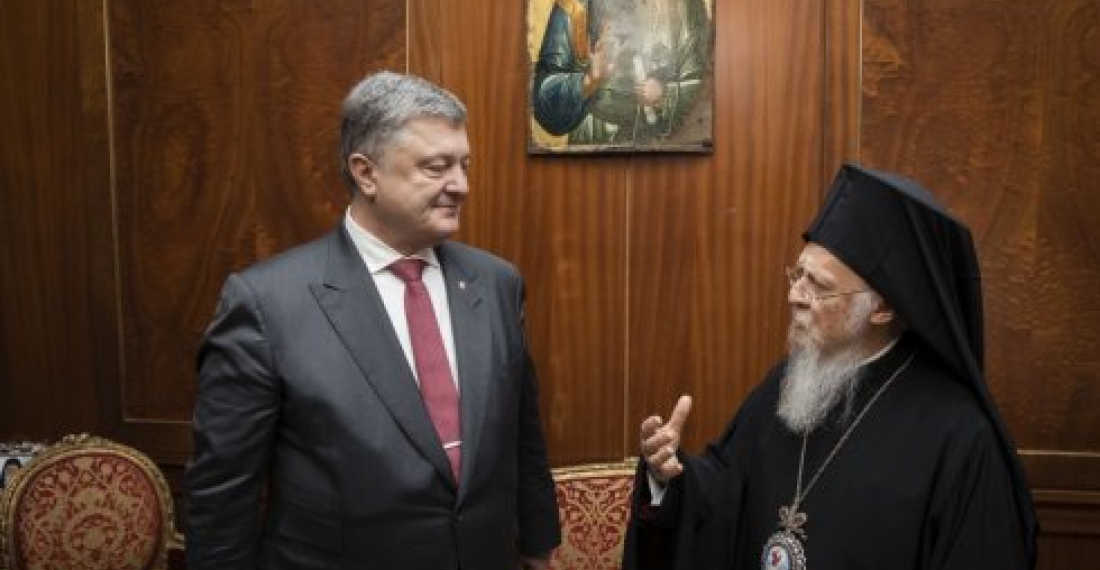
The Government of Ukraine and the Ecumenical Patriarchate of Constantinople have signed an agreement on co-operation and collaboration. Ukrainian President Petro Poroshenko and Ecumenical Patriarch Bartholomew I signed the agreement in Istanbul on Saturday during the official visit of president Poroshenko to Turkey.
According to the Ukrainian government sources the deal will ensure that the Ukrainian Church is given independence, also known as Tomos, in line with all the canons of the Orthodox Church.
"On behalf of the Ukrainian people, I am very grateful to His Holiness and to all the bishops of the Ecumenical Patriarchy for the extremely important and wise decision to open the road to God for the Ukrainian nation and its church," Poroshenko said after visiting the Patriarchate in Istanbul's Fener neighborhood.
"Today is a historic day. Ukraine and the Ecumenical Patriarch signed an agreement on the establishment of an independent Ukrainian Church," Poroshenko said in an Instagram post.
Following their meeting with Poroshenko, Patriarch Bartholomew expressed confidence that the independence of the Ukrainian Church will ensure unity of all Orthodox churches in the country.
Later in the day, Poroshenko attended the seventh meeting of the Turkey-Ukraine High Level Strategic Cooperation Council that convened in Istanbul.
The church in Ukraine has been tied to the Moscow Patriarchate for hundreds of years, although many parishes have split off over the past two decades to form a schismatic church. Calls for independence have increased since Moscow's 2014 annexation of the Crimean Peninsula from Ukraine.
Poroshenko, who is running for re-election next March, has strongly pushed Bartholomew to grant independence to the Ukrainian church.
In October, the Greek Orthodox Patriarchate, whose Patriarch Bartholomew is seen as the first among equals of Orthodox Church leaders, agreed to recognize the independence of the Ukrainian Orthodox Church.
The decision was a huge blow to Moscow's spiritual authority in the Orthodox world.
The Russian Orthodox Church condemned the move and announced it is breaking ties with the Constantinople Patriarchate in protest.
The Russian annexation of Crimea and the Kremlin-backed separatist uprising in Ukraine's east in 2014 triggered an increase in the number of believers in Ukraine loyal to Kiev Patriarch Filaret's church and seeking the establishment of an independent Ukrainian church.
Russian Orthodox Patriarch Kirill, who is seen as a strong ally of Putin, fought hard to prevent pro-Western Ukraine from getting an independent church.
In the meantime in Kiev, the Ukrainian Church is urging caution not to give in to provocations from Moscow.The leader of the Ukrainian Orthodox Church of the Kyiv Patriarchate says steps toward independence from Moscow must be carried out carefully to avoid giving the Kremlin a pretext for further Russian incursions into Ukrainian territory.
In an exclusive interview with RFE/RL, Filaret talked in detail about the process of establishing a fully independent Ukrainian church and the future status of the Moscow-loyal church in Ukraine.
Ukraine currently has three Orthodox denominations: the Ukrainian Orthodox Church of the Moscow Patriarchate, which remained subordinate to Russia after the breakup of the Soviet Union; and two breakaway entities -- the Ukrainian Orthodox Church of the Kyiv Patriarchate led by Filaret, and the Ukrainian Autocephalous Orthodox Church led by Metropolitan Makariy.
"We will be striving to have a single Orthodox Church in Ukraine and to make sure that the Russian [Orthodox] Church is not hiding under the Ukrainian name while, in essence, it is Russian," Filaret told RFE/RL on October 31.
source: commonspace.eu with agencies
photo: president Poroshenko of Ukraine met the Ecumenical Patriarch of Constantinople in Istanbul on 3 November 2018 (picture courtesy of the press service of the government of Ukraine)