Turkish Referendum: Yes campaign declares victory, but result tight.(Update 4)

Update 4, 19.15 GMT

With 99.27% of the votes counted, the yes vote appears to have won the constitutional referendum in Turkey, with 51.35% voting yes, and 48.65% voting no.  Opposition leaders are calling foul, and have asked for recounts in many polling stations.

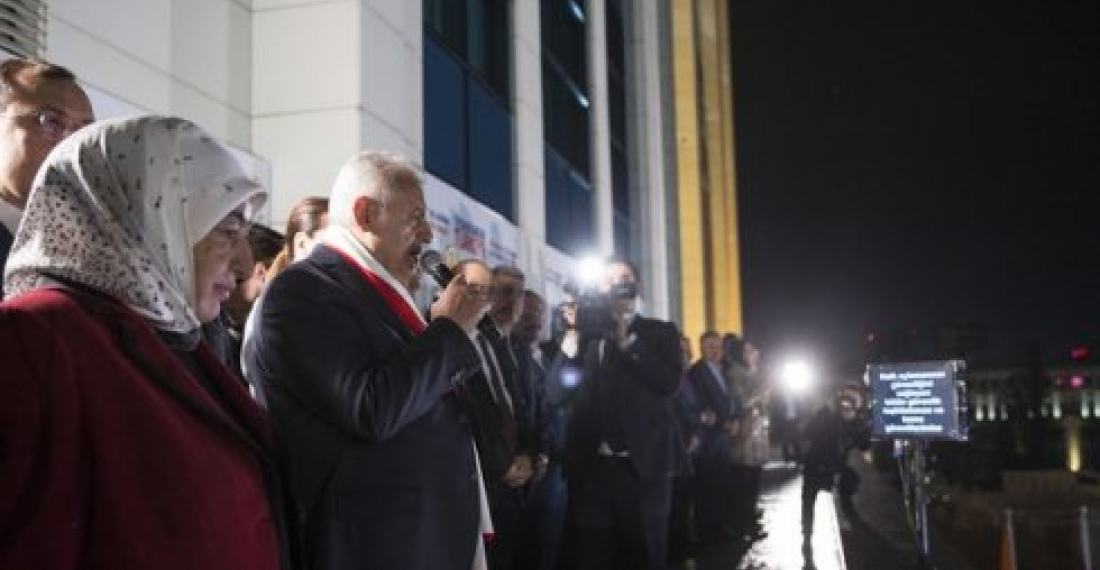
However, Turklish Prime Minister Binali Yildirim has declared that the yes vote has won. Speaking to supporters at the headquarters of the AK Party in Ankara Yildirim sai"This is a decision made by the people. In our democracy's history, a new page has opened."

The prime minister said the last word has been said by the nation and thanked all nation whether they voted "yes" or "no".

"There are no losers in this referendum. The whole nation emerged as the winner," he said.

photo: Turkish Prime Minister Binali Yildirim declaring a victiory for the yes vote in the 16 April referendum (picture courtesy of Anadolou News Agency, Ankara)

Update 3, 15.45 GMT

With 81% of the votes counted, the yes vote is leading by 53.9% against the no vote 46.1% according to the official Anadolou agency

Update 2, 15.15 GMT

Although technically there is uspposed to be a blackout on resulta until 18.00 GMT, most Turkish media are now ignoring this and have started giving results. Hurriyet Daily News reports that with 40% of ballot boxes opened, the yes vote has 59.4% and the no vote 40.6%. Turnout was reported to have been very high.

Update 1 - Sunday, 16 April 14.30 GMT

Polling has closed in Turkey's crucial consitutional referendum. Results are expected to start coming in shortly after 18.00 GMT

......................................

More than 55 million Turks are voting today in a referendum that has split the nation, and which will have wide ranging consequences for the country and for its neighbours.

The historic referendum proposes key constitutional changes, including giving wide-ranging executive powers to the president.

Citizens are casting their ballots at 167,000 polling stations nationwide. Over 1 million of them are first-time voters who recently turned 18.

In today's vote ballots have two sides with two different colors, and voters will indicate their choice by voting either Yes on the white side of the paper or No on the brown side. Voters will impress a seal on the side they have chosen.  

Poling stations opened at 8 a.m. (0500GMT) and people would be allowed to vote until 5 p.m. (1400GMT).

The electorate in Turkey is being asked to vote Yes or No to an 18-article reform bill, which would also change the current parliamentary system to a presidential one.

The Yes campaign is backed by the ruling Justice and Development (AK) Party and the opposition, Nationalist Movement Party (MHP), whereas the main opposition, Republican People's Party (CHP), is in favor of No.The proposals are also opposed by the main political forces in the predominatly Kurdish areas of the South East.

Approximately 2.9 million Turkish expatriates have already voted in the referendum between March 27 and April 9. 

Commonspace.eu political editor said that today's referendum result will have wide ranging implications both for Turkey as well as for Turkey's relations with its neighbours.

"Internally there is fear that the referendum opens the way to dictatorship, although others say that a more empowered President may be able to push through important changes, particularly as regards the Kurdish issue. The referendum is likely also to impact relations between Turkey and the EU, considered at the moment to be at their lowest point for many years. Turkey could either abandon any hope of joining the EU and readjust its foreign policy - which may have also implications for NATO, or the result could be used to re-energise relations.

For the neighbouring South Caucasus countries the current uncertainties in Turkey are a cause for concern, although for different reasons. Azerbaijan which has very strong and close relations with Turkey, is concerned about political upheavel of its closest ally. Conversely, Armenia which has strained relations with Turkey, is also concerned that political uncertainties may trigger new complications in its relations with its big neighbour, and make any prospect for rappraochment even more difficult. Georgia also has very close economic and military relations with Turkey. Georgia is concerned about problems between Turkey and NATO and the EU, and would like to see politics returning to normal in Turkey as soon as possible. When the results are out later this evening all three countries will be taking stock on how it is going to effect them."

source: commonspace.eu with Anadolou News Agency, Ankara

photo: A polling station in Turkey's Erzerum prepares for today's poll (picture courtesy of Anadolou News Agency, Ankara).
 

Related articles

Editor's choice
News
Council of Europe launches new International Claims Commission for Ukraine

Council of Europe launches new International Claims Commission for Ukraine

Thirty-four countries and the European Union have signed a new convention establishing an International Claims Commission for Ukraine at a diplomatic conference co-hosted by the 46-nation Council of Europe and the Netherlands in the Hague. The diplomatic conference was attended by leaders and high-level representatives from over 50 states, including the President of Ukraine, Volodymyr Zelenskyy, the President of the Republic of Moldova, Maia Sandu, and the Prime Minister of the Netherlands, Dick Schoof.  “Today marks a major step forward in ensuring accountability for Ukraine. The International Claims Commission represents justice and hope for tens of thousands of victims—our determination that those who have suffered will not be forgotten. I call for quick ratifications so we can get the commission rapidly up and running for the people of Ukraine,” said Council of Europe Secretary General Alain Berset. Ukrainian President Volodymyr Zelenskyy said: “We expect that every mechanism for compensation from the Register of Damage and Claims Commission to the actual payments – will start working and receive strong and sufficient international support, so that people can truly feel that any kind of damage caused by the war can be compensated. This war, and Russia’s responsibility for it, MUST become a clear example – so that others learn not to choose aggression.” “Accountability is about creating the conditions for peace that endures. And therefore, accountability is a condition of security – today and for the future. But accountability is not only about Ukraine. And it is not only about one aggressor and one victim. Accountability is about Europe. About every country in Europe. It is about whether Europe, as a whole, is willing to defend its peace,” said Maia Sandu, President of the Republic of Moldova, which currently holds the Presidency of the Council of Europe’s Committee of Ministers. The Prime Minister of the Netherlands, Dick Schoof, said: “Every day Russia is deliberately bombarding homes, destroying businesses and damaging infrastructure in Ukraine. Russia must compensate Ukraine for the damage caused. That is why we have launched the International Claims Commission for Ukraine and we are honoured to host it.” The International Claims Commission will be the second part of a comprehensive compensation mechanism related to Russia’s war of aggression, building on the existing Register of Damage for Ukraine. The claims commission will be established within the framework of the Council of Europe and will also be open to other countries. The Register of Damage for Ukraine, created in 2023, collects and records compensation claims submitted by individuals, organisations and public bodies in Ukraine. Forty-four states and the European Union have so far joined the Register, which has already received 86,000 claims. The International Claims Commission will review, assess and decide upon claims submitted to the Register of Damage for Ukraine and determine the amount of compensation, if any, which is due in each case. The convention establishing the commission will enter into force once it has been ratified by 25 signatories, as long as sufficient funds have been secured to support its initial work.

Popular

Editor's choice
News
Council of Europe launches new International Claims Commission for Ukraine

Council of Europe launches new International Claims Commission for Ukraine

Thirty-four countries and the European Union have signed a new convention establishing an International Claims Commission for Ukraine at a diplomatic conference co-hosted by the 46-nation Council of Europe and the Netherlands in the Hague. The diplomatic conference was attended by leaders and high-level representatives from over 50 states, including the President of Ukraine, Volodymyr Zelenskyy, the President of the Republic of Moldova, Maia Sandu, and the Prime Minister of the Netherlands, Dick Schoof.  “Today marks a major step forward in ensuring accountability for Ukraine. The International Claims Commission represents justice and hope for tens of thousands of victims—our determination that those who have suffered will not be forgotten. I call for quick ratifications so we can get the commission rapidly up and running for the people of Ukraine,” said Council of Europe Secretary General Alain Berset. Ukrainian President Volodymyr Zelenskyy said: “We expect that every mechanism for compensation from the Register of Damage and Claims Commission to the actual payments – will start working and receive strong and sufficient international support, so that people can truly feel that any kind of damage caused by the war can be compensated. This war, and Russia’s responsibility for it, MUST become a clear example – so that others learn not to choose aggression.” “Accountability is about creating the conditions for peace that endures. And therefore, accountability is a condition of security – today and for the future. But accountability is not only about Ukraine. And it is not only about one aggressor and one victim. Accountability is about Europe. About every country in Europe. It is about whether Europe, as a whole, is willing to defend its peace,” said Maia Sandu, President of the Republic of Moldova, which currently holds the Presidency of the Council of Europe’s Committee of Ministers. The Prime Minister of the Netherlands, Dick Schoof, said: “Every day Russia is deliberately bombarding homes, destroying businesses and damaging infrastructure in Ukraine. Russia must compensate Ukraine for the damage caused. That is why we have launched the International Claims Commission for Ukraine and we are honoured to host it.” The International Claims Commission will be the second part of a comprehensive compensation mechanism related to Russia’s war of aggression, building on the existing Register of Damage for Ukraine. The claims commission will be established within the framework of the Council of Europe and will also be open to other countries. The Register of Damage for Ukraine, created in 2023, collects and records compensation claims submitted by individuals, organisations and public bodies in Ukraine. Forty-four states and the European Union have so far joined the Register, which has already received 86,000 claims. The International Claims Commission will review, assess and decide upon claims submitted to the Register of Damage for Ukraine and determine the amount of compensation, if any, which is due in each case. The convention establishing the commission will enter into force once it has been ratified by 25 signatories, as long as sufficient funds have been secured to support its initial work.