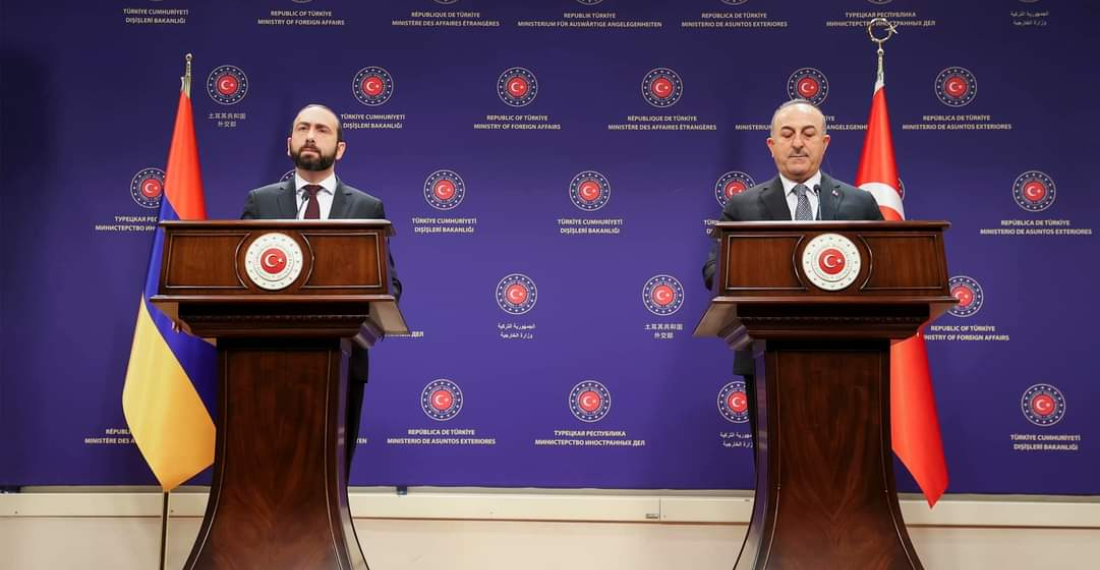
The Turkish and Armenian foreign ministers Mevlut Cavusoglu and Ararat Mirzoyan have met in the Turkish capital of Ankara on Wednesday (15 February).
The meeting followed an announcement from Armenian officials that a second Armenian aid convoy crossed the land border into Turkey late on Tuesday after the devastating 6 February earthquake which has killed over 40,000 people across Turkey and Syria.
The meeting is being seen as a major development in the normalisation of ties between the two countries who do not enjoy any formal diplomatic relations and who remain divided over a number of issues.
Mirzoyan expressed his "condolences to the families of the many thousands of victims of the devastating earthquake, the people and government of Turkey, and I wish swift recovery to all those injured." Recalling the 1988 Spitak earthquake in Armenia that killed over 20,000 people, Mirzoyan said, "I believe that the international community must not remain indifferent towards any humanitarian crisis happening anywhere around the globe. And it was by this very principle that immediately after the devastating earthquake the government of Armenia made a decision to send rescuers and humanitarian aid to Turkey."
FMs agree to speed up preparations to open the border after 30 years, express commitment to normalise relations
At a press conference following their meeting, both sides agreed to expedite preparations to open their mutual border which has been shut since Turkey closed it in protest at the First Kabakh War 30 years ago.
Mirzoyan continued, "I’d like to once again reiterate Armenia’s readiness and intention to build peace in the region, and particularly to fully normalise relations and establish diplomatic relations with Turkey and fully open the border between Armenia and Turkey." He added that that reached an agreement to restore the Ani Bridge "through joint efforts", and to restore the relevant infrastructure to permit opening the border.
Cavusoglu thanks Armenia for "solidarity and cooperation"
On his part, Turkish Foreign Minister Mevlut Cavusoglu said, "We all remember the devastating Spitak earthquake of 1988, when Turkey had also sent aid to Armenia. In 1999 Armenia also sent humanitarian aid during the earthquake in our country. And during these difficult days it extended a helping [humanitarian] hand and showed solidarity and cooperation."
Cavusoglu noted that the Armenian search and rescue team working in Adiyaman had saved a little girl and a young woman from under the rubble, adding that Armenia had sent 100 tons of aid and that more was on its way.
"The process of normalising relations continues in the South Caucasus. We believe that the cooperation that happened during these days will contribute to this process. The normalisation processes of Armenia with Turkey and Azerbaijan, I believe, will contribute to establishing stability and welfare in our region. With sincere steps our three countries can bring lasting stability to the Caucasian region,” the Turkish FM said.
Cavasoglu also confirmed the agreement with his Armenian counterpart to rebuild the Ani Bridge, saying, "On one hand our preparations aimed for the future continue, there’s research, conclusions and approvals regarding the bridges in the border crossing points on both sides, and there are steps related to the roads leading to the border which we can make. We agreed to speed up these steps."
Turkey will "not forget" Armenian support, Klaar calls the meeting "historic"
Following the meeting, the Turkish Special Representative for the normalisation of relations with Armenia Serdar Kilic said that it was an "important development". "Of course we will not forget this support provided by Armenia," he said. "This is a very important event. At the same time, pains bring people together. We are going through important processes."
Responding to news of the visit, the EU Special Representative for the South Caucasus and the Crisis in Georgia Toivo Klaar tweeted, "This is a historic visit following Armenia's decision to support its neighbour in need. Hopefully a harbinger of developments to come in the Turkey-Armenia relationship."
source: commonspace.eu with agencies
photo: The meeting of Ararat Mirzoyan and Mevlut Cavusoglu in Ankara, 15 February 2023