Turkey's accession to the European Union frozen due to lack of progress

Turkey's EU accession process remains frozen due to democratic backsliding, despite the Mediterranean country's strategic importance and cooperation on migration, the European Parliament has stated in a report approved by MEPS in Strasbourg. Turkey's EU accession process, which has been at a standstill since 2018, cannot be relaunched in the current circumstances, despite Ankara's geopolitical and strategic importance, the report says. MEPs in Strasbourg approved the report on Wednesday 7 April, with 367 votes in favour, 74 against and 188 abstentions.

The arrest of Istanbul Mayor Ekrem İmamoğlu, the crackdown on anti-government demonstrations, and human rights violations were all pointed out as signs of democratic backsliding. "The accession process is frozen. There is no progress," Nacho Sánchez Amor, Spanish MEP (S&D/Spain) and rapporteur for the report on Turkey, told Euronews.

"The detention and harassment of ... İmamoğlu are probably the peak of this repressive trend", Sánchez Amor said.

However, the report noted that Ankara remains a strategic partner of the bloc and a key NATO ally, particularly for its growing influence in Ukraine, the Black Sea and the Middle East.

During a debate in the European Parliament, the European Commissioner for Enlargement Marta Kos stressed the need to deepen cooperation with Turkey in areas of mutual strategic interest such as climate, energy security and trade. "The 2016 EU-Turkey declaration on migration continues to deliver results. Irregular arrivals from Turkey to the EU have decreased by 33% this year compared to the same period last year," Kos said.

MEPs also criticised Turkish President Recep Tayyip Erdoğan's recent visit to the occupied areas of Cyprus, recognised only by Ankara. The island has been divided since the Turkish invasion in 1974, while the Republic of Cyprus is a full-fledged member of the EU.

While Sánchez Amor believes the door to Turkey joining the bloc has not been closed for good, he pointed out that "there are no shortcuts to EU membership". "We need to make a distinction between the country and its current leaders. It's true that under the AKP regime, it's impossible to move forward because there is no political will to advance democratic values," he said.

"But there is a dynamic civil society that ... wants to keep alive the hope that perhaps in the future, with other leaders, another country, in a different environment, this could be an opportunity for Turkey to re-engage with the European Union on the basis of membership," Sánchez Amor added.

According to a European Commission report, Turkey's alignment with the EU's Common Foreign and Security Policy had fallen to 5% in 2024.
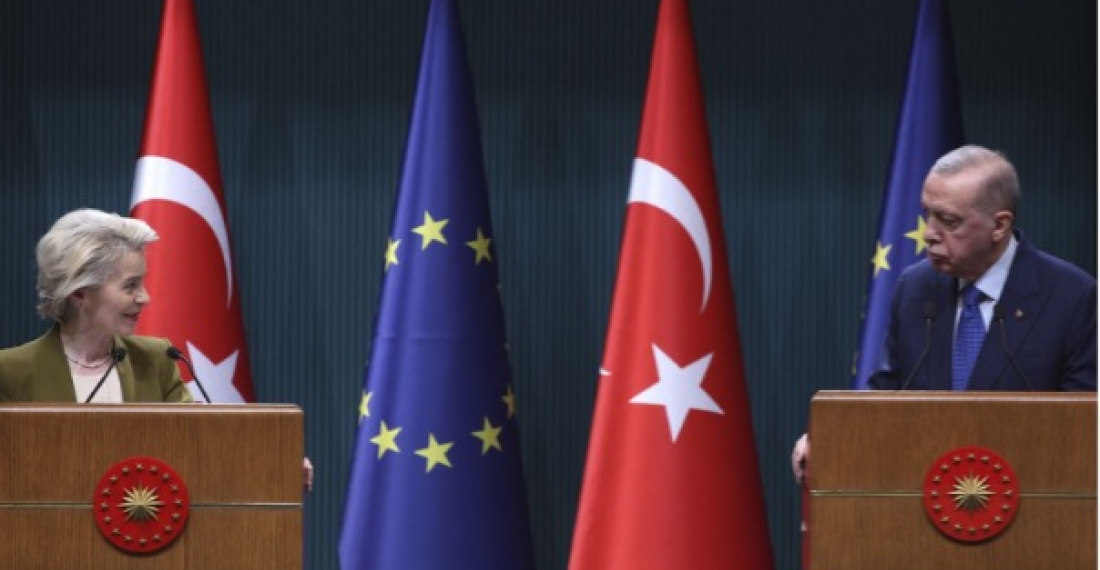
Source: commonspace.eu with agencies and Euronews. Photo: Commission President Von der Leyen and Turkish President Tayyo Erdoğan. Yavuz Ozden/AP

Related articles

Editor's choice
News
Borrell tells the European Parliament that the situation in Afghanistan was critical, but the EU will remain engaged

Borrell tells the European Parliament that the situation in Afghanistan was critical, but the EU will remain engaged

Borrell underlined that the European Union will make every effort to support the peace process and to remain a committed partner to the Afghan people. "Of course, we will have to take into account the evolving situation, but disengagement is not an option.  We are clear on that: there is no alternative to a negotiated political settlement, through inclusive peace talks.
Editor's choice
News
NATO Chief says war is on Europe's doorstep, and warns against complacency

NATO Chief says war is on Europe's doorstep, and warns against complacency

Russia could attack a Nato country within the next five years, the Secretary General of NATO, Mark Rutte, said in a stark new warning. "Nato's own defences can hold for now," Rutte warned in Berlin, but conflict was "next door" to Europe and he feared "too many are quietly complacent, and too many don't feel the urgency, too many believe that time is on our side. "Russia is already escalating its covert campaign against our societies," Rutte said in a speech in Germany. "We must be prepared for the scale of war our grandparents or great-grandparents endured." Earlier this month, Russia's President Vladimir Putin said his country was not planning to go to war with Europe, but it was ready "right now" if Europe wanted to - or started a war. But similar reassurances were given by Moscow in 2022, just before 200,000 Russian troops crossed the border and invaded Ukraine. Putin has accused European countries of hindering US efforts to bring peace in Ukraine - a reference to the role Ukraine's European allies have recently played in trying to change a US peace plan to end the war, whose initial draft was seen as favouring Russia. But Putin was not sincere, Nato's secretary-general said in the German capital, Berlin. Supporting Ukraine, he added, was a guarantee for European security. "Just imagine if Putin got his way; Ukraine under the boot of Russian occupation, his forces pressing against a longer border with Nato, and the significantly increased risk of an armed attack against us." Russia's economy has been on a war footing for more than three years now - its factories churn out ever more supplies of drones, missiles and artillery shells. According to a recent report by the Kiel Institute for the World Economy, Russia has been producing each month around 150 tanks, 550 infantry fighting vehicles, 120 Lancet drones and more than 50 artillery pieces. The UK, and most of its Western allies, are simply not anywhere near this point. Analysts say it would take years for Western Europe's factories to come close to matching Russia's mass-production of weapons. "Allied defence spending and production must rise rapidly, our armed forces must have what they need to keep us safe," the Nato chief said.

Popular

Editor's choice
News
NATO Chief says war is on Europe's doorstep, and warns against complacency

NATO Chief says war is on Europe's doorstep, and warns against complacency

Russia could attack a Nato country within the next five years, the Secretary General of NATO, Mark Rutte, said in a stark new warning. "Nato's own defences can hold for now," Rutte warned in Berlin, but conflict was "next door" to Europe and he feared "too many are quietly complacent, and too many don't feel the urgency, too many believe that time is on our side. "Russia is already escalating its covert campaign against our societies," Rutte said in a speech in Germany. "We must be prepared for the scale of war our grandparents or great-grandparents endured." Earlier this month, Russia's President Vladimir Putin said his country was not planning to go to war with Europe, but it was ready "right now" if Europe wanted to - or started a war. But similar reassurances were given by Moscow in 2022, just before 200,000 Russian troops crossed the border and invaded Ukraine. Putin has accused European countries of hindering US efforts to bring peace in Ukraine - a reference to the role Ukraine's European allies have recently played in trying to change a US peace plan to end the war, whose initial draft was seen as favouring Russia. But Putin was not sincere, Nato's secretary-general said in the German capital, Berlin. Supporting Ukraine, he added, was a guarantee for European security. "Just imagine if Putin got his way; Ukraine under the boot of Russian occupation, his forces pressing against a longer border with Nato, and the significantly increased risk of an armed attack against us." Russia's economy has been on a war footing for more than three years now - its factories churn out ever more supplies of drones, missiles and artillery shells. According to a recent report by the Kiel Institute for the World Economy, Russia has been producing each month around 150 tanks, 550 infantry fighting vehicles, 120 Lancet drones and more than 50 artillery pieces. The UK, and most of its Western allies, are simply not anywhere near this point. Analysts say it would take years for Western Europe's factories to come close to matching Russia's mass-production of weapons. "Allied defence spending and production must rise rapidly, our armed forces must have what they need to keep us safe," the Nato chief said.