Turkey rules out support for Sweden NATO bid after Stockholm protests

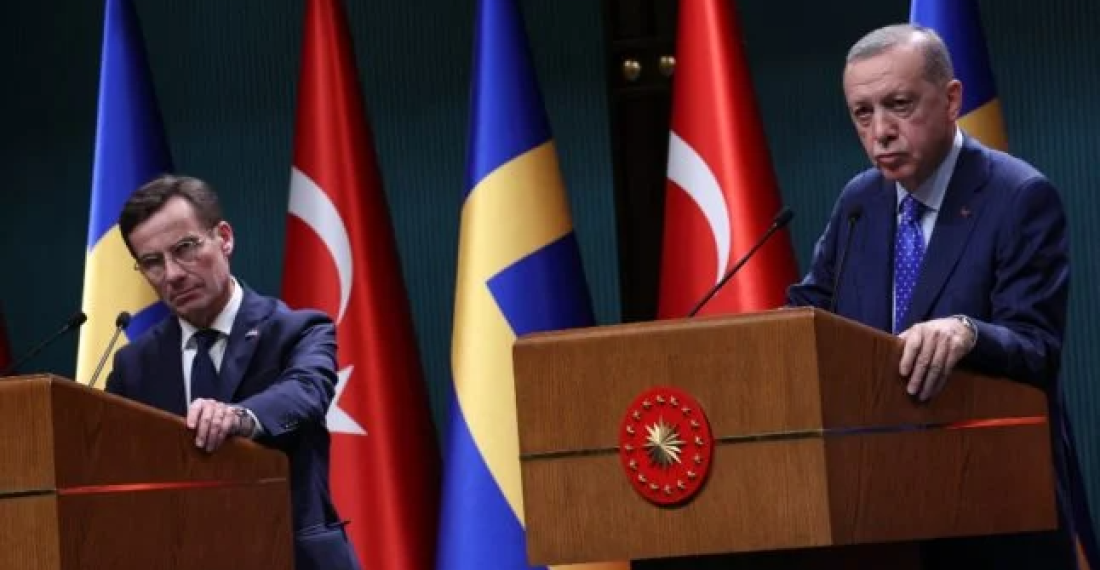
The President of Turkey, Recep Tayyip Erdogan, has said that Sweden should not expect support from Ankara over its bid to join NATO following protests in Stockholm at the weekend.

Surrounded by police for his protection, on Saturday (21 January) Danish-Swedish, far-right, anti-Islam activist Rasmus Paludan burned the Quran outside the Turkish Embassy in Stockholm while making disparaging remarks about immigrants and Islam. This incensed President Erdogan who criticised the Swedish authorities for letting the stunt happen.

“It is clear that those who allowed such vileness to take place in front of our embassy can no longer expect any charity from us regarding their NATO membership application,” Erdogan said on Monday (23 January).

Another bone of contention between Sweden and Turkey regarding the former's accession to NATO concerns the Kurdish question. Later on Saturday following Paludan's stunt, there was a pro-Kurdish demonstration in Stockholm where flags of various Kurdish groups were waved, including that of the Kurdish Workers' Party, or the PKK. The PKK has waged a decades-long insurgency in Turkey, and although it is considered a terrorist group by Turkey, the United States and the European Union, its symbols are not banned in Sweden.

In the same speech, Erdogan said: “So you will let terror organisations run wild on your avenues and streets and then expect our support for getting into NATO. That’s not happening.”

In a tweet on Saturday, Swedish Prime Minister Ulf Kristersson criticised Paludan for the stunt while defending his right to freedom of expression. He said: "Freedom of expression is a fundamental part of democracy. But what is legal is not necessarily appropriate. Burning books that are holy to many is a deeply disrespectful act. I want to express my sympathy for all Muslims who are offended by what has happened in Stockholm today."

source: commonspace.eu with agencies
photo: Adem ALTAN/AFP/The Local

Related articles

Editor's choice
News
European leaders set out their plan for Ukraine

European leaders set out their plan for Ukraine

The leaders of Germany, Denmark, Finland, France, Italy, Netherlands, Norway, Poland, Sweden, and United Kingdom, together with the President of the European Council, and the President of the European Commission, o  Monday (15 December) issued a statement, outlining their plan for Ukraine. In their statement, Chancellor Merz, Prime Minister Frederiksen, President Stubb, President Macron, Prime Minister Meloni, Prime Minister Schoof, Prime Minister Støre, Prime Minister Tusk, Prime Minister Kristersson, Prime Minister Starmer, as well as President Costa and President von der Leyen spoke about "Peace for Ukraine". The Leaders welcomed significant progress on President Trump’s efforts to secure a just and lasting peace in Ukraine. They also welcomed the close work between President Zelenskyy’s and President Trump’s teams as well as European teams over the recent days and weeks. They agreed to work together with President Trump and President Zelenskyy to get to a lasting peace which preserves Ukrainian sovereignty and European security. Leaders appreciated the strong convergence between the United States, Ukraine and Europe. Leaders agreed that ensuring the security, sovereignty, and prosperity of Ukraine was integral for wider Euro-Atlantic security. They were clear that Ukraine and its people deserved a prosperous, independent, and sovereign future, free from fear of future Russian aggression. Both the US and European leaders committed to work together to provide robust security guarantees and economic recovery support measures for Ukraine in the context of an agreement on ending the war. This would include commitments to: Provide sustained and significant support to Ukraine to build its armed forces, which should remain at a peacetime level of 800,000 to be able to deter conflict and defend Ukraine’s territory. A European-led ‘multinational force Ukraine’ made up from contributions from willing nations within the framework of the Coalition of the Willing and supported by the US. It will assist in the regeneration of Ukraine’s forces, in securing Ukraine’s skies, and in supporting safer seas, including through operating inside Ukraine. (Click the image to read the statement in full).

Popular