Trump’s “Board of Peace” Launched at the World Economic Forum in Davos

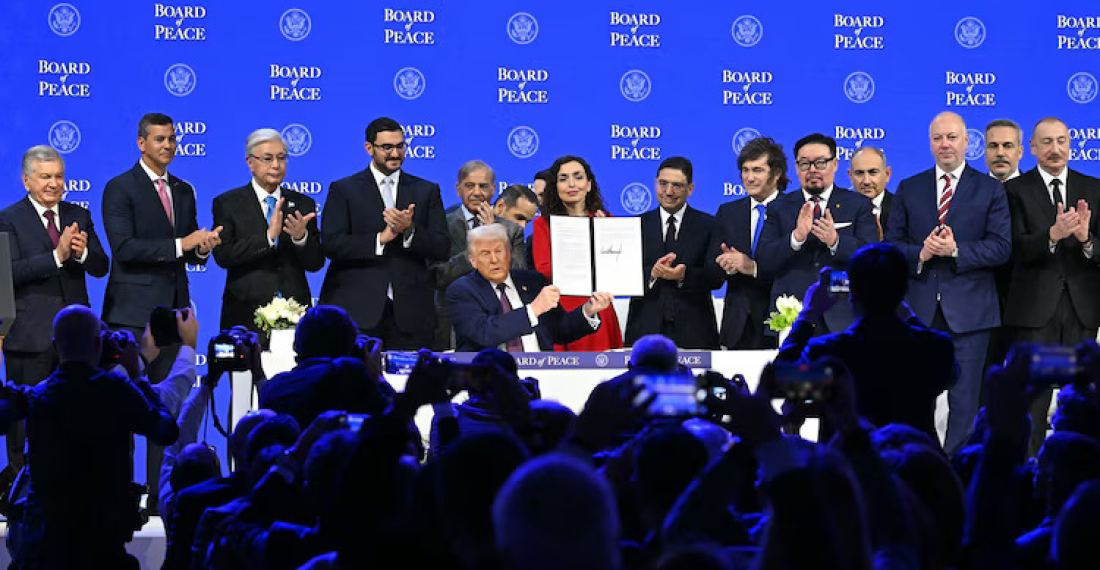
US President Donald Trump holds a signing ceremony for a deal establishing his “Board of Peace” on Thursday (22 January) at the World Economic Forum in Davos, according to ABC News.

ABC News reports that more than 20 countries have already accepted Trump’s invitation to join the new global peacekeeping and conflict-resolution body. The initiative is being presented by the White House as a major new international framework, with a mandate that has quickly expanded beyond resolving the war in Gaza. 

Among the countries that have agreed to participate are Albania, Argentina, Armenia, Azerbaijan, Bahrain, Belarus, Bulgaria, Egypt, Hungary, Indonesia, Israel, Jordan, Kazakhstan, Kosovo, Kuwait, Mongolia, Morocco, Pakistan, Paraguay, Qatar, Saudi Arabia, Turkey, the United Arab Emirates, Uzbekistan and Vietnam.

Notably, Israel’s Prime Minister Benjamin Netanyahu failed to attend the Board’s launch due to concerns around his International Criminal Court arrest warrant issued in November 2024. 

Invitations have also been submitted to the Kremlin. Russia has confirmed receipt of an invitation, despite its ongoing war against Ukraine.

Donald Trump will act as chair of the Board of Peace, holding exclusive authority to invite new members, establish, amend or dissolve subsidiary bodies, and nominate his designated successor, according to a review of the charter by The Times of Israel. Western allies have expressed serious reservations about joining the Board of Peace, while Germany, the United Kingdom, and Italy have remained noncommittal.

Source: commonspace.eu with ABC News (Washington) and The Times of Israel

Related articles

Editor's choice
News
Russian attacks against Ukrainian civilians continue

Russian attacks against Ukrainian civilians continue

Rescuers in Ukraine are continuing their search for survivors in the wreckage of a big shopping centre hit by Russia on Friday. Sixteen people were killed and 130 injured when two drones hit the busy centre in Kryvyi Rih in quick succession in what is known as a double-tap strike. Four people are still missing. The search and rescue operation could last for another two days. President Volodymyr Zelensky condemned the "cynical and despicable" attack in which the second drone targeted emergency workers. The sides exchanged more fire overnight, with Ukrainian attacks said to have killed at least four people in Russia, including two children, and three people reported dead by Kyiv as a result of Russian strikes. The death toll from Friday's attack reached 16 after another body was retrieved from the rubble overnight, said Dnipropetrovsk regional head Oleksandr Hanzha. "We're doing everything possible to speed up... the search and rescue operation," he told Ukrainian TV on Saturday morning. (click image tio read more)

Popular

Editor's choice
Interview
Thursday Interview: Murad Muradov

Thursday Interview: Murad Muradov

Today, commonspace.eu starts a new regular weekly series. THURSDAY INTERVIEW, conducted by Lauri Nikulainen, will host  persons who are thinkers, opinion shapers, and implementors in their countries and spheres. We start the series with an interview with Murad Muradov, a leading person in Azerbaijan's think tank community. He is also the first co-chair of the Action Committee for a new Armenian-Azerbaijani Dialogue. Last September he made history by being the first Azerbaijani civil society activist to visit Armenia after the 44 day war, and the start of the peace process. Speaking about this visit Murad Muradov said: "My experience was largely positive. My negative expectations luckily didn’t play out. The discussions were respectful, the panel format bringing together experts from Armenia, Azerbaijan, and Turkey was particularly valuable during the NATO Rose-Roth Seminar in Yerevan, and media coverage, while varied in tone, remained largely constructive. Some media outlets though attempted to represent me as more of a government mouthpiece than an independent expert, which was totally misleading.  Overall, I see these initiatives as important steps in rebuilding trust and normalising professional engagement. The fact that soon a larger Azerbaijani civil society visits to Armenia followed, reinforces the sense that this process is moving in the right direction." (click the image to read the interview in full)