A new EU Neighbours East survey has found that a large majority of Georgians continue to support the country's accession to the European Union, although public trust in the bloc and perceptions of EU-Georgia relations have weakened significantly in recent years.
According to the survey published on the 18th of June, 71% of respondents support Georgia joining the EU. However, nearly half (49%) said they believe the country is not moving in the right direction toward achieving membership.
The findings indicate a decline in positive attitudes toward the EU since 2024. While 60% of respondents held a favourable view of the bloc in 2024, that figure fell to 43% in 2025 and 50% in 2026. At the same time, negative perceptions increased from 32% in 2024 to 48% in 2025 and 50% in 2026.
Trust in the EU has also declined. In 2024, 81% of respondents said they trusted the bloc, compared with 67% in both 2025 and 2026. Perceptions of relations between Georgia and the EU followed a similar trend, with the share of respondents describing ties positively dropping from 87% in 2024 to 63% in 2025 and 60% in 2026.
Economic concerns continue to dominate public opinion regarding domestic challenges. Unemployment was identified as Georgia’s most pressing issue by 69% of respondents, followed by poverty (58%) and low salaries or pensions (57%). Only 11% considered the state of democracy to be the country’s main problem.
When asked where the EU should increase its support, respondents most frequently cited education (36%), economic development and trade (34%), and healthcare (33%).
The survey also examined expectations regarding EU accession. Twenty-seven percent of respondents believed Georgia could join the EU within five years, while 24% expected membership to be achieved within five to fifteen years. The most commonly cited obstacle to accession was a perceived lack of political will within Georgia, identified by 34% of respondents. Unresolved territorial disputes and difficulties in meeting membership criteria were each cited by 13%.
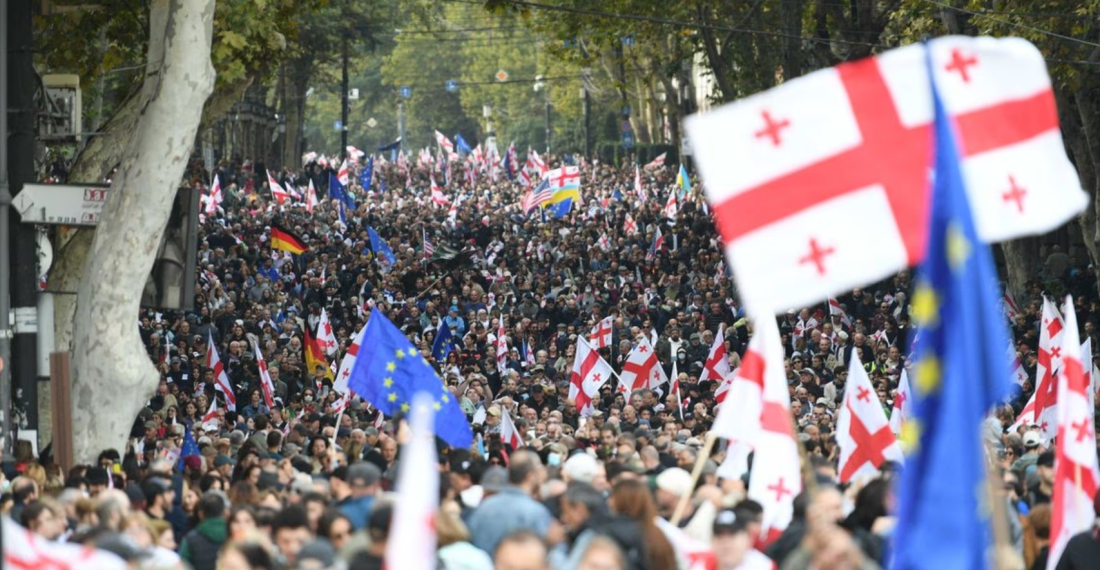
The decline in public confidence coincides with the Georgian government's decision in December 2024 to suspend progress on EU integration temporarily. The move triggered large-scale protests that have continued into 2026. Despite strained relations with Brussels, the Georgian government reportedly sought assistance from Luxembourg in mid-June to help restore dialogue with EU institutions.
Source: commonspace.eu with OC Media