


The statement of the Minsk Group co-Chairmen triggers reaction in Baku and Yerevan

On Saturday, 9 March, the three co-Chairmen of the OSCE Minsk Process, mandated by the international community to facilitate the process for a peaceful solution to the Nagorno-Karabakh conflict, issued what for them is an unusually long statement in which they urged the parties to the conflict to remain focused on the upcoming summit between the leaders of Armenia and Azerbaijan under their auspices and underlined "the importance of maintaining an environment conducive to productive discussions".

read more: International community tries to keep Armenia and Azerbaijan focused on conflict settlement

The statement immediately triggered a response from both Baku and Yerevan. The foreign ministries of Armenia and Azerbaijan issued statements through their spokespersons on the same day, both giving their own spin to the statement, and as often happened in the past, highlighting the bits they found most convenient. Over the last forty eight hours, numerous commentators, experts and political parties have joined the chorus in pretty much the same vein. Not exactly what the co-Chairmen had in mind when they issued the statement, but it quite accurately reflects the highly polorised situation within public opinion on both sides of the conflict divide.

This is the background for other events happening these days. In Azerbaijan, the Ministry of Defence launched large military manoevres on Monday morning (11 March). Azerbaijani military sources told the media that "the exercises involve up to 10,000 military personnel, up to 500 tanks and other armoured vehicles, up to 300 missiles and artillery systems of different calibre, multiple launch rocket systems, and mortars, up to 20 army and front-line  aircraft."

The sources said that "in the course of the exercise, troops will implement tasks of preparing an offensive operation, striking an imaginary enemy in several directions, breaking through its defence, and defeating military groups, as well as launching missile and artillery strikes against military and strategic targets located in the enemy's defensive depth. At the same time, combat firing will be carried out in training centres and combined-arms ranges using new weapons systems, including the practical launch of missiles."

Armenia has condemned the exercises and said that Azerbaijan failed to give advance notice, as it was due to under several international obligations.

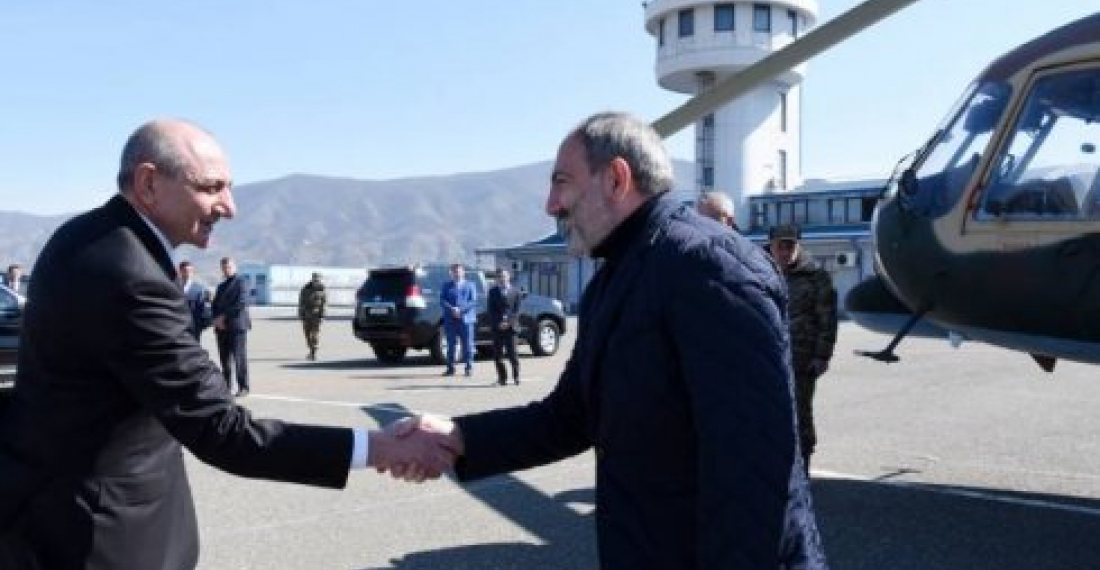
In Armenia meanwhile, opposition forces of various shades have used the statement of the co-Chairmen of the OSCE Minsk process to attack the government of Nikol Pashinyan. On Monday morning Pashinyan travelled to Stepanakert on a military helicopter and was met at Stepanakert airport by the leadership of the self-declared Nagorno-Karabakh Republic. Pashinyan was accompanied by his wife Anna Hakobyan.

A government source in Yerevan said that Pashinyan has convened on Tuesday a meeting of the Armenian National Security Council in Stepanakert. This is a highly unusual, perhaps even unprecedented step, and it is not clear what will be discussed in this meeting.

source: commonspace.eu with agencies

photo: Nikol Pashinyan arrives in Stepanakert on Monday (11 March) and is greeted by Bako Sahakyan, president of the self-declared Nagorno Karabakh Republic (picture courtesy of ARMENPRESS, Yerevan)



Related articles

Editor's choice
News
Borrell tells the European Parliament that the situation in Afghanistan was critical, but the EU will remain engaged

Borrell tells the European Parliament that the situation in Afghanistan was critical, but the EU will remain engaged

Borrell underlined that the European Union will make every effort to support the peace process and to remain a committed partner to the Afghan people. "Of course, we will have to take into account the evolving situation, but disengagement is not an option.  We are clear on that: there is no alternative to a negotiated political settlement, through inclusive peace talks.
Editor's choice
News
Germany accuses Russia of cyberattacks and disinformation campaign

Germany accuses Russia of cyberattacks and disinformation campaign

The German government holds Russia responsible for a cyberattack on German air traffic control, and for targeted disinformation campaigns before the last federal election. According to the German Foreign Office in Berlin, the incidents could be clearly attributed to the Russian military intelligence service, the GRU. In response, the Russian ambassador to Berlin was summoned to the Foreign Ministry. "We have been observing a massive increase in threatening hybrid activities by Russia for some time now," a spokesperson for the Foreign Ministry stated. These range from disinformation campaigns and espionage to cyberattacks and sabotage attempts. The aim is to divide society, sow distrust, and undermine confidence in democratic institutions. The spokesperson added that with these actions, Russia is "very concretely threatening our security, not only through its war of aggression against Ukraine, but also here in Germany."  The Foreign Ministry spokesperson explained that the cyberattack on air traffic control in August 2024 was clearly attributed to the hacker collective "APT28," known as "Fancy Bear," and to the responsibility of the Russian military intelligence service, the GRU. Furthermore, it could now be "conclusively stated" that Russia had attempted "to influence and destabilize both the last Federal election and the ongoing internal affairs of the Federal Republic of Germany." There was "absolutely irrefutable evidence" for this". The so-called "Storm 1516" campaign, which has been running since 2024, is allegedly backed by "reliable information" that the Moscow-based think tank "Center for Geopolitical Expertise" is behind it. The Center is also said to be supported by Russian military intelligence. Its primary aim is to influence democratic elections in the West. (Click the image to read more).

Popular

Editor's choice
News
Germany accuses Russia of cyberattacks and disinformation campaign

Germany accuses Russia of cyberattacks and disinformation campaign

The German government holds Russia responsible for a cyberattack on German air traffic control, and for targeted disinformation campaigns before the last federal election. According to the German Foreign Office in Berlin, the incidents could be clearly attributed to the Russian military intelligence service, the GRU. In response, the Russian ambassador to Berlin was summoned to the Foreign Ministry. "We have been observing a massive increase in threatening hybrid activities by Russia for some time now," a spokesperson for the Foreign Ministry stated. These range from disinformation campaigns and espionage to cyberattacks and sabotage attempts. The aim is to divide society, sow distrust, and undermine confidence in democratic institutions. The spokesperson added that with these actions, Russia is "very concretely threatening our security, not only through its war of aggression against Ukraine, but also here in Germany."  The Foreign Ministry spokesperson explained that the cyberattack on air traffic control in August 2024 was clearly attributed to the hacker collective "APT28," known as "Fancy Bear," and to the responsibility of the Russian military intelligence service, the GRU. Furthermore, it could now be "conclusively stated" that Russia had attempted "to influence and destabilize both the last Federal election and the ongoing internal affairs of the Federal Republic of Germany." There was "absolutely irrefutable evidence" for this". The so-called "Storm 1516" campaign, which has been running since 2024, is allegedly backed by "reliable information" that the Moscow-based think tank "Center for Geopolitical Expertise" is behind it. The Center is also said to be supported by Russian military intelligence. Its primary aim is to influence democratic elections in the West. (Click the image to read more).

