The leaders of Armenia, Azerbaijan and Georgia have expressed optimism for what lays ahead in 2020 in their traditional new year's eve messages to their citizens, broadcast just before the stroke of midnight.
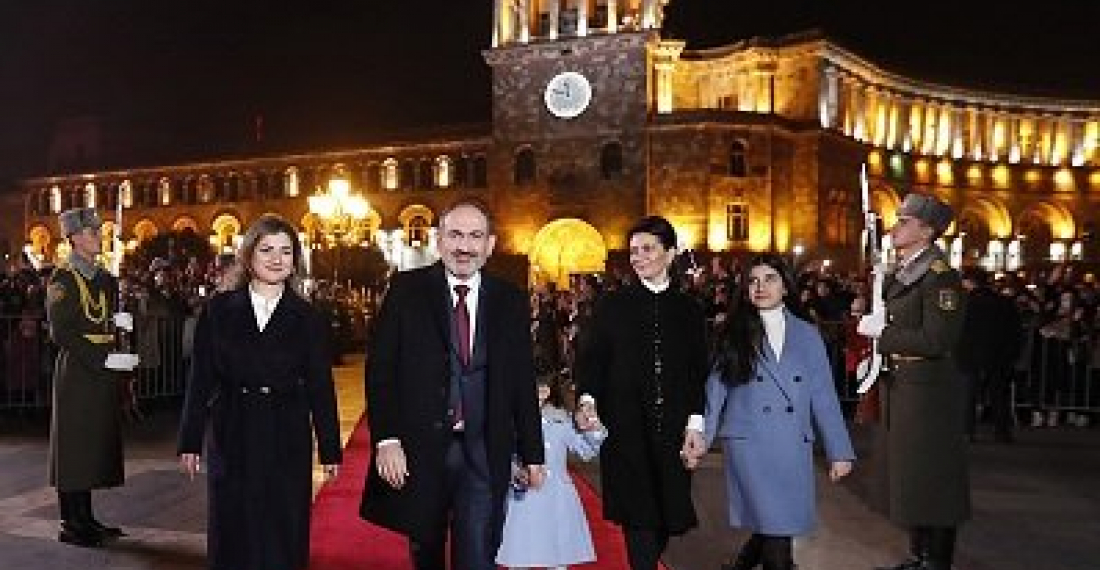
Armenian prime minister Nikol Pashinyan delivered his message live from Yerevan's central square where he and his family joined those preparing to welcome the new year. in his speech Pashinyam highlighted some of the achievements of his government since coming to power in May 2018. He said that 84,000 new jobs had been created and that Armenia will in 2019 register one of the highest economic growths in Europe.
Pashinyan told the Armenian people:
"The time has come in Armenia when it is necessary to make the impossible possible.
In 2018, very few believed that a non-violent velvet popular revolution could be carried out in the country, and in 2019 very few believed that we could achieve economic indicators worthy of worldwide attention. 2020 will be a year of hope for skeptics and take-off for enthusiasts. 2020 will be the year of economic, political, social and psychological take-off for the Republic of Armenia. Such is the significance of this moment in this crowded revolutionary square of the Republic, full of joy, love and solidarity."
Azerbaijan's president Ilham Aliyev was also satisfied by the achievements in 2019, and optimistic about the coming year. He said that 2019 "will go down in history as a year of in-depth reforms. Political reforms, personnel reforms, structural reforms, economic, reforms in the political and social spheres have made us stronger."
Aliyev dedicated a large part of his speech to the Nagorno-Karabakh conflict, reiterating that Azerbaijan's position has not changed. He slammed the Armenian side for "making very conflicting, contradictory and nonsensical statements in relation to the conflict." He added:
"I am convinced that our consistent and thought-out policy will lead to the resolution of the conflict. Our economic strength, our military strength, our political strength and our demographic growth – all these factors are strengthening our position. I am sure that the day will come when Azerbaijan will restore its territorial integrity. To achieve this, we need to be even stronger, and great steps have been taken this year."
Georgian prime minister Giorgi Gaharia's message was shorter, lasting two and half minutes. Looking back at 2019 which saw considerable political turmoil in Georgia, Gaharia said that the year was full of events, emotions, passion, "but we all agree that peace and stability are essential to the development of the country."
He added:
"Georgia has historically faced significant challenges, but with our traditions, purpose, constant striving for freedom, and with the wisdom of the nation - we have retained our unique cultural identity. It is with this intention that we must take care of the future of the country as our ancestors cared. We all need to contribute - doctors, teachers, soldiers, police, public officials, entrepreneurs and students. We must overcome the challenges together, no one else will do that for us - we must create the future we want our children to live in!
I am confident that 2020 will be a successful year, and that Georgia, with its traditions and unique cultural identity, will make significant progress on the path of European and Euro-Atlantic integration."
source: commonspace.eu with agencies
photo: Armenian prime minister Nikol Pashinyan arrives in Yerevan's Republic Square for new year celebrations. He made the traditional new year address to the nation live from the square. (picture courtesy of the press service of the government of Armenia)