"The spat in Bishkek is an indication that the atmosphere between the two sides remains poisoned, and that President Putin efforts at 'peace-making' do not seem to be going very far".
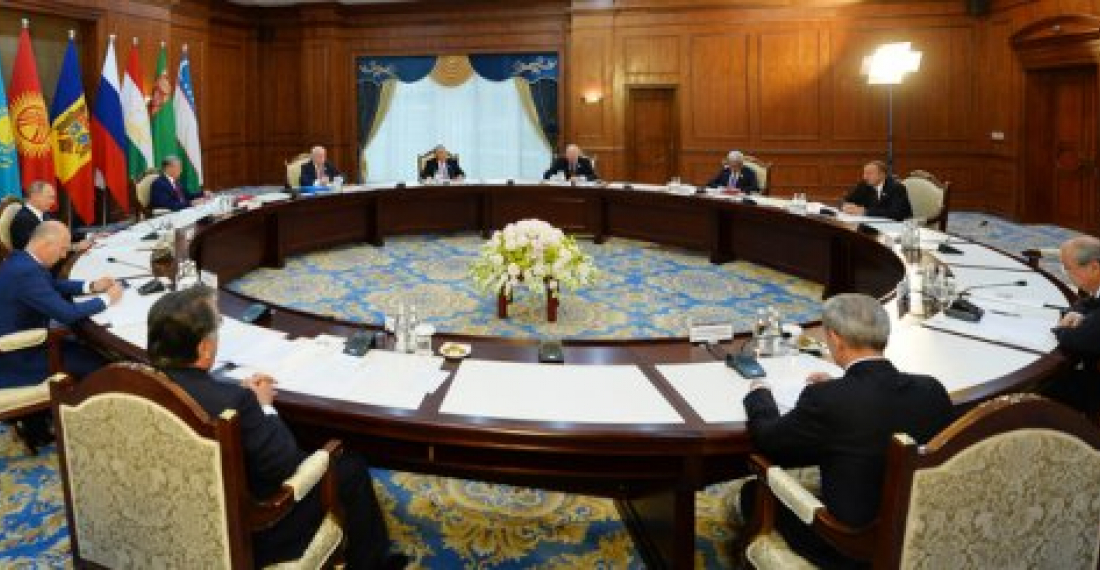
A summit of the presidents of the Commonwealth of Independent States, the CIS took place in the Kyrgyz Capital Bishkek on 16 September. This was supposed to be a celebratory summit to mark the 25th anniversary of the organisation formed after the collapse of the USSR in an effort by Russia to keep influence on its neighbours. The CIS has had a lacklustre history and on many occasions looked as if it was collapsing. Of the 15 former USSR republics only nine are now full members of the CIS. The three Baltic states never joined, Georgia left after Russia recognised Abkhazia and South Ossetia as independent states after the 2008 Georgia Russia War, and Ukraine and Turkmenistan downgraded their membership to associate members.
The meeting was also marked by a sharp exchange between the Presidents of Armenia and Azerbaijan, with both men accusing each other of "saying a lie".
The incident started when in his address to the meeting, Armenian President Serzh Sargsyan made a reference to the Nagorno-Karabakh conflict. According to the website of the Armenian president Sargsyan said;
Unfortunately, tension and pockets of resistance are present also on the territory of our Commonwealth. Last April, for the first time after the establishment of the ceasefire in 1994, the territory of Nagorno Karabakh became a war place. The military activities not only resulted in combat losses but caused loss of life among the peaceful civil population, and caused a heavy blow to the peace process.
I refer to this problem because the ceasefire agreement was signed right here, in Bishkek and was based on the provisions of the Declaration made by the Council of the CIS Heads of State on April 15, 1994. Nursultan Nazarbaev is a witness, he was there.
It means that in a sense the CIS member states are guarantors of the implementation of this permanent ceasefire which stipulates the necessity of reaching a comprehensive resolution to the problem through the exclusively political means.
We have always been stating our position which is line with the position of the Co-Chairs of the OSCE Minsk Group: the conflict must be solved through the peace negotiations, based on the norms and principles of international law, as well as on the reasonable mutual compromise, I stress - mutual compromise.
I would like to express my gratitude to the President of the Russian Federation Vladimir Putin, thank the Russian side which along with the other Co-Chairs of the OSCE Minsk Group - the United States and France - undertakes steps for the political and diplomatic solution of the NK conflict, for the implementation of the agreements reached during the Summits in Vienna and Saint Petersburg. First of all, it is the unconditional implementation of the trilateral agreements of 1994-95 on the cessation of military activities, creation of the mechanism for the investigation of the incidents, broadening of the capabilities of the mission of the Personal Representative of the OSCE Chairman-in-Office.
We are guided by the understanding that the consistent implementation of the mentioned above agreements would create an appropriate atmosphere for the advancement of the peace talks.
You can read the full text of the Armenian President speech here
According to the press office of the Azerbaijani president, Belarusian President Alexander Lukashenko was supposed to speak next after the Armenian President, however Azerbaijani president Ilham Aliev asked the Belarusian president for permission to speak before him . As Alexander Lukashenko did not object President Aliyev took the floor and gave what the website of the Azerbaijani Presidential administration described as "a compelling and tough response to the Armenian president's provocative remarks". It quoted Aliev as saying,
"I deemed it my duty to comment on the Armenian President's remarks. I did not consider it necessary to talk about the Nagorno-Karabakh conflict resolution here as this problem is addressed by other international organizations," said President Aliyev. "But when I heard another complaint of the Armenian side, I deemed it my duty to comment on this."
Armenia has already bothered all the international organizations with those complaints, he added.
"Situation is so paradoxical, as you can imagine: Armenia occupied territory of a sovereign state, violated its territorial integrity, expelled local Azerbaijani population from the Nagorno-Karabakh and seven surrounding districts, making more than one million people refugees and IDPs, destroyed everything in the occupied lands, including historical, religious, cultural monuments and all the infrastructure, which was evidenced by the reports of two OSCE missions," said Azerbaijan's president. "Then Armenia has just pretended to engage in the negotiations process for more than 20 years. Moreover Armenia periodically makes different provocations to make this process eternal. One of these provocations took place this April. Over 500 houses of Azerbaijani civilians were shelled from the Armenian artillery, more than 100 houses were destroyed, nearly 10 civilians, including children, were killed, died."
According to president.az Aliev noted that international organizations have a clear understanding of how this problem must be solved.
"There is a supreme international body - United Nations Security Council. It is the highest international organization. The Security Council adopted four resolutions in early 1990s. These documents demand unconditional and immediate withdrawal of the occupant Armenian forces from Azerbaijan's territory. These resolutions remain unfulfilled. Armenia disregards them and tries to create a new reality by artificially changing the administrative borders of former Nagorno-Karabakh Autonomous Oblast and illegally resettling in that area. It is absolutely illegal. It is a crime, and this crime has continued up to the present time," he said.
The Azerbaijani President website said that Ilham Aliev stressed that Azerbaijan is committed to a peace process.
"We work constructively. We have a Minsk Group format, but the Armenian side misuses this format just to make the negotiations continue for ever. They do not want peace. They just want to keep our territories under control and to accuse Azerbaijan everywhere of violating something. We are the aggrieved party. We did not occupy anybody's territory. It is our territory, 20 per cent of Azerbaijan's internationally-recognized territory, that has been under occupation. This is the reality. Therefore, with reference to the Armenian President's another inappropriate complaint, I deemed it my duty to bring this to the attention of our colleagues once again," he added.
The same source says that after this, the Armenian President said "It makes no sense to respond to a lie" to which the Azerbaijani President replied, "I have already responded to a lie".
Commonspace.eu political editor said in a comment that "this of course is not the first time that there has been sharp exchange of words between the two leaders in international fora, and their subordinates have in the past said much worse.
What is important and significant however is that this exchange took place at this moment and in the presence of Russian President Vladimir Putin. The Russians have for some time been pushing for progress in the settlement of the Nagorno-Karabakh conflict and for the last year thought they had the green light of the two sides to push forward what have become known as the Lavrov ideas. The intense fighting in April, which left hundreds dead on both sides, led the Russians to intensify their efforts and for a moment after the last summit involving the Presidents of Russia, Azerbaijan and Armenia in St Petersburg in June there were expressions of optimism that a breakthrough was imminent. The negotiations, as always have been ongoing in secret and there has been little indication of what progress, if any, has been made. The spat in Bishkek is an indication that the atmosphere between the two sides remains poisoned and that President Putin efforts at 'peace-making' do not seem to be going very far".
source: commonspace.eu with the official websites of the president of Armenia and the President of Azerbaijan.
phot: A closed session of the leaders of the CIS at their 25th anniversary summit in Bishkek on 16 September 2016.