


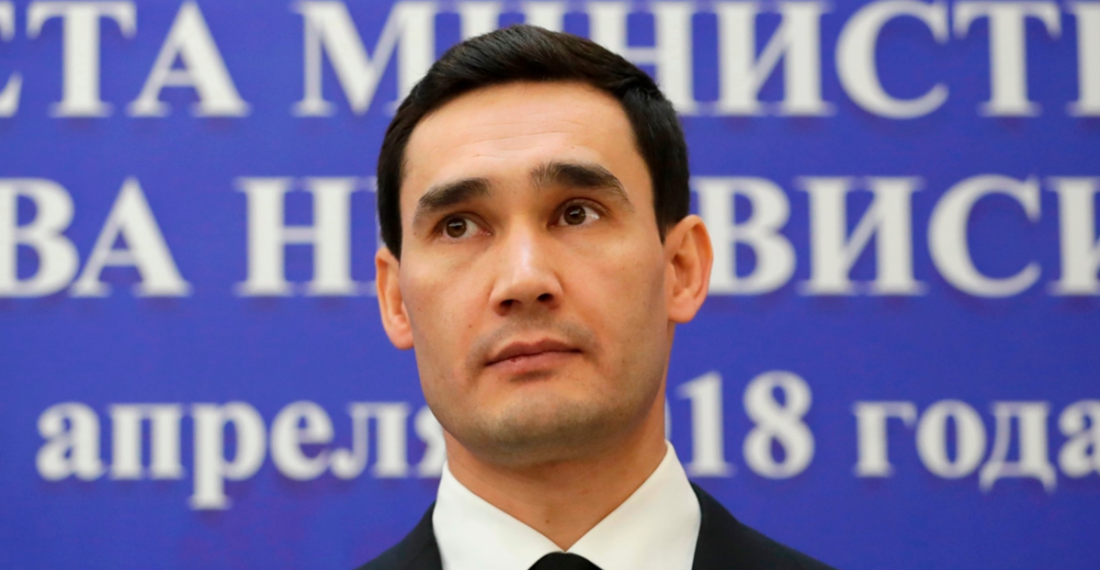
Serdar Berdymukhamedov in line to become next President of Turkmenistan in Father-Son transition

Turkmenistan’s President, Gurbanguly Berdymukhamedov, who succeeded "Turkmenbashi" Saparmurav Niyazov in 2007, announced last week that he is preparing to step down two years before the end of his current term. The Democratic Party voted unanimously on 14 February to nominate the current president’s son, Serdar Berdymukhamedov, for the upcoming snap election slated for 12 March, all but ensuring he will become the next President of Turkmenistan. 

The incumbent leader, famed for acts like shooting guns while on a bicycle, performing doughnuts in a car meters from a volcanic crater, and horse-riding, is reportedly unwell. Ruslan Myatiev, editor of Turkmen news, said “[Gurbanguly] Berdymukhamedov, despite being shown on TV energetic and physically fit, is ill.

On 11 February, in a session of the upper house of Turkmenistan’s parliament, the current president, known as “the protector”, stated that he had made a “tough decision” and that it was time to give way to “young leaders”. The next day, Bezirgen Karaev, assistant to the chairman of the Turkmen Central Election Commission, told RIA Novosti that an early election had been scheduled for 12 March. 

40-year-old Serdar Berdymukhamedov, the nominee for the Democratic Party of Turkmenistan, has quickly become one of the most powerful men in Turkmenistan. After studying at the Russian Foreign Ministry’s Diplomatic Academy from 2008-11 while working at the Turkmen embassy in Moscow, the “President-in-waiting” has taken on a series of jobs such as a senior role in the agency responsible for administering the country’s energy resources, head of the Foreign Ministry’s information department, and member of parliament. More recently, he was elected as deputy foreign minister and subsequently made deputy governor of the Ahal province in January 2019 until his promotion to governor five months later. He assumed his current position as Deputy Prime Minister in February 2021. Furthermore, he holds a seat on the State Security Council and is chair of the Supreme Control Chamber.

Turkmenistan is nominally a secular democracy, but has never had an election deemed to have been free and fair by international standards, including those of the OSCE, of which it is a member.  The Democratic Party won 97% of the votes at the previous presidential election and the country ranks 161st out of 167 countries in the Economist Intelligence Unit's Democracy Index 2021 survey. Serdar Berdymukhamedov is therefore unlikely to face any significant opposition to him being elected as the next president of Turkmenistan.

Turkmenistan has an official status as a neutral country, which has also been acknowledged by the United Nations. Although considered isolated from many mainstream international processes it has recently sought to strengthen ties with a number of neighbouring countries, particularly in the economic sphere.
Sources: commonspace.eu with Nikkei Asia (Tokyo) and eurasianet (New York)
Photo: Serdar Berdymukhamedov (picture courtesy of AP)

Related articles

Editor's choice
News
Borrell tells the European Parliament that the situation in Afghanistan was critical, but the EU will remain engaged

Borrell tells the European Parliament that the situation in Afghanistan was critical, but the EU will remain engaged

Borrell underlined that the European Union will make every effort to support the peace process and to remain a committed partner to the Afghan people. "Of course, we will have to take into account the evolving situation, but disengagement is not an option.  We are clear on that: there is no alternative to a negotiated political settlement, through inclusive peace talks.
Editor's choice
News
Germany accuses Russia of cyberattacks and disinformation campaign

Germany accuses Russia of cyberattacks and disinformation campaign

The German government holds Russia responsible for a cyberattack on German air traffic control, and for targeted disinformation campaigns before the last federal election. According to the German Foreign Office in Berlin, the incidents could be clearly attributed to the Russian military intelligence service, the GRU. In response, the Russian ambassador to Berlin was summoned to the Foreign Ministry. "We have been observing a massive increase in threatening hybrid activities by Russia for some time now," a spokesperson for the Foreign Ministry stated. These range from disinformation campaigns and espionage to cyberattacks and sabotage attempts. The aim is to divide society, sow distrust, and undermine confidence in democratic institutions. The spokesperson added that with these actions, Russia is "very concretely threatening our security, not only through its war of aggression against Ukraine, but also here in Germany."  The Foreign Ministry spokesperson explained that the cyberattack on air traffic control in August 2024 was clearly attributed to the hacker collective "APT28," known as "Fancy Bear," and to the responsibility of the Russian military intelligence service, the GRU. Furthermore, it could now be "conclusively stated" that Russia had attempted "to influence and destabilize both the last Federal election and the ongoing internal affairs of the Federal Republic of Germany." There was "absolutely irrefutable evidence" for this". The so-called "Storm 1516" campaign, which has been running since 2024, is allegedly backed by "reliable information" that the Moscow-based think tank "Center for Geopolitical Expertise" is behind it. The Center is also said to be supported by Russian military intelligence. Its primary aim is to influence democratic elections in the West. (Click the image to read more).

Popular

Editor's choice
News
Germany accuses Russia of cyberattacks and disinformation campaign

Germany accuses Russia of cyberattacks and disinformation campaign

The German government holds Russia responsible for a cyberattack on German air traffic control, and for targeted disinformation campaigns before the last federal election. According to the German Foreign Office in Berlin, the incidents could be clearly attributed to the Russian military intelligence service, the GRU. In response, the Russian ambassador to Berlin was summoned to the Foreign Ministry. "We have been observing a massive increase in threatening hybrid activities by Russia for some time now," a spokesperson for the Foreign Ministry stated. These range from disinformation campaigns and espionage to cyberattacks and sabotage attempts. The aim is to divide society, sow distrust, and undermine confidence in democratic institutions. The spokesperson added that with these actions, Russia is "very concretely threatening our security, not only through its war of aggression against Ukraine, but also here in Germany."  The Foreign Ministry spokesperson explained that the cyberattack on air traffic control in August 2024 was clearly attributed to the hacker collective "APT28," known as "Fancy Bear," and to the responsibility of the Russian military intelligence service, the GRU. Furthermore, it could now be "conclusively stated" that Russia had attempted "to influence and destabilize both the last Federal election and the ongoing internal affairs of the Federal Republic of Germany." There was "absolutely irrefutable evidence" for this". The so-called "Storm 1516" campaign, which has been running since 2024, is allegedly backed by "reliable information" that the Moscow-based think tank "Center for Geopolitical Expertise" is behind it. The Center is also said to be supported by Russian military intelligence. Its primary aim is to influence democratic elections in the West. (Click the image to read more).

