In different ways, art can play a crucial role in times of crises, William Murray writes in this piece for commonspace.eu
Whether being used by celebrities to raise money for charity, as a way to spread awareness and positive messages, or as a form of personal expression, escapism and mediation, art has the potential to play a vital role in how we handle and cope with the coronavirus crisis. So, what makes it so important and how can we contribute?
Art can help us to bring attention to issues and act as a focal point for solidarity. Throughout the struggles of the 20th century, some of the world's most notable artists used their talents to record the emotions of the people, bring attention to issues, and to raise money for certain causes. A good example is Pablo Picasso's colossal 'Guernica' of 1937. The artist's anti-war, 3.5m-by-7.8m masterpiece brought attention to Spanish Civil War, whilst placing a significant emphasis on the too-often, ill-considered plight of women, children and animals in conflict. The painting was unveiled at the 1937 Paris International Exposition, and its subsequent tour was used to raise funds for Spanish war relief [1]. In our current crisis, we are seeing certain famous names using art in comparable ways. Damien Hirst, for instance, yesterday unveiled his new work 'Butterfly Rainbow' as a way of showing support to the work of British National Health Service (NHS) workers during the ongoing COVID-19 crisis; with profits from limited edition prints going directly to the NHS. Hirst stated that the message of his piece is 'hope' and has celebrated the fact that parents and children have been producing and displaying their own versions of the piece in the windows of their homes [2]. Similarly, Scottish Artist Katie Paterson has been selling digital copies of her book 'A Place that Exists Only in Moonlight' to raise awareness and funding for victims of domestic abuse - a plight exacerbated by the coronavirus pandemic [3].
Art also plays a pastoral role in times of crisis, promoting positive messages and bringing people together. During World War II, we saw the British government's message of 'Keep Calm and Carry On' displayed in bold text on a bright red poster attempting to lower stress and ensure the composure of a population in turmoil. At present, there are similar efforts being made by a number of organisations to comfort and assure people during COVID-19. At the end of March, the World Health Organization (WHO) issued an open brief for creatives to help bring the organisation's health guidelines to life as well as to counter the spread of misinformation [4]. Not dissimilarly, the Red Cross has also teamed up with 11 artists to promote the message that 'Kindness will keep us together', with proceeds from associated prints and souvenirs going towards efforts to counter the virus [5].
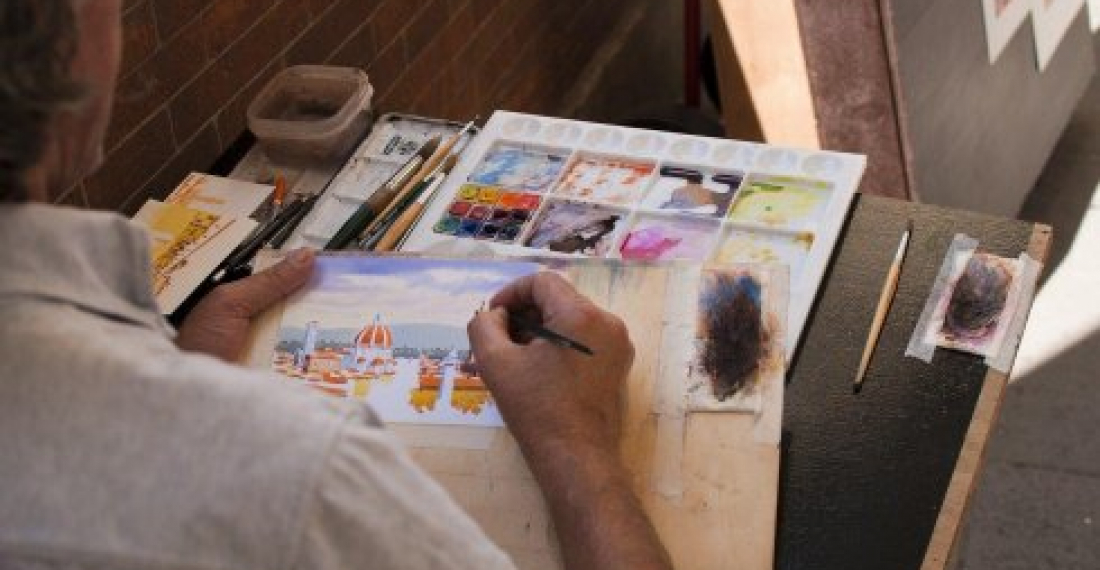
However, art needs not be reserved for those considered artists by society. Art as an activity can play an invaluable role as a form of expression and relaxation for all, and - especially in a time such as this - can promote feelings of hope. Studies have extensively shown the benefits of 'art therapy', with the act of creation alone having significant success in the mitigation of stress, anxiety and depression, regardless of whether the art is ever exhibited to anyone [6]. In the creation of art, we can find a healthy outlet through which to vent and understand our emotions, which are often difficult to put down in words; and it can give us a sense of structure, achievement and self-worth, in a time where many of our normal, day-to-day activities have had to be put on hold. In the words of the writer Kurt Vonnegut:
"Practicing an art, no matter how well or badly, is a way to make your soul grow, for heaven's sake. Sing in the shower. Dance to the radio. Tell stories. Write a poem to a friend, even a lousy poem. Do it as well as you possibly can. You will get an enormous reward. You will have created something." [7]
The nature of the current crisis makes times especially hard on professional artists, who are predominantly self-employed and rely heavily on physical sales and gallery footfall to survive. In order to help them and limit long-term cultural damage, the Artwork Archive has suggested a number of ways that we can support artists during this difficult time. These include taking part in online art classes, commissioning artwork from your favourite creators, attending exhibits and openings online, and donating to arts programmes [8].
Through embracing art as a hobby and by helping professional artists to continue with their work, we can enrich both our own lives and our societies, helping to make this time a little more bearable for all.
We would love to see and hear about how art is helping you through this crisis. Let us know on twitter @commonspaceEU
Source: William Murray, Project Officer and Coordinator at LINKS Europe, for commonspace.eu
Featured references:
[1] Gallery Walk - 'Guernica': https://www.gallerywalk.org/Picasso_Guernica.html
[2] Damien Hirst - 'Damien Hirst creates rainbow artwork for the NHS': http://www.damienhirst.com/news/2020/damien-hirst-creates-rainbow-artwork-for-the-nhs
[3] The Art Newspaper - 'Artist Katie Paterson raises money for domestic abuse victims at risk during coronavirus outbreak': https://www.theartnewspaper.com/news/artist-katie-paterson-raises-money-for-domestic-abuse-victims
[4] talenthouse artworks - 'United Nations Global Call Out To Creatives - help stop the spread of COVID-19': https://www.talenthouse.com/i/united-nations-global-call-out-to-creatives-help-stop-the-spread-of-covid-19
[5] The British Red Cross - 'Kindness will keep us together': https://giftshop.redcross.org.uk/pages/kindness-will-keep-us-together
[6] J.S. Potash, D. Kalmanowitz, I. Fung, S.A. Anand, G.M. Miller - 'Art Therapy in Pandemics: Lessons for COVID-19': https://www.tandfonline.com/doi/full/10.1080/07421656.2020.1754047?needAccess=true
[7] K. Vonnegut - 'A Man Without a Country'
[8] Artwork Archive - 'How to Support Artists and the Arts During COVID-19': https://www.artworkarchive.com/blog/how-to-support-artists-and-the-arts-during-covid-19