Russian fighter jet and US drone collide over the Black Sea

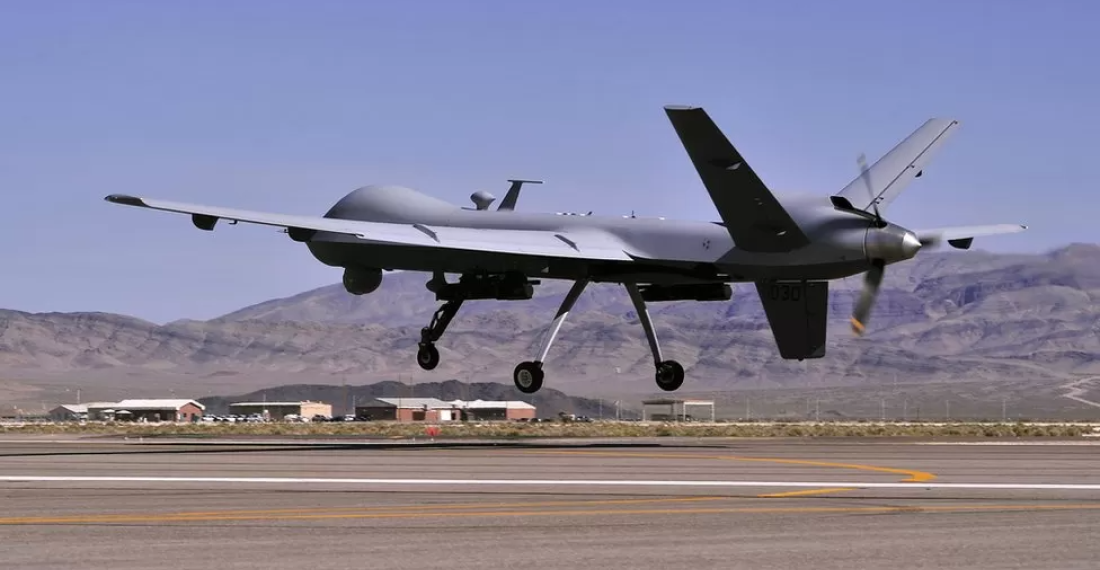
A Russian Su-27 fighter jet has collided with an American MQ-9 Reaper drone over the Black Sea on Tuesday (14 March). The collision rendered the drone "unflyable" according to the Pentagon, forcing the U.S. to crash the drone into the sea.

Before the collision, Russian jets are said to have dumped fuel into the path of the drone which the US says was in international airspace. The confrontation between the drone and the fighter jet is said to have lasted between 30-40 minutes, with the collision happening at 07.03 CET.

The collision occurred approximately 200km south of Ukraine's southern port city of Odesa. Russia has denied its two Su-27 fighter jets made any contact.

In a statement, U.S. Air Force General James Hecker, commander of U.S. Air Forces Europe and Air Forces Africa, said "Our MQ-9 aircraft was conducting routine operations in international airspace when it was intercepted and hit by a Russian aircraft, resulting in a crash and complete loss of the MQ-9."

"In fact, this unsafe and unprofessional act by the Russians nearly caused both aircraft to crash," Hecker said.

The U.S. uses MQ-9 Reapers for both surveillance and strikes and has operated the drones in a variety of locations, including in the Middle East and Africa. The UK and France are two countries that also fly Reapers.

Russia denies all wrongdoing

On its part, Moscow denied causing the drone to crash.

"As a result of sharp manoeuvering... the MQ-9 unmanned aerial vehicle went into uncontrolled flight with a loss of altitude and collided with the water surface," the Russian Defense Ministry said in a statement. It added that the two Russian jets had no contact with the U.S. aircraft and did not use their weapons.

The Defense Ministry also called the drone an "intruder", and argued that it was heading toward Russia's border. Air Force Brig. Gen. Pat Ryder told reporters during a Pentagon briefing that the drone was operating in international airspace over international waters.

The incident is the first direct US-Russia confrontation since Russia launched its full-scale invasion of Ukraine on 24 February 2022. The key question is whether the collision was indeed deliberate, which could amount to an escalation between Washington and Moscow.
source: commonspace.eu with agencies
photo: BBC/EPA

Related articles

Editor's choice
News
European leaders set out their plan for Ukraine

European leaders set out their plan for Ukraine

The leaders of Germany, Denmark, Finland, France, Italy, Netherlands, Norway, Poland, Sweden, and United Kingdom, together with the President of the European Council, and the President of the European Commission, o  Monday (15 December) issued a statement, outlining their plan for Ukraine. In their statement, Chancellor Merz, Prime Minister Frederiksen, President Stubb, President Macron, Prime Minister Meloni, Prime Minister Schoof, Prime Minister Støre, Prime Minister Tusk, Prime Minister Kristersson, Prime Minister Starmer, as well as President Costa and President von der Leyen spoke about "Peace for Ukraine". The Leaders welcomed significant progress on President Trump’s efforts to secure a just and lasting peace in Ukraine. They also welcomed the close work between President Zelenskyy’s and President Trump’s teams as well as European teams over the recent days and weeks. They agreed to work together with President Trump and President Zelenskyy to get to a lasting peace which preserves Ukrainian sovereignty and European security. Leaders appreciated the strong convergence between the United States, Ukraine and Europe. Leaders agreed that ensuring the security, sovereignty, and prosperity of Ukraine was integral for wider Euro-Atlantic security. They were clear that Ukraine and its people deserved a prosperous, independent, and sovereign future, free from fear of future Russian aggression. Both the US and European leaders committed to work together to provide robust security guarantees and economic recovery support measures for Ukraine in the context of an agreement on ending the war. This would include commitments to: Provide sustained and significant support to Ukraine to build its armed forces, which should remain at a peacetime level of 800,000 to be able to deter conflict and defend Ukraine’s territory. A European-led ‘multinational force Ukraine’ made up from contributions from willing nations within the framework of the Coalition of the Willing and supported by the US. It will assist in the regeneration of Ukraine’s forces, in securing Ukraine’s skies, and in supporting safer seas, including through operating inside Ukraine. (Click the image to read the statement in full).

Popular