Putin highlights foreign policy priorities and red lines

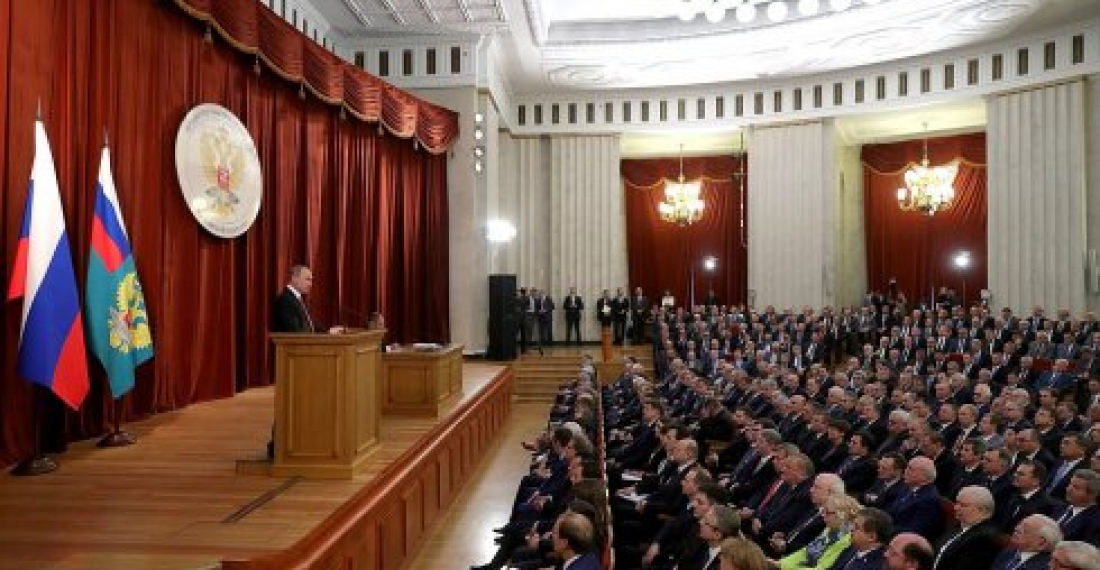
Russian President Vladimir Putin on Thursday (19 July) addressed ambassadors and permanent representatives of Russia at a traditional biannual meeting which is usually also attended by government and parliamentary leaders, as well as the heads of ministries and agencies involved in international activities and members of the research, expert and business communities.

Fresh from the controversial Helsinki summit with US president Donald Trump. President Putin used the occasion to spell out the current priorities in Russian foreign policy, and to lash out at critics of Russia - and of president Trump - in the United States.

I would like to point out that Russia's active involvement in global affairs is driven by our priority national interest, which is to create favourable and safe conditions for the country's breakthrough development, for attaining large-scale social and economic goals and for improving the quality of life for the people.

Our people want Russia to be a strong, independent and peaceful state. We are open to partnerships, to mutually beneficial and constructive relations with all countries and regional associations.

After refering to ongoing international crises in Syria, Korea, Iran, and Ukraine, president Putin delved straight into what he sees as the core of Russian government priorities. He said,

Colleagues, our foreign policy efforts are not aimed at achieving some kind of speculative greatness or creating problems for others. Let me reiterate that what matters most is ensuring the right conditions for the sustainable development of our country. In the years to come, Russia must not only firmly establish itself among the world's top five economies, but also substantially improve the key standards related to the quality of life of its citizens. To achieve these strategic objectives we must make full use of our foreign policy opportunities. It is important that we focus our efforts on achieving specific, pragmatic results, tap new markets, expand exports and gain access to advanced technology and investment, while overcoming the obstacles and limitations Russian companies face in foreign markets.

In today's world, the principles of competition and openness in global trade are increasingly replaced by protectionism, while economic gain and expediency are swapped for partisan agendas and political pressure. Economic ties and entrepreneurial freedom are being politicised. Against this backdrop, Russia's foreign policy must run counter to this trend by being more economically driven and rational. Creating a space of good neighbourly relations, wellbeing, security and stability along the entire perimeter of our state border has special importance.

President Putin hailed the achievements of the Eurasian Economic Unioin (EAEU):

The Eurasian Economic Union is a key integration project for Russia. It is gratifying that our partners are guided by the same priorities as we are within the EAEU, and we implement them together quite effectively. The essence of these approaches is to use the opportunities arising from the integration processes to stimulate economic growth in all member countries so that citizens and businesses benefit from this cooperation.

We also believe in the importance of stepping up EAEU contacts with other countries. Its free trade area with Vietnam has been launched, and talks are underway with Israel, Serbia and Singapore. Consultations with Egypt and India are to begin soon. A temporary agreement paving the way to the creation of a free trade area with Iran has been signed. All in all, there are about 50 proposals aimed at establishing partnerships with the Eurasian Economic Union.

Good prospects are opening up due to joint efforts with China resulting from the Agreement on Trade and Economic Cooperation signed in May between Beijing and the Eurasian Economic Union. The Eurasian Economic Union and the Belt and Road Initiative are efficiently complementing each other. Harmonisation of these projects can lay the foundation for establishing a Greater Eurasian Partnership - an economic cooperation space that is as free as possible from all barriers.

We should apply the same logic to developing relations with the European Union, which remains one of our major trade partners despite current difficulties. We have many overlapping economic interests with the EU. Our common transport and energy infrastructure has been developing for decades. I would like to emphasise that all the business projects that we are implementing with Europe, including, for instance, Nord Stream 2, are solely commercial and economically viable; they are not politically charged and have no hidden agenda.

President Putin than cambe back to one of his favorite themes - NATO expansion

The key to providing security and safety in Europe is in expanding cooperation and restoring trust, and not in deploying new NATO bases and military infrastructure near Russia's borders, which is what is taking place now.

We will respond appropriately to such aggressive steps, which pose a direct threat to Russia. Our colleagues, who are trying to aggravate the situation, seeking to include, among others, Ukraine and Georgia in the orbit of the alliance, should think about the possible consequences of such an irresponsible policy.

Putin lambasted critics of Russia - and of President Trump - in the United States, whilst evaluating positively the Helsinki summit: 

Of course, it would be naive to believe that the problems that piled up over years would be resolved in a matter of several hours. No one was counting on this. However, I believe that we have embarked on a path to positive changes.Importantly, a full-fledged summit with an opportunity to talk directly has finally taken place. It was overall successful and led to productive agreements. We will have to wait and see, of course, what turn the events will take, all the more so as certain forces in America are trying to downplay and disavow the results of the Helsinki summit.

source: commonspace.eu with the press service of the president of Russia

photo: President Vladimir Putin addressing Russian diplomats in Moscow on 19 July b2018 (picture copurtesy of the press service of the president opf Russia
 

Related articles

Editor's choice
News
Germany accuses Russia of cyberattacks and disinformation campaign

Germany accuses Russia of cyberattacks and disinformation campaign

The German government holds Russia responsible for a cyberattack on German air traffic control, and for targeted disinformation campaigns before the last federal election. According to the German Foreign Office in Berlin, the incidents could be clearly attributed to the Russian military intelligence service, the GRU. In response, the Russian ambassador to Berlin was summoned to the Foreign Ministry. "We have been observing a massive increase in threatening hybrid activities by Russia for some time now," a spokesperson for the Foreign Ministry stated. These range from disinformation campaigns and espionage to cyberattacks and sabotage attempts. The aim is to divide society, sow distrust, and undermine confidence in democratic institutions. The spokesperson added that with these actions, Russia is "very concretely threatening our security, not only through its war of aggression against Ukraine, but also here in Germany."  The Foreign Ministry spokesperson explained that the cyberattack on air traffic control in August 2024 was clearly attributed to the hacker collective "APT28," known as "Fancy Bear," and to the responsibility of the Russian military intelligence service, the GRU. Furthermore, it could now be "conclusively stated" that Russia had attempted "to influence and destabilize both the last Federal election and the ongoing internal affairs of the Federal Republic of Germany." There was "absolutely irrefutable evidence" for this". The so-called "Storm 1516" campaign, which has been running since 2024, is allegedly backed by "reliable information" that the Moscow-based think tank "Center for Geopolitical Expertise" is behind it. The Center is also said to be supported by Russian military intelligence. Its primary aim is to influence democratic elections in the West. (Click the image to read more).
Editor's choice
News
NATO Chief says war is on Europe's doorstep, and warns against complacency

NATO Chief says war is on Europe's doorstep, and warns against complacency

Russia could attack a NATO country within the next five years, the Secretary General of NATO, Mark Rutte, said in a stark new warning. "NATO's own defences can hold for now," Rutte warned in Berlin, but conflict was "next door" to Europe, and he feared "too many are quietly complacent, and too many don't feel the urgency, too many believe that time is on our side. "Russia is already escalating its covert campaign against our societies," Rutte said in a speech in Germany. "We must be prepared for the scale of war our grandparents or great-grandparents endured." Earlier this month, Russia's President Vladimir Putin said his country was not planning to go to war with Europe, but it was ready "right now" if Europe wanted to - or started a war. But similar reassurances were given by Moscow in 2022, just before 200,000 Russian troops crossed the border and invaded Ukraine. Putin has accused European countries of hindering US efforts to bring peace in Ukraine - a reference to the role Ukraine's European allies have recently played in trying to change a US peace plan to end the war, whose initial draft was seen as favouring Russia. But Putin was not sincere, Nato's secretary-general said in the German capital, Berlin. Supporting Ukraine, he added, was a guarantee for European security. "Just imagine if Putin got his way; Ukraine under the boot of Russian occupation, his forces pressing against a longer border with Nato, and the significantly increased risk of an armed attack against us." Russia's economy has been on a war footing for more than three years now - its factories churn out ever more supplies of drones, missiles and artillery shells. According to a recent report by the Kiel Institute for the World Economy, Russia has been producing each month around 150 tanks, 550 infantry fighting vehicles, 120 Lancet drones and more than 50 artillery pieces. The UK, and most of its Western allies, are simply not anywhere near this point. Analysts say it would take years for Western Europe's factories to come close to matching Russia's mass-production of weapons. "Allied defence spending and production must rise rapidly, our armed forces must have what they need to keep us safe," the Nato chief said.

Popular

Editor's choice
News
Germany accuses Russia of cyberattacks and disinformation campaign

Germany accuses Russia of cyberattacks and disinformation campaign

The German government holds Russia responsible for a cyberattack on German air traffic control, and for targeted disinformation campaigns before the last federal election. According to the German Foreign Office in Berlin, the incidents could be clearly attributed to the Russian military intelligence service, the GRU. In response, the Russian ambassador to Berlin was summoned to the Foreign Ministry. "We have been observing a massive increase in threatening hybrid activities by Russia for some time now," a spokesperson for the Foreign Ministry stated. These range from disinformation campaigns and espionage to cyberattacks and sabotage attempts. The aim is to divide society, sow distrust, and undermine confidence in democratic institutions. The spokesperson added that with these actions, Russia is "very concretely threatening our security, not only through its war of aggression against Ukraine, but also here in Germany."  The Foreign Ministry spokesperson explained that the cyberattack on air traffic control in August 2024 was clearly attributed to the hacker collective "APT28," known as "Fancy Bear," and to the responsibility of the Russian military intelligence service, the GRU. Furthermore, it could now be "conclusively stated" that Russia had attempted "to influence and destabilize both the last Federal election and the ongoing internal affairs of the Federal Republic of Germany." There was "absolutely irrefutable evidence" for this". The so-called "Storm 1516" campaign, which has been running since 2024, is allegedly backed by "reliable information" that the Moscow-based think tank "Center for Geopolitical Expertise" is behind it. The Center is also said to be supported by Russian military intelligence. Its primary aim is to influence democratic elections in the West. (Click the image to read more).