Putin commits to the security and independence of Abkhazia during visit to the territory

Russian President Vladimir Putin visited the self-declared republic of Abkhazia on Tuesday, (8 August), and declared that Russia will continue to support its security and independence. The visit came despite Georgian protestations. The international community recognises Abkhazia as part of Georgia.

Russia is determined to firmly guarantee the security and independence of Abkhazia, Russian President Vladimir Putin said on Tuesday, the Russian news agency TASS reported. "There is a great deal for us to discuss. What is most important is we have a special relationship of trust with Abkhazia. We firmly guarantee the security and independence of Abkhazia. I am certain that it will be so further on," Putin said at a meeting with Abkhazia’s President Raul Khajimba on Tuesday.  He pointed to the need for identifying only the optimal ways of developing Abkhazia’s economy for creating jobs and its own tax base. "That’s what we are going to discuss today," Putin said. Upon completion of the talks an agreement would be signed that would open Russia’s system of medical insurance and Russian hospitals to Abkhazian citizens.

For his part Khajimba said that Abkhazia with Russia’s support was moving on along the road of social economic development and building infrastructures and addressing security and defense issues. "All questions we discussed at the previous meetings are being resolved to the benefit of our people," Khajimba said, adding that there had been steady progress in translating into reality the treaty of alliance and strategic partnership between Abkhazia and Russia. Khajimba pointed to pro-active cooperation between the two countries’ foreign ministries. "Work on the program’s investment programs is proceeding as expected. This year’s spending on them will reach about 2.5 billion rubles ($42 million). All budget documents had been drafted, scrutinized and approved," Khajimba said. He is certain that the discussions due would produce solutions serving the interests of Abkhazia’s further development.  

"Abkhazia and its people are sincerely grateful to you for the decisions being made to develop our relations. I would like to say once again that the questions to be raised and resolved today would make our relations stronger," Khajimba said. He recalled that August 8 was a memorable date for Abkhazia and South Ossetia. "On that day the Georgian army mounted a large-scale attack and the resolute measures the Russian leadership took in response allowed South Ossetia to survive and paved the way for the further recognition of our tiny states," Khajimba said.

You can aslo read: Commentary: August War exposes Russia's bad intentions

commonspace.eu with TASS news agency

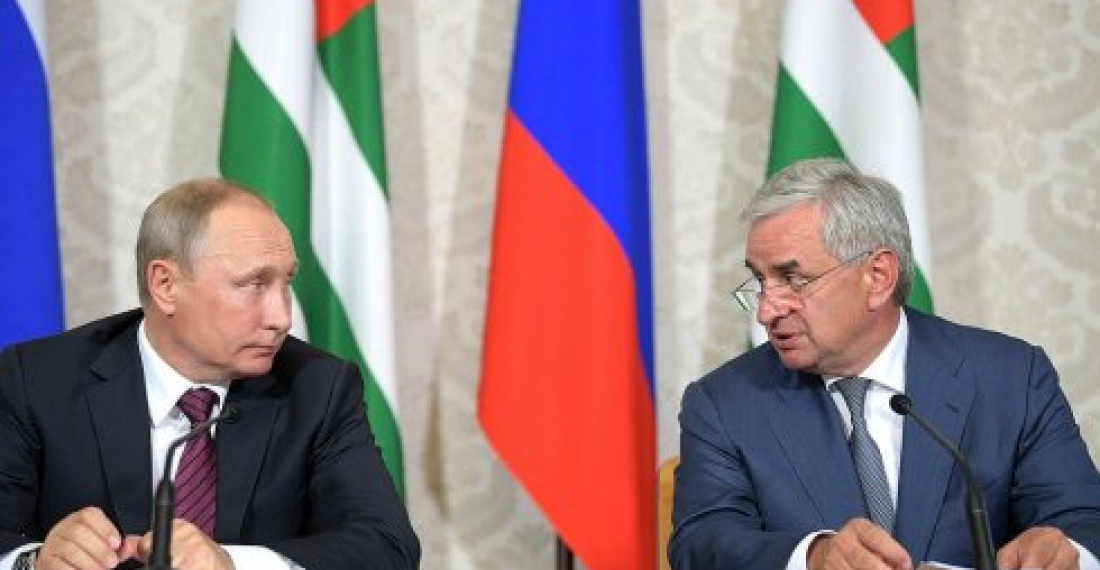
photo: Presiident Putin with the president of the self declared republic of Abkhazia, Rauf Khajimba in Pitsunda on 8 August 2017. (Picture courtesy of the twitter feed of the president of Russia)

Related articles

Editor's choice
News
Borrell tells the European Parliament that the situation in Afghanistan was critical, but the EU will remain engaged

Borrell tells the European Parliament that the situation in Afghanistan was critical, but the EU will remain engaged

Borrell underlined that the European Union will make every effort to support the peace process and to remain a committed partner to the Afghan people. "Of course, we will have to take into account the evolving situation, but disengagement is not an option.  We are clear on that: there is no alternative to a negotiated political settlement, through inclusive peace talks.
Editor's choice
News
Germany accuses Russia of cyberattacks and disinformation campaign

Germany accuses Russia of cyberattacks and disinformation campaign

The German government holds Russia responsible for a cyberattack on German air traffic control, and for targeted disinformation campaigns before the last federal election. According to the German Foreign Office in Berlin, the incidents could be clearly attributed to the Russian military intelligence service, the GRU. In response, the Russian ambassador to Berlin was summoned to the Foreign Ministry. "We have been observing a massive increase in threatening hybrid activities by Russia for some time now," a spokesperson for the Foreign Ministry stated. These range from disinformation campaigns and espionage to cyberattacks and sabotage attempts. The aim is to divide society, sow distrust, and undermine confidence in democratic institutions. The spokesperson added that with these actions, Russia is "very concretely threatening our security, not only through its war of aggression against Ukraine, but also here in Germany."  The Foreign Ministry spokesperson explained that the cyberattack on air traffic control in August 2024 was clearly attributed to the hacker collective "APT28," known as "Fancy Bear," and to the responsibility of the Russian military intelligence service, the GRU. Furthermore, it could now be "conclusively stated" that Russia had attempted "to influence and destabilize both the last Federal election and the ongoing internal affairs of the Federal Republic of Germany." There was "absolutely irrefutable evidence" for this". The so-called "Storm 1516" campaign, which has been running since 2024, is allegedly backed by "reliable information" that the Moscow-based think tank "Center for Geopolitical Expertise" is behind it. The Center is also said to be supported by Russian military intelligence. Its primary aim is to influence democratic elections in the West. (Click the image to read more).

Popular

Editor's choice
News
Germany accuses Russia of cyberattacks and disinformation campaign

Germany accuses Russia of cyberattacks and disinformation campaign

The German government holds Russia responsible for a cyberattack on German air traffic control, and for targeted disinformation campaigns before the last federal election. According to the German Foreign Office in Berlin, the incidents could be clearly attributed to the Russian military intelligence service, the GRU. In response, the Russian ambassador to Berlin was summoned to the Foreign Ministry. "We have been observing a massive increase in threatening hybrid activities by Russia for some time now," a spokesperson for the Foreign Ministry stated. These range from disinformation campaigns and espionage to cyberattacks and sabotage attempts. The aim is to divide society, sow distrust, and undermine confidence in democratic institutions. The spokesperson added that with these actions, Russia is "very concretely threatening our security, not only through its war of aggression against Ukraine, but also here in Germany."  The Foreign Ministry spokesperson explained that the cyberattack on air traffic control in August 2024 was clearly attributed to the hacker collective "APT28," known as "Fancy Bear," and to the responsibility of the Russian military intelligence service, the GRU. Furthermore, it could now be "conclusively stated" that Russia had attempted "to influence and destabilize both the last Federal election and the ongoing internal affairs of the Federal Republic of Germany." There was "absolutely irrefutable evidence" for this". The so-called "Storm 1516" campaign, which has been running since 2024, is allegedly backed by "reliable information" that the Moscow-based think tank "Center for Geopolitical Expertise" is behind it. The Center is also said to be supported by Russian military intelligence. Its primary aim is to influence democratic elections in the West. (Click the image to read more).