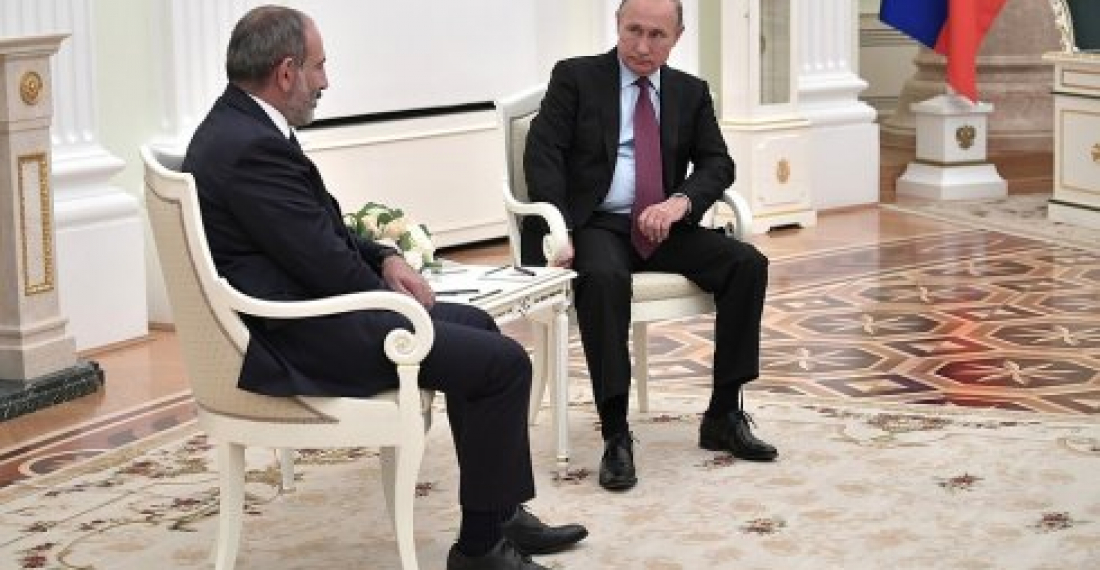
Putin and Pashinyan met in Moscow

Russian President Vladimir Putin on Saturday (8 September), received in Moscow the Armenian prime minister Nikol Pashinyan. This was the third meeting between the two men since Pashinyan became prime minister of Armenia in May, and came amidst speculation in Russian and Armenian media that there were problems in the historically close relations between the two countries.

Welcoming the Armenian leader, president Putin said:

Dear Nikolai Vovaevich! I am very glad to see you.

Probably, there is no need to particularly go into the nature of our relations: they are of a very special nature, specific. And it manifested itself through the centuries, and not only during our joint work with you.

For today, the relations between Armenia and Russia are developing steadily in all directions. This concerns the sphere of political relations, military sphere, security issues, economic cooperation.

Russia confidently ranks first among the economic partners of the Republic of Armenia. We are the biggest investor in the Armenian economy, and here it can be noted that relations in this sense are quite diversified.

This is energy, and hydrocarbon energy, gas supplies, and at the lowest prices, for which only Gazprom sells gas in the world - for $ 150 per 1,000 cubic meters. This is nuclear power, thermal generation. We develop relations in the metallurgical industry, and in different areas, in mechanical engineering. In general, we have many things to talk about.

I am particularly pleased that last year the trade turnover grew by almost 30 percent, and for the first half of this year the growth was already 22.2 percent, that is, if things go on at this rate, we will exceed the figures of the previous year.

The scope of our cooperation is great. I am very glad to see you in order to compare co-operation in the current and medium term.

On his part prime minister Pashinyan said:

Dear Mr Putin!

First of all, allow me to congratulate you on the Day of Moscow. I already felt that a very big holiday is planned, and I am very glad that I visit Moscow in such an atmosphere.

Of course, I am very pleased to attend this meeting, our third in the last four months. I think that such regularity underlines the special character of relations between our countries. Let me say, there is also a special character between us, the special character of our personal relations.

I want to emphasize that, contrary to some pessimism, which now exists in the Armenian, Russian press, and social networks. our relations are developing very dynamically, very naturally, and I think that the main task is to find the full potential of the development of our relations.

This does not mean that there are no questions in our relations - God forbid from such a situation when there are no issues in the relationship, because this would mean that there is no relationship at all. I can say with confidence that there are no unsolvable issues in our relations, and we, of course, today will discuss a very wide range of issues.

source: commonspace.eu with kremlin.ru

photo: Vladimir Putin with Nikol Pashinyan at their meeting in Moscow on 8 Sepotember 2018 (picture courtesy of the press service of the president of Russia)

Related articles

Editor's choice
News
Borrell tells the European Parliament that the situation in Afghanistan was critical, but the EU will remain engaged

Borrell tells the European Parliament that the situation in Afghanistan was critical, but the EU will remain engaged

Borrell underlined that the European Union will make every effort to support the peace process and to remain a committed partner to the Afghan people. "Of course, we will have to take into account the evolving situation, but disengagement is not an option.  We are clear on that: there is no alternative to a negotiated political settlement, through inclusive peace talks.
Editor's choice
News
Germany accuses Russia of cyberattacks and disinformation campaign

Germany accuses Russia of cyberattacks and disinformation campaign

The German government holds Russia responsible for a cyberattack on German air traffic control, and for targeted disinformation campaigns before the last federal election. According to the German Foreign Office in Berlin, the incidents could be clearly attributed to the Russian military intelligence service, the GRU. In response, the Russian ambassador to Berlin was summoned to the Foreign Ministry. "We have been observing a massive increase in threatening hybrid activities by Russia for some time now," a spokesperson for the Foreign Ministry stated. These range from disinformation campaigns and espionage to cyberattacks and sabotage attempts. The aim is to divide society, sow distrust, and undermine confidence in democratic institutions. The spokesperson added that with these actions, Russia is "very concretely threatening our security, not only through its war of aggression against Ukraine, but also here in Germany."  The Foreign Ministry spokesperson explained that the cyberattack on air traffic control in August 2024 was clearly attributed to the hacker collective "APT28," known as "Fancy Bear," and to the responsibility of the Russian military intelligence service, the GRU. Furthermore, it could now be "conclusively stated" that Russia had attempted "to influence and destabilize both the last Federal election and the ongoing internal affairs of the Federal Republic of Germany." There was "absolutely irrefutable evidence" for this". The so-called "Storm 1516" campaign, which has been running since 2024, is allegedly backed by "reliable information" that the Moscow-based think tank "Center for Geopolitical Expertise" is behind it. The Center is also said to be supported by Russian military intelligence. Its primary aim is to influence democratic elections in the West. (Click the image to read more).

Popular

Editor's choice
News
Germany accuses Russia of cyberattacks and disinformation campaign

Germany accuses Russia of cyberattacks and disinformation campaign

The German government holds Russia responsible for a cyberattack on German air traffic control, and for targeted disinformation campaigns before the last federal election. According to the German Foreign Office in Berlin, the incidents could be clearly attributed to the Russian military intelligence service, the GRU. In response, the Russian ambassador to Berlin was summoned to the Foreign Ministry. "We have been observing a massive increase in threatening hybrid activities by Russia for some time now," a spokesperson for the Foreign Ministry stated. These range from disinformation campaigns and espionage to cyberattacks and sabotage attempts. The aim is to divide society, sow distrust, and undermine confidence in democratic institutions. The spokesperson added that with these actions, Russia is "very concretely threatening our security, not only through its war of aggression against Ukraine, but also here in Germany."  The Foreign Ministry spokesperson explained that the cyberattack on air traffic control in August 2024 was clearly attributed to the hacker collective "APT28," known as "Fancy Bear," and to the responsibility of the Russian military intelligence service, the GRU. Furthermore, it could now be "conclusively stated" that Russia had attempted "to influence and destabilize both the last Federal election and the ongoing internal affairs of the Federal Republic of Germany." There was "absolutely irrefutable evidence" for this". The so-called "Storm 1516" campaign, which has been running since 2024, is allegedly backed by "reliable information" that the Moscow-based think tank "Center for Geopolitical Expertise" is behind it. The Center is also said to be supported by Russian military intelligence. Its primary aim is to influence democratic elections in the West. (Click the image to read more).