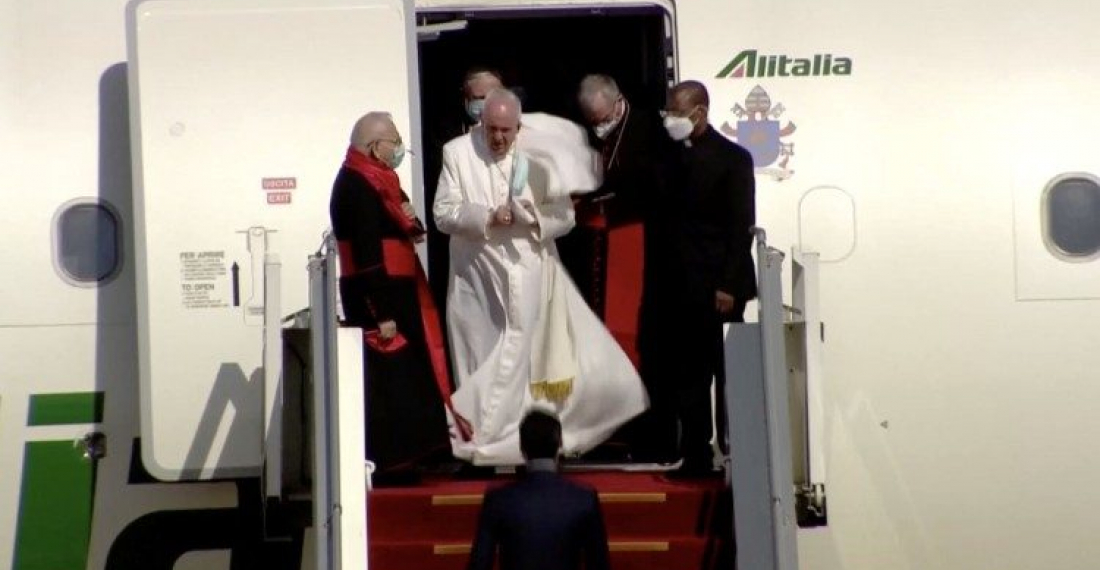
Pope Francis, leader of the Roman Catholic Church, has arrived in Iraq on a visit that is being described as both pastoral and official. Welcoming Pope Francis on the tarmac at Baghdad International Airport was a group of religious and political authorities representing the many different realities of Iraq's diverse make-up, as well as a group of Iraqi citizens and two children with a posy of flowers.
Pope Francis will spend four days in the Middle Eastern nation during which he will travel north and south as “a pilgrim seeking peace, fraternity and reconciliation”, as he himself has said.
His intense schedule foresees moments of prayer and encounter with Christian communities and representatives of the Catholic Church in Iraq, as well as meetings to foster interreligious dialogue.
As per protocol, the Pope’s first official meeting takes place at the Presidential Palace. During the courtesy visit he meets privately with President Barham Ahmed Salih Qassim.
Pope Francis, is visiting Iraq for the first time from 5-8 March. Previous Popes had intended to visit Iraq on a number of occasions in the last two decades, but their visits were postponed after the US invasion, its aftermath, and then the ISIS insurgency.
On the eve of his departure, Pope Francis said on Thursday that he is visiting Iraq as a "pilgrim led by peace" for "forgiveness and reconciliation after years of war and terror."
The Pope had expressed his hope that his visit would take place in the best possible way and achieve the desired results.
Tomorrow I will go to #Iraq for a three-day pilgrimage. I have long wanted to meet those people who have suffered so much. I ask you to accompany this apostolic journey with your prayers, so it may unfold in the best possible way and bear hoped-for fruits.
— Pope Francis (@Pontifex) March 4, 2021
The Vatican has said last month that the visit entails two main objectives, namely shedding light on what is described as the plight of Iraq's dwindling Christian population and promote interfaith dialogue.
Since the US invasion of Iraq in 2003, the number of Christians in the country has decreased from about 1.5 million to less than 400,000. Pope Francis had previously condemned what he called "fatal indifference" to the conditions of Christians in the Middle East.
Iraq is home of the world’s oldest Christian communities including Catholics, Protestants and Orthodox communities. Last year, the Iraqi Prime Minister, Mustafa Al-Kadhimi, urged Iraqi Christians to return to their country.
"Iraq is a country for everyone, and Christians are the original children of this country," al-Kadhimi said. "We are serious about providing assistance to our Christian families and solving their problems. We are happy for the Christians to return to Iraq and contribute to its reconstruction. Iraqis of all sects yearn for a new Iraq that believes in peace and rejects violence."
The extensive visit of the Pope is of enormous significance to Iraqi Christians. The presence of Francis in Baghdad Cathedral and his trip to Mosul and Erbil, home to the Christian community persecuted by ISIS, is a great comfort to them.
In light of recent and recurring attacks on Iraq, the security forces are tightening their measures. The Pope has insisted on his visit regardless of the situation which has been described by some media as a logistical nightmare.
The Pope will visit several landmarks and meet with key religious figures. The Pope is scheduled to deliver a speech from inside the Syriac Catholic Church Sayedat al-Najat ("Our Lady of Salvation"), which was the site of the infamous 2010 Baghdad church massacre by the Islamic state of Iraq. He will visit Najaf, a major spiritual hub for Shiites across the world, and will meet the Shiite marja’, Grand Ayatollah Ali al-Sistani. He is visiting the ancient city of Ur, the birthplace of Abraham and Mosul, which was captured by ISIS. The Pope will also hold a mass in Erbil, capital of the Kurdistan region of Iraq, where a large number of Christians have taken refuge after ISIS attacks on their towns and villages
Ayatollah Al-Sistani is a main Shiite marja’ from an Iranian origin. Marja’ (meaning "source to follow" or "religious reference"), is a title given to the highest level of Twelver Shia judicial authority. They are given the authority to make legal decisions within the confines of Islamic law for followers and lower-ranking clerics. Al-Sistani is ninety years of age and is described as the leading spiritual leader of Iraqi Shia Muslims. He rarely appears in public or meets officials but in the last month, the Vatican has secured a meeting between him and Pope Francis. The Pope will discuss with Al-Sistani, the issues of limiting extremism, rejecting hatred, spreading peace values and supporting the residents of the liberated areas.
In Erbil, a stadium with the capacity of 30 thousand was chosen as a mass location despite the coronavirus pandemic as it is located nearby one of the Middle East’s largest Christian community. Around ten thousand are expected to show up at the mass where necessary precautions against the coronavirus will be taken.
The Iraqi Minister of Culture, Tourism and Antiquities, Hassan Nazim, affirmed that the Pope’s visit to Iraq gives an indication of tolerance and love, and pointed out that the Pope’s meeting with Sistani is the culmination of a global movement with dialogue.
Pope Francis focuses on the importance of international agreements "that allow the consolidation of mutual trust relations and pave the way for the Church to cooperate in the interest of spiritual and social prosperity in various countries," as stated on the Vatican website.
Two years ago, Pope Francis signed a fraternity and peace declaration with the Imam of Al-Azhar, Sheikh Ahmed Al-Tayeb.