Pashinyan raises concerns about Eurasian Economic Union

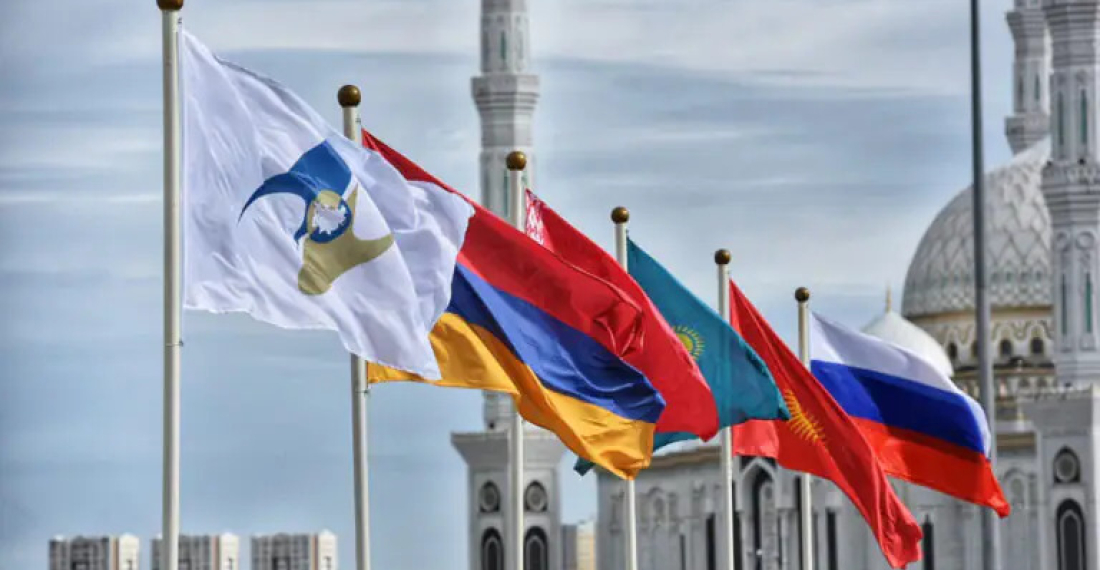
Armenian Prime Minister Nikol Pashinyan raised concerns over the Russia-led Eurasian Economic Union (EAEU) during a press briefing on Thursday (25 June), amid restrictions affecting Armenian goods in the bloc’s market.

Pashinyan said Armenia would continue to work with the EAEU and did not believe that “anything irreversible” had happened, or that Armenia should abandon cooperation with the bloc.

“We will work very actively. I am confident we will find solutions. If we cannot find solutions, that means something entirely different, first and foremost for the Eurasian Economic Union,” Pashinyan said. “The EAEU rests on several fundamental principles: the free movement of labour, goods, services and capital. If those principles do not exist, then the Eurasian Economic Union does not exist.”

He added that temporary disruption could be understandable, but warned that a prolonged failure to resolve the issue would call the bloc’s existence into question.

“The problem may last for one month, two months or three months. But if it remains unresolved in the fourth month, that means the EAEU does not exist,” he said. “If the EAEU itself says it does not exist, what are we supposed to do then?”

While trade between EAEU member states remains limited for a free trade bloc, and the economic impact of a potential Armenian exit would likely be modest for the bloc as a whole, Moscow’s response has underlined the EAEU’s political significance.

Earlier this month, Russian President Vladimir Putin has called for Armenia to hold a referendum to decide between continued membership of the EAEU and closer integration with the European Union.

Source: commonspace.eu with JAMnews and Jamestown
Related articles

Editor's choice
News
Armenian and Azerbaijani officials seek to defuse tension

Armenian and Azerbaijani officials seek to defuse tension

Armenian and Azerbaijani senior officials have moved to reduce tensions that erupted following an outcry in Armenia after a visit by foreign diplomats to Karabakh and surrounding regions, and a subsequent reaction in Azerbaijan. Armenia’s Security Council Secretary Alen Simonyan has said that following the events that took place at Gandzasar Monastery, he spoke by phone with Azerbaijani President Ilham Aliyev’s Assistant Hikmet Hajiyev. Responding to a question about whether he plans to publicly respond to Hajiyev’s statements regarding Gandzasar, Simonyan said at a press briefing that not all statements necessarily need to receive a public response. “I think everything has been said, and not everything that is said always needs a response. We need to realize whether this will change something or not. I can say something sharp now, respond in some way, we can all feel good for 15 minutes, but by doing so I could harm the negotiations,” Simonyan said. He stressed that the peace process requires a cautious approach. (click image to read more)

Popular

Editor's choice
Interview
Thursday Interview: Murad Muradov

Thursday Interview: Murad Muradov

Today, commonspace.eu starts a new regular weekly series. THURSDAY INTERVIEW, conducted by Lauri Nikulainen, will host  persons who are thinkers, opinion shapers, and implementors in their countries and spheres. We start the series with an interview with Murad Muradov, a leading person in Azerbaijan's think tank community. He is also the first co-chair of the Action Committee for a new Armenian-Azerbaijani Dialogue. Last September he made history by being the first Azerbaijani civil society activist to visit Armenia after the 44 day war, and the start of the peace process. Speaking about this visit Murad Muradov said: "My experience was largely positive. My negative expectations luckily didn’t play out. The discussions were respectful, the panel format bringing together experts from Armenia, Azerbaijan, and Turkey was particularly valuable during the NATO Rose-Roth Seminar in Yerevan, and media coverage, while varied in tone, remained largely constructive. Some media outlets though attempted to represent me as more of a government mouthpiece than an independent expert, which was totally misleading.  Overall, I see these initiatives as important steps in rebuilding trust and normalising professional engagement. The fact that soon a larger Azerbaijani civil society visits to Armenia followed, reinforces the sense that this process is moving in the right direction." (click the image to read the interview in full)