Netanyahu considering seizing all of Gaza strip

Israeli Prime Minister Benjamin Netanyahu is contemplating a complete military takeover of Gaza for the first time in two decades, media reported, and was to meet senior security officials on Tuesday 5 August to finalize a new strategy in the 22-month war. It was unclear, however, whether Netanyahu was foreseeing a prolonged occupation or a short-term operation aimed at dismantling Hamas and freeing Israeli hostages. Mediation between Israel and Palestinian militant group Hamas has collapsed despite intense international pressure for a ceasefire to ease hunger and appalling conditions in the besieged Palestinian enclave.

Eight more people died of starvation or malnutrition between Monday and Tuesday, Gaza’s health ministry said, while another 79 died in the latest Israeli fire. Netanyahu was to meet Defense Minister Israel Katz and military Chief of Staff Eyal Zamir to decide on a strategy to take to cabinet later this week, an Israeli official told Reuters. Strategic Affairs Minister Rob Dermer, a confidant of Netanyahu, will also be present.

Israel’s Channel 12, citing an official from Netanyahu’s office, said the prime minister was leaning toward taking control of the entire territory. That would reverse a 2005 decision to pull settlers and military out of Gaza while retaining control over its borders, a move right-wing parties blame for Hamas gaining power there.

A Palestinian official said it may be a tactic to pressure Hamas into concessions, while the Palestinian Foreign Ministry urged foreign nations to take heed of the reports. “The ministry urges countries and the international community to treat these leaks with utmost seriousness and to intervene urgently to prevent their implementation, whether these leaks are meant to exert pressure, test international reactions, or are genuine and serious,” it said.

Israel’s coalition government, the most right-wing and religiously conservative in its history, includes far-right politicians who advocate for the annexation of both Gaza and the West Bank and encourage Palestinians to leave their homeland.

Nearly two years of fighting in Gaza has strained the military, which has a small standing army and has had to repeatedly mobilise reservists. It has throughout the war pushed back against the idea of Israel fully occupying Gaza and establishing military rule.

In a sign of differences between some members of Israel’s ruling coalition and the military, far-right National Security Minister Itamar Ben Gvir on X challenged military head Zamir to state he would comply with government directives even if a decision was made to take all of Gaza.

Foreign Minister Gideon Saar then said the military chief must give his professional opinion, while Defense Minister Katz weighed in to say the military would professionally implement whatever policy the government set. “Defeating Hamas in Gaza, while creating the conditions for the return of the hostages, are the central goals of the war in Gaza, and we must take all necessary actions to achieve them,” Katz said.

The war was triggered when Hamas-led militants on October 7, 2023, attacked Israel, killing around 1,200 people, mostly civilians, and capturing 251 hostages, taking them into Gaza. Israel’s military response has devastated the tiny, crowded enclave, killing more than 61,000 people, mostly civilians, according to Palestinian health authorities.

Israel’s campaign has forced nearly all of Gaza’s over 2 million people from their homes and caused what a global hunger monitor called last week an unfolding famine. Some 188 Palestinians, including 94 children, have died from hunger since the war began, according to Gaza authorities.

An Israeli security official, in a briefing to reporters, acknowledged there may be hunger in some parts of Gaza but rejected reports of famine or starvation. International anger at the suffering in Gaza has prompted several countries to recognize or announce their intention to recognize Palestine as an independent state.

On Tuesday 5 August, Israeli tanks pushed into central Gaza but it was not clear if the move was part of a larger ground offensive. Palestinians living in the last quarter of territory where Israel has not yet taken military control, via ground incursions or orders for civilians to leave, said any new push would be catastrophic. “If the tanks pushed through, where would we go, into the sea? This will be like a death sentence to the entire population,” said Abu Jehad, a Gaza wood merchant, quoted by Reuters.

The failed mediation in Doha had aimed to clinch agreements on a US-backed proposal for a 60-day truce, during which aid would be flown into Gaza and half of the hostages Hamas is holding would be freed in exchange for Palestinian prisoners in Israel. 

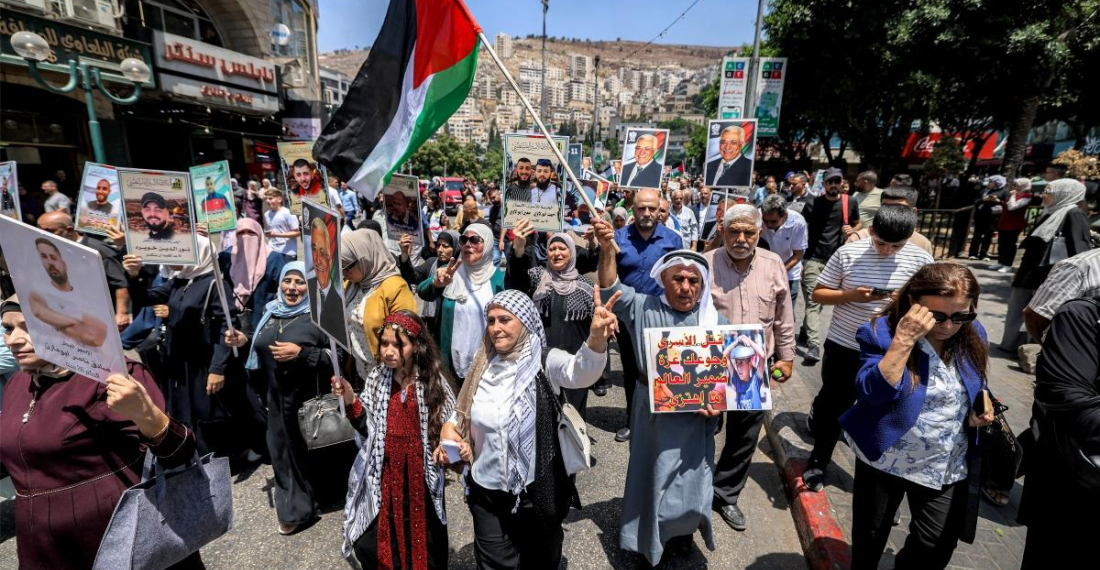
Source: commonspace.eu with Reuters, Arab News, Channel 12 and agencies. Photo: Demonstrators march in a protest in solidarity with the people of the Gaza Strip and Palestinian detainees in protests Sunday 3 August/JAAFAR ASHTIYEH / AFP

Related articles

Editor's choice
News
Borrell tells the European Parliament that the situation in Afghanistan was critical, but the EU will remain engaged

Borrell tells the European Parliament that the situation in Afghanistan was critical, but the EU will remain engaged

Borrell underlined that the European Union will make every effort to support the peace process and to remain a committed partner to the Afghan people. "Of course, we will have to take into account the evolving situation, but disengagement is not an option.  We are clear on that: there is no alternative to a negotiated political settlement, through inclusive peace talks.
Editor's choice
News
NATO Chief says war is on Europe's doorstep, and warns against complacency

NATO Chief says war is on Europe's doorstep, and warns against complacency

Russia could attack a Nato country within the next five years, the Secretary General of NATO, Mark Rutte, said in a stark new warning. "Nato's own defences can hold for now," Rutte warned in Berlin, but conflict was "next door" to Europe and he feared "too many are quietly complacent, and too many don't feel the urgency, too many believe that time is on our side. "Russia is already escalating its covert campaign against our societies," Rutte said in a speech in Germany. "We must be prepared for the scale of war our grandparents or great-grandparents endured." Earlier this month, Russia's President Vladimir Putin said his country was not planning to go to war with Europe, but it was ready "right now" if Europe wanted to - or started a war. But similar reassurances were given by Moscow in 2022, just before 200,000 Russian troops crossed the border and invaded Ukraine. Putin has accused European countries of hindering US efforts to bring peace in Ukraine - a reference to the role Ukraine's European allies have recently played in trying to change a US peace plan to end the war, whose initial draft was seen as favouring Russia. But Putin was not sincere, Nato's secretary-general said in the German capital, Berlin. Supporting Ukraine, he added, was a guarantee for European security. "Just imagine if Putin got his way; Ukraine under the boot of Russian occupation, his forces pressing against a longer border with Nato, and the significantly increased risk of an armed attack against us." Russia's economy has been on a war footing for more than three years now - its factories churn out ever more supplies of drones, missiles and artillery shells. According to a recent report by the Kiel Institute for the World Economy, Russia has been producing each month around 150 tanks, 550 infantry fighting vehicles, 120 Lancet drones and more than 50 artillery pieces. The UK, and most of its Western allies, are simply not anywhere near this point. Analysts say it would take years for Western Europe's factories to come close to matching Russia's mass-production of weapons. "Allied defence spending and production must rise rapidly, our armed forces must have what they need to keep us safe," the Nato chief said.

Popular

Editor's choice
News
NATO Chief says war is on Europe's doorstep, and warns against complacency

NATO Chief says war is on Europe's doorstep, and warns against complacency

Russia could attack a Nato country within the next five years, the Secretary General of NATO, Mark Rutte, said in a stark new warning. "Nato's own defences can hold for now," Rutte warned in Berlin, but conflict was "next door" to Europe and he feared "too many are quietly complacent, and too many don't feel the urgency, too many believe that time is on our side. "Russia is already escalating its covert campaign against our societies," Rutte said in a speech in Germany. "We must be prepared for the scale of war our grandparents or great-grandparents endured." Earlier this month, Russia's President Vladimir Putin said his country was not planning to go to war with Europe, but it was ready "right now" if Europe wanted to - or started a war. But similar reassurances were given by Moscow in 2022, just before 200,000 Russian troops crossed the border and invaded Ukraine. Putin has accused European countries of hindering US efforts to bring peace in Ukraine - a reference to the role Ukraine's European allies have recently played in trying to change a US peace plan to end the war, whose initial draft was seen as favouring Russia. But Putin was not sincere, Nato's secretary-general said in the German capital, Berlin. Supporting Ukraine, he added, was a guarantee for European security. "Just imagine if Putin got his way; Ukraine under the boot of Russian occupation, his forces pressing against a longer border with Nato, and the significantly increased risk of an armed attack against us." Russia's economy has been on a war footing for more than three years now - its factories churn out ever more supplies of drones, missiles and artillery shells. According to a recent report by the Kiel Institute for the World Economy, Russia has been producing each month around 150 tanks, 550 infantry fighting vehicles, 120 Lancet drones and more than 50 artillery pieces. The UK, and most of its Western allies, are simply not anywhere near this point. Analysts say it would take years for Western Europe's factories to come close to matching Russia's mass-production of weapons. "Allied defence spending and production must rise rapidly, our armed forces must have what they need to keep us safe," the Nato chief said.