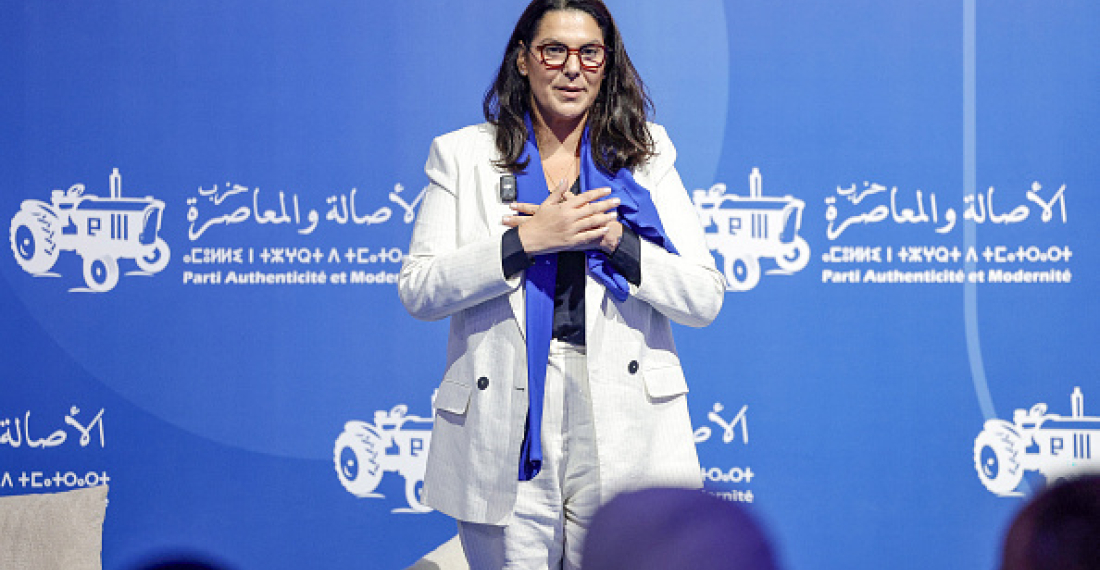
Parliamentary elections were held in Morocco on 23 rd September, and as a result the country is on the verge of appointing its first female prime minister after Fatima Ezzahra El Mansouri's party emerged victorious in parliamentary elections, putting the prominent politician among the leading contenders to head the next government.
The Authenticity and Modernity Party (PAM) won 97 seats in Wednesday’s election, according to preliminary results announced by the interior ministry, making it the largest party in Morocco's 395-seat House of Representatives.
It finished ahead of its outgoing coalition partners, the National Rally of Independents (RNI), which secured 66 seats, and the Istiqlal Party with 65.
The result has turned attention to Mansouri, one of Morocco’s most prominent female politicians and a leading figure in PAM.
If King Mohammed VI appoints her to lead the next government, the 50-year-old would become the first woman to serve as prime minister and only the second woman to head a government in the Arab world, after Tunisia's Najla Bouden.
Under Article 47 of the constitution, the king appoints the head of government from the political party that comes first in elections to the House of Representatives.
That means the next prime minister should come from PAM, but it does not automatically mean the job goes to the party’s leader.
Mansouri is among the names being discussed for the post, alongside other senior PAM figures.
One potential rival is Fouzi Lekjaa, Morocco’s budget minister and president of the Royal Moroccan Football Federation, who joined PAM ahead of the election.
Another name floated in Moroccan media is Mohamed Mehdi Bensaid, who served as youth, culture and communications minister in the outgoing government.
The decision ultimately rests with King Mohammed VI.
PAM will also have to negotiate a coalition after falling well short of the 198 seats needed for an outright parliamentary majority.
Its outgoing coalition partners could provide the numbers. PAM, the RNI and Istiqlal together secured 228 seats according to the preliminary results, although the shape of the next governing coalition has yet to be determined.
Who is Azzahra El Mansouri?
Born in Marrakech in 1976, Mansouri trained as a lawyer before entering politics following PAM's establishment in 2008.
She rose to national prominence the following year when she became mayor of Marrakech, the first woman to hold the position.
Mansouri returned to the mayoralty following the 2021 elections and was appointed minister of national territorial planning, urban planning, housing and city policy in the government of outgoing Prime Minister Aziz Akhannouch.
She further strengthened her position within PAM in 2024 when she took a leading role in the party's collective leadership.
Her party's victory has now placed her within reach of Morocco’s most senior government post.
Mansouri has sought to present herself as a politician whose career has been built through party politics and local government rather than her gender.
She has also rejected descriptions of herself as an "iron woman", previously describing herself instead as a “free activist”.
PAM emerged as the largest party with 97 seats, gaining 10 compared with the previous parliament.
The RNI, which led the outgoing government, fell to 66 seats, while Istiqlal secured 65.
The Islamist Justice and Development Party (PJD) staged one of the election's biggest comebacks, winning 54 seats after securing just 13 in the 2021 election.
The PJD had led Morocco's government for a decade before suffering a dramatic electoral collapse five years ago.
Its campaign this year included strong opposition to Morocco’s deepening ties with Israel, an issue that has generated considerable public anger since the start of Israel’s war on Gaza.
Morocco normalised relations with Israel in 2020 as part of the US-brokered Abraham Accords, when the PJD itself was leading the government.
The election also took place against a backdrop of economic and social discontent, including high youth unemployment and the aftermath of Gen Z-led protests.
Turnout stood at just 38 percent, the lowest level recorded in a Morroccan Parliamentary Election since 2007.
source: commonspace.eu with New Arab (London) and agencies.