


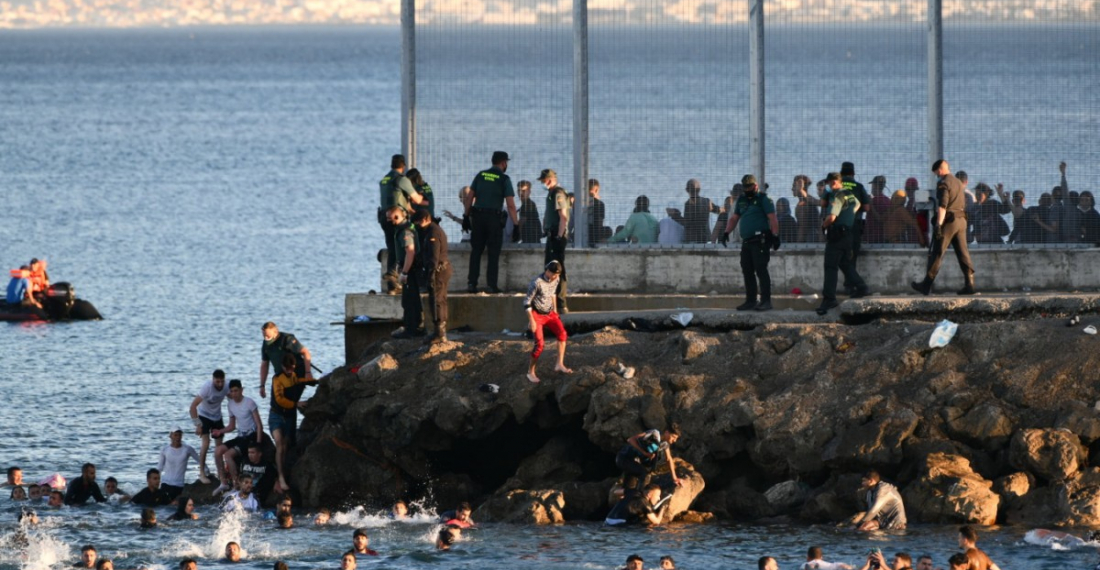
Morocco allows thousands of migrants to swim to the Spanish enclave of Ceuta

The town of Ceuta, together with its sister town Mellila a bit further down the Mediterranean coast, is an anachronism. Whilst situated on the African continent the towns are recognised as being fully part of Spain – a colonial hang-over that has taken a life of its own. The enclaves were once considered of strategic importance for the defence of Spain. They have now become springboards for illegal migration into Europe.

Yesterday, 5,000 arrived, taking the authorities by surprise. They say the migrants – who include hundreds of minors – either swam around the border fences that jut out into the sea or walked across at low tide.

They are said to be mostly from Morocco. Spanish media says Moroccan border guards did not stop them.

Early reports on Monday said more than 100 people had come overnight around the coast at Benzu on the north side of Ceuta, followed by some at Tarajal on the south side.

Most were said to be young men, but the group also included children and several families. Many had used inflatable rings and rubber dinghies, authorities added.

They were taken to a migrant reception centre. But as more turned up later in the day, officials said the number had risen to 5,000 - an unprecedented figure which they warned could rise further.

The Spanish foreign minister, Arancha González Laya, said some migrants were already being sent back to Morocco.

According to the BBC, last month more than 100 migrants arrived in Tarajal. Most of them were sent back, except about 30 minors whose ages were confirmed by medical tests.

The arrivals come at a tense time in Morocco's relations with Spain. Morocco is angry that the leader of the Polisario Front, Brahim Ghali, has been receiving treatment in a Spanish hospital.

Read more on commonspace.eu: Polisario leader summoned by Spanish Court

Polisario has been fighting for the independence of Western Sahara for decades. The territory was occupied by Spain until 1975, when Morocco took control of most of it.

The EU border force, Frontex, reports that illegal migration to Spain's Canary Islands – off the Moroccan coast – has surged this year. In most cases, sub-Saharan Africans make perilous journeys in rickety boats and drowning is common.

However, the overall numbers of undocumented migrants reaching Europe so far this year remain far below the levels seen in 2015-16.


Source: commonspace.eu with agencies
Photo: Migrants swimming to Ceuta on 17 May 2021.

 

Related articles

Editor's choice
News
STC announces two year transitional period and referendum ahead of self-determination for South Yemen

STC announces two year transitional period and referendum ahead of self-determination for South Yemen

Tensions remain high in South Yemen, one week after an unprecedented rift between Saudi Arabia and UAE, as a result of which UAE withdrew its forces from Yemen. On Friday (2 January), the UAE backed Southern Transitional Council (STC), an umbrella of groups in the South, announced a two-year transition period leading to a popular referendum and self-determination for the South. The announcement came after political tensions spiraled into clashes on the ground as Hadhramaut's governor, backed by the Presidential Leadership Council (PLC) chief, launched a military operation to retake STC-held positions. The STC said the transitional period would be used to agree “a clear path and mechanisms that guarantee the right of the southern people within a defined time frame”. Its statement added that the process would include a referendum regulating the exercise of the southern people’s right to self-determination, through peaceful and transparent mechanisms consistent with recognised international rules and practices, and with the participation of international observers,” the STC said. It said the move was based on a popular mandate and growing risks facing the political partnership in Yemen, warning that failure to address southern demands could lead to further instability. The STC also called on the international community to play a direct role in overseeing dialogue between the parties “south and north” to ensure the process remains peaceful and time-bound. STC Vice President Ahmed bin Breik responded by called for a “general mobilisation of the southern people” to confront what he described as a “coming invasion”. Hours later, a spokesman for forces within the STC said “brave fighters of southern armed forces succeeded in repelling a large-scale attack”. It was not immediately clear where the attack took place or whether it resulted in casualties. The Hadhramaut governor, who has been out overall in charge of coalition forces in the region, later said that forces took control of the camp of the 37th Brigade, the largest in the province. It is also understood that Saudi Naval Forces have been active in the Arabian Sea. The STC, which seeks the restoration of an independent South Yemen, took control of Hadhramaut and Mahra from other pro-government forces, effectively consolidating its grip over all southern governorates. It said the developments followed the failure of other pro-government factions to launch a serious campaign against the Houthis in their northern strongholds, including the capital, Sanaa. Saudi Arabia, which hosts senior Yemeni government and PLC figures, condemned the STC’s takeover. The kingdom has led the anti-Houthi alliance since 2015, with the UAE playing a key role in the south Tensions took an unprecedented turn this week, marked by a Saudi strike on Emirati armoured vehicles in the southern port of Mukalla. In the meantime, Saudi Arabia’s foreign ministry has invited factions in south Yemen to hold a dialogue in Riyadh to “discuss just solutions to the southern cause.” The ministry statement said the conference in the Saudi capital had been requested by Rashad Al-Alimi, President of the Yemeni Presidential Leadership Council, and the Kingdom urged all factions to participate “to develop a comprehensive vision” that would fulfill the aspirations of the southern people.  

Popular

Editor's choice
News
STC announces two year transitional period and referendum ahead of self-determination for South Yemen

STC announces two year transitional period and referendum ahead of self-determination for South Yemen

Tensions remain high in South Yemen, one week after an unprecedented rift between Saudi Arabia and UAE, as a result of which UAE withdrew its forces from Yemen. On Friday (2 January), the UAE backed Southern Transitional Council (STC), an umbrella of groups in the South, announced a two-year transition period leading to a popular referendum and self-determination for the South. The announcement came after political tensions spiraled into clashes on the ground as Hadhramaut's governor, backed by the Presidential Leadership Council (PLC) chief, launched a military operation to retake STC-held positions. The STC said the transitional period would be used to agree “a clear path and mechanisms that guarantee the right of the southern people within a defined time frame”. Its statement added that the process would include a referendum regulating the exercise of the southern people’s right to self-determination, through peaceful and transparent mechanisms consistent with recognised international rules and practices, and with the participation of international observers,” the STC said. It said the move was based on a popular mandate and growing risks facing the political partnership in Yemen, warning that failure to address southern demands could lead to further instability. The STC also called on the international community to play a direct role in overseeing dialogue between the parties “south and north” to ensure the process remains peaceful and time-bound. STC Vice President Ahmed bin Breik responded by called for a “general mobilisation of the southern people” to confront what he described as a “coming invasion”. Hours later, a spokesman for forces within the STC said “brave fighters of southern armed forces succeeded in repelling a large-scale attack”. It was not immediately clear where the attack took place or whether it resulted in casualties. The Hadhramaut governor, who has been out overall in charge of coalition forces in the region, later said that forces took control of the camp of the 37th Brigade, the largest in the province. It is also understood that Saudi Naval Forces have been active in the Arabian Sea. The STC, which seeks the restoration of an independent South Yemen, took control of Hadhramaut and Mahra from other pro-government forces, effectively consolidating its grip over all southern governorates. It said the developments followed the failure of other pro-government factions to launch a serious campaign against the Houthis in their northern strongholds, including the capital, Sanaa. Saudi Arabia, which hosts senior Yemeni government and PLC figures, condemned the STC’s takeover. The kingdom has led the anti-Houthi alliance since 2015, with the UAE playing a key role in the south Tensions took an unprecedented turn this week, marked by a Saudi strike on Emirati armoured vehicles in the southern port of Mukalla. In the meantime, Saudi Arabia’s foreign ministry has invited factions in south Yemen to hold a dialogue in Riyadh to “discuss just solutions to the southern cause.” The ministry statement said the conference in the Saudi capital had been requested by Rashad Al-Alimi, President of the Yemeni Presidential Leadership Council, and the Kingdom urged all factions to participate “to develop a comprehensive vision” that would fulfill the aspirations of the southern people.


