


More than eight million people displaced in Sudan amid threat of widespread famine as a result of the ongoing conflict

Sudan is suffering one of the worst humanitarian crises in recent history after nearly a year of war, the United Nations has warned.

Fighting between the army, headed by General Abdel Fattah al-Burhan, and the paramilitary Rapid Support Forces (RSF), led by Mohamed Hamdan Dagalo, since last April has killed tens of thousands of people, as the threat of famine looms amid international inaction.

“By all measures – the sheer scale of humanitarian needs, the numbers of people displaced and facing hunger – Sudan is one of the worst humanitarian disasters in recent memory,” Edem Wosornu, director of operations at the UN Office for the Coordination for Humanitarian Affairs (OCHA), said on Wednesday (20 March).

“A humanitarian travesty is playing out in Sudan under a veil of international inattention and inaction,” Wosornu told the UN Security Council on behalf of OCHA head Martin Griffiths.

According to the UN, the conflict has led to more than eight million people being displaced.

In early March, the Security Council called for an immediate ceasefire during Ramadan and urged better access to humanitarian aid. However, the ceasefire was not realised due to disagreements between the warring sides.

More than 18 million Sudanese are facing acute food insecurity – 10 million more than at this time last year – while 730,000 Sudanese children are believed to be suffering from severe malnutrition.

Griffiths warned the Security Council last week that “almost five million people could slip into catastrophic food insecurity in some parts of the country in the coming months”.

The deputy executive director of the UN World Food Programme (WFP), Carl Skau, also said on Wednesday, “If we are going to prevent Sudan from becoming the world’s largest hunger crisis, coordinated efforts and joined-up diplomacy is urgent and critical.”

The meeting of the UN Security Council was held after OCHA submitted a "white note" in accordance with resolution 2417 of 24 May 2018, which requested the Secretary-General to report swiftly when “the risk of conflict-induced famine and wide-spread food insecurity” occurs. Over the last 11 months, Sudan has been grappling with the devastating humanitarian consequences of fighting that erupted on 15 April 2023 between the Sudanese Armed Forces (SAF), headed by General Abdel Fattah al-Burhan, Sudan’s military leader and chairperson of the Transitional Sovereignty Council, and the Rapid Support Forces (RSF), a paramilitary group led by General Mohamed Hamdan Dagalo (known as Hemeti). As at 15 March, more than 14,790 people had reportedly been killed since the onset of the conflict, according to the  Armed Conflict Event and Data Centre (ACLED), a non-governmental organisation (NGO) that collects conflict-related data.

The OCHA white note says that nearly 18 million people across Sudan are currently facing acute food insecurity, described by the Integrated Food Security Phase Classification (IPC)—used by relief agencies to measure hunger levels—as crisis level conditions or worse (IPC Phase 3 or above). This is the highest recorded share of people facing this level of food insecurity during Sudan’s harvest season (October to February). Of this total, five million people are currently experiencing emergency levels of food insecurity (IPC Phase 4), some of whom may face catastrophic conditions (IPC Phase 5) over the coming months, particularly in West and Central Darfur, according to the white note. Referring to the IPC’s December 2023 projection, the note says that the most highly food insecure populations in Sudan have been identified in areas where conflict has been particularly intense, including in Al Jazirah, Darfur, Khartoum, and Kordofan.

The white note further points out that vulnerable groups—including women, children, and internally displaced persons (IDPs)—remain at particular risk. It notes that approximately 730,000 children in Sudan, including over 240,000 in Darfur, are projected to suffer from severe acute malnutrition, the most severe form of childhood malnutrition. Conditions are especially dire in hard-to-reach areas, which host nearly three quarters of the country’s 4.7 million acutely malnourished children and pregnant or breastfeeding women in urgent need of support, according to the white note.

source: commonspace.eu with Al Jazeera (Doha), Security Council Report (New York) and agencies
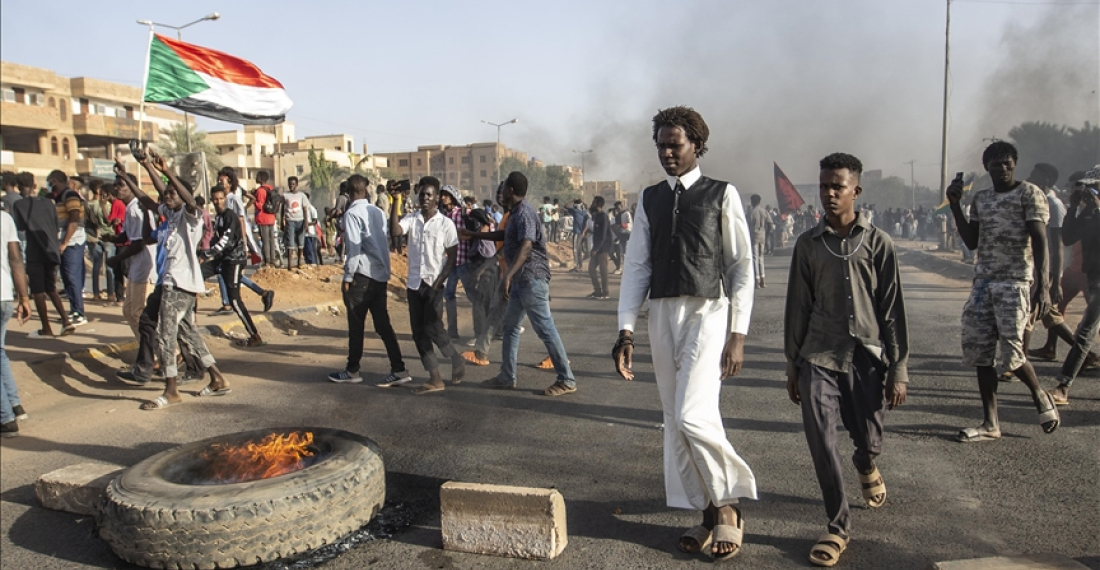
photo: Protesters burn tires as they protest against framework agreement signed between the military and civilians, which aims to resolve the governance crisis that has been going on since 25 October 2021 in Khartoum, Sudan on April 06, 2023 (picture courtesy of Anadolou Agency, Ankara).

Related articles

Editor's choice
News
UAE says it will withdraw from Yemen, but division emerges in Yemeni presidential council

UAE says it will withdraw from Yemen, but division emerges in Yemeni presidential council

In a move seen as an attempt to de-escalate a crises with Saudi Arabia, the United Arab Emirates, on Tuesday (30th December) announced that it was heeding a call to withdraw its troops from Southern Yemen. UAE says that its presence included counter-terrorism teams that were crucial in fighting against Islamist groups. UAE sources said that parts of Yemen not controlled by the Houthis have had Al Qaeda in the Arab Peninsula (AQAP) operatives using the territory to launch attacks on Europe, the US and Middle East. UAE teams have co-ordinated with American and British special forces and intelligence. The sources added that Emirati forces and their Yemeni allies also helped reverse Houthi gains in the south. including the liberation of Aden port. The small UAE contingent has remained in place since the UAE withdrew most of its military personnel in 2019. The leading English-language newspaper in Abu Dhabi, The National, said that the main UAE force was based at Riyan Mukalla International Airport, with access to fixed-wing aircraft and helicopters, but also operated smaller contingents in the port town Balhaf and Shabwa. "It is understood it also flew a number of drones from the airbase that were able to track terrorist movements, pass information back to its allies and assisted special forces' missions." Meanwhile a division has emerged in Yemen's presidential council after four members denounced what they called the 'unilateral decisions' by the chairman. Four of Yemen’s eight Presidential Leadership Council members on Tuesday denounced an announcement by the council’s chairman accusing him of breaching the governing agreement. Tension between Yemeni leaders has been rising for weeks, underscoring the fragility of the country's already fractured political landscape and further complicating efforts to confront the Iran-backed Houthi rebels. The latest rift took an unprecedented turn on Tuesday morning, marked by a Saudi-led coalition “limited operation” striking combat vehicles Riyadh linked to the Southern Transitional Council, which has three members in the PLC. The PLC Chairman, Rashad al Alimi, on Tuesday said that he was seeking to cancel the joint defence agreement with the UAE. “What has been issued … constitutes a clear violation of the Declaration of the Transfer of Power [agreement], which explicitly stipulates that the Presidential Leadership Council is a collective body whose decisions are taken by consensus, or by majority when consensus is not possible,” the statement by the four members said. “It does not, under any circumstances, allow for unilateral decision-making on sovereign, military, or major political matters." The statement was signed by STC chief Aidarous Al Zubaidi, Faraj Al Bahsani, Tariq Saleh and Abu Zaraa al Muharrami. (click the picture to read the full article).

Popular

Editor's choice
News
UAE says it will withdraw from Yemen, but division emerges in Yemeni presidential council

UAE says it will withdraw from Yemen, but division emerges in Yemeni presidential council

In a move seen as an attempt to de-escalate a crises with Saudi Arabia, the United Arab Emirates, on Tuesday (30th December) announced that it was heeding a call to withdraw its troops from Southern Yemen. UAE says that its presence included counter-terrorism teams that were crucial in fighting against Islamist groups. UAE sources said that parts of Yemen not controlled by the Houthis have had Al Qaeda in the Arab Peninsula (AQAP) operatives using the territory to launch attacks on Europe, the US and Middle East. UAE teams have co-ordinated with American and British special forces and intelligence. The sources added that Emirati forces and their Yemeni allies also helped reverse Houthi gains in the south. including the liberation of Aden port. The small UAE contingent has remained in place since the UAE withdrew most of its military personnel in 2019. The leading English-language newspaper in Abu Dhabi, The National, said that the main UAE force was based at Riyan Mukalla International Airport, with access to fixed-wing aircraft and helicopters, but also operated smaller contingents in the port town Balhaf and Shabwa. "It is understood it also flew a number of drones from the airbase that were able to track terrorist movements, pass information back to its allies and assisted special forces' missions." Meanwhile a division has emerged in Yemen's presidential council after four members denounced what they called the 'unilateral decisions' by the chairman. Four of Yemen’s eight Presidential Leadership Council members on Tuesday denounced an announcement by the council’s chairman accusing him of breaching the governing agreement. Tension between Yemeni leaders has been rising for weeks, underscoring the fragility of the country's already fractured political landscape and further complicating efforts to confront the Iran-backed Houthi rebels. The latest rift took an unprecedented turn on Tuesday morning, marked by a Saudi-led coalition “limited operation” striking combat vehicles Riyadh linked to the Southern Transitional Council, which has three members in the PLC. The PLC Chairman, Rashad al Alimi, on Tuesday said that he was seeking to cancel the joint defence agreement with the UAE. “What has been issued … constitutes a clear violation of the Declaration of the Transfer of Power [agreement], which explicitly stipulates that the Presidential Leadership Council is a collective body whose decisions are taken by consensus, or by majority when consensus is not possible,” the statement by the four members said. “It does not, under any circumstances, allow for unilateral decision-making on sovereign, military, or major political matters." The statement was signed by STC chief Aidarous Al Zubaidi, Faraj Al Bahsani, Tariq Saleh and Abu Zaraa al Muharrami. (click the picture to read the full article).

