


Menu

Mark Carney’s Liberal Party wins Election in Canada: World Leaders React

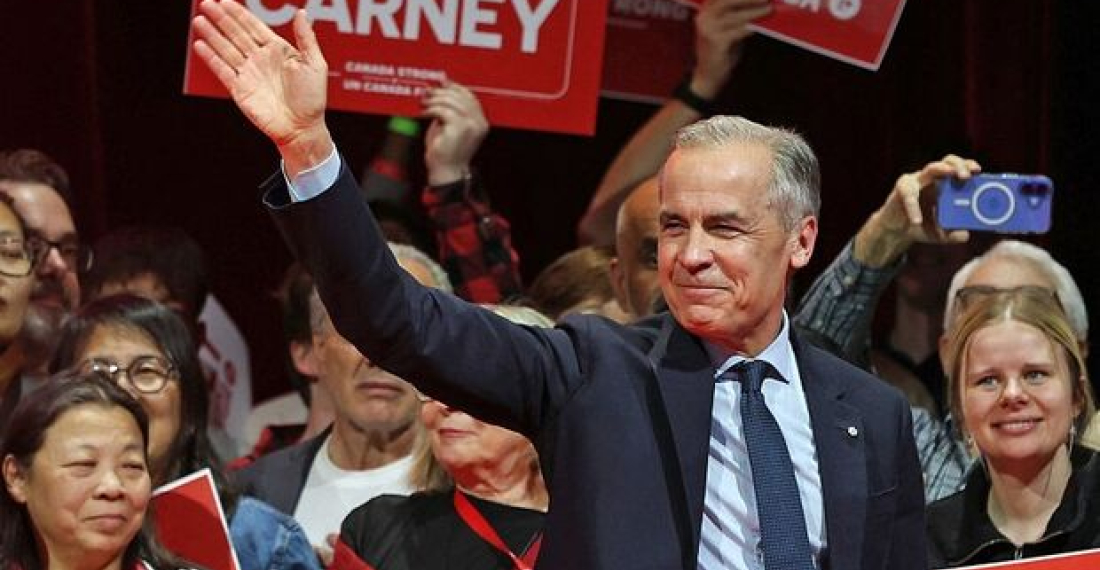
Prime Minister Mark Carney won Canada's election held on Monday, leading his Liberal Party to a new term in power after convincing voters his experience managing crises had prepared him to confront US President Donald Trump. The public broadcaster CBC and other outlets projected the Liberals would form Canada's next government, but it was not yet clear if they would hold a majority in parliament. 

Carney’s rival, populist Conservative Party leader Pierre Poilievre, was voted out of his seat in Parliament, the Canadian Broadcasting Corporation projected on Tuesday. The loss of his seat representing his Ottawa district capped a swift decline in fortunes for the firebrand Poilievre, who a few months ago appeared to be a shoo-in to become Canada’s next prime minister and shepherd the Conservatives back into power for the first time in a decade.

Carney, who had never held elected office and only replaced Justin Trudeau as prime minister last month, previously served as central bank governor in both Canada and Britain.  Trump's trade war and annexation threats outraged Canadians and made dealing with the United States a top campaign issue. 

Carney, a 60-year-old former investment banker, anchored his campaign on an anti-Trump message, promising to expand Canada's overseas trading relationships to curb reliance on the United States, a country he said "we can no longer trust."  Carney has described the threat of Trump in stark terms.  "Donald Trump wants to break us so America can own us," he said during the campaign.

"They want our resources, they want our water, they want our land, they want our country. They can't have it."  When the CBC projection was announced, cheers of joy erupted at the Ottawa venue where Liberal supporters were watching the results. 

Leaders around the world reacted to the election results in Canada:

European Council President Antonio Costa

He offered “warm congratulations, saying: “We share the same values, and attachment to the UN Charter and the rules-based international order.”

British Prime Minister Keir Starmer

“Congratulations to Mark Carney on your election victory. The UK and Canada are the closest of allies, partners and friends,” Starmer said. “I welcome your leadership on international issues, and I know we will continue to work closely on defence, security, trade and investment.”

French President Emmanuel Macron

“You embody a strong Canada in the face of the great challenges of our time,” Macron said in a social media post, referring to Carney. “France looks forward to further strengthening the friendship that binds our countries.”

NATO Secretary General Mark Rutte

“Canada is a valued member of NATO,” Rutte wrote on social media. “I look forward to working together to build an even stronger, fairer Alliance – investing more in defence and ramping up industrial production so we have what we need to stay safe.”

Dutch Prime Minister Dick Schoof

Schoof said he looks forward to continuing “the close cooperation” between Canada and the Netherlands and to welcoming Carney to the NATO Summit in The Hague in June.

Australian Prime Minister Anthony Albanese

“Congratulations to Prime Minister Mark Carney on your victory,” he said. “In a time of global uncertainty, I look forward to continuing to work with you to build on the enduring friendship between our nations, in the shared interests of all our citizens.”

Indian Prime Minister Narendra Modi

“India and Canada are bound by shared democratic values, a steadfast commitment to the rule of law, and vibrant people-to-people ties,” said Modi, whose country’s relations with Canada have been strained recently. “I look forward to working with you to strengthen our partnership and unlock greater opportunities for our people.”

China

China, another country with icy relations with Canada, said it is open to improving ties. “China is willing to develop China-Canada relations on the basis of mutual respect, equality, and mutual benefit,” Ministry of Foreign Affairs spokesman Guo Jiakun said

Source: commonspace.eu with agencies. Photo: AFP

 

Related articles

Editor's choice
News
Kazakhstan votes in referendum on important constitutional changes

Kazakhstan votes in referendum on important constitutional changes

Voting is taking place on Sunday (15 March)  in Kazakhstan in a nationwide referendum on a new draft Constitution. According to the Central Referendum Commission of Kazakhstan, 12,046,617 citizens are eligible to participate in the referendum. 359 international observers and 206 foreign journalists were accredited to monitor the referendum in order to ensure the transparency of the voting process. International organizations monitoring the referendum include the Organization for Security and Cooperation in Europe, the CIS, the Shanghai Cooperation Organization, the Organization of Turkic States, and the Organization of Islamic Cooperation. The Central Referendum Commission must announce the final results of the vote within seven days after the referendum. A total of 10,401 polling stations are operating inside and outside the country to organize voting. 71 of them were opened at diplomatic missions in 54 countries. If citizens support the proposed changes, the new Constitution will enter into force on July 1, 2026. After that, elections for a new parliament are planned in the country, and these elections are expected to be organized by the end of August. The position of vice president will be implemented after the formation of the new parliament. The referendum is the fifth in the history of independent Kazakhstan and may lead to the adoption of a new fundamental law that will determine the direction of the country's political and legal development in the coming years. The Referendum is being held at the initiative of the President of Kazakhstan Kassym-Jomart Tokayev and envisages the implementation of large-scale constitutional reforms in the country. According to the submitted draft, approximately 84 percent of the text of the Constitution has been updated and new articles and sections have been developed. The question on the ballot paper asks, "Do you accept the new Constitution of the Republic of Kazakhstan?" Voters express their position by answering "for" or "against" this question. Currently, the Constitution adopted on August 30, 1995, is in force in Kazakhstan. Since its adoption, the document has been repeatedly amended and supplemented. The latest amendments entered into force in September 2022. However, the scale of the proposed reforms necessitated the preparation of a new Constitutional document. Thus, the amendments cover approximately 84 percent of the text of the existing basic law. The draft of the new Constitution was presented to the public in early February 2026. After the document was published, the country's citizens were given more than a month to familiarize themselves with it and discuss the proposed changes. (Click the picture to read more)

Popular

Editor's choice
Interview
Thursday Interview: Murad Muradov

Thursday Interview: Murad Muradov

Today, commonspace.eu starts a new regular weekly series. THURSDAY INTERVIEW, conducted by Lauri Nikulainen, will host  persons who are thinkers, opinion shapers, and implementors in their countries and spheres. We start the series with an interview with Murad Muradov, a leading person in Azerbaijan's think tank community. He is also the first co-chair of the Action Committee for a new Armenian-Azerbaijani Dialogue. Last September he made history by being the first Azerbaijani civil society activist to visit Armenia after the 44 day war, and the start of the peace process. Speaking about this visit Murad Muradov said: "My experience was largely positive. My negative expectations luckily didn’t play out. The discussions were respectful, the panel format bringing together experts from Armenia, Azerbaijan, and Turkey was particularly valuable during the NATO Rose-Roth Seminar in Yerevan, and media coverage, while varied in tone, remained largely constructive. Some media outlets though attempted to represent me as more of a government mouthpiece than an independent expert, which was totally misleading.  Overall, I see these initiatives as important steps in rebuilding trust and normalising professional engagement. The fact that soon a larger Azerbaijani civil society visits to Armenia followed, reinforces the sense that this process is moving in the right direction." (click the image to read the interview in full)


