


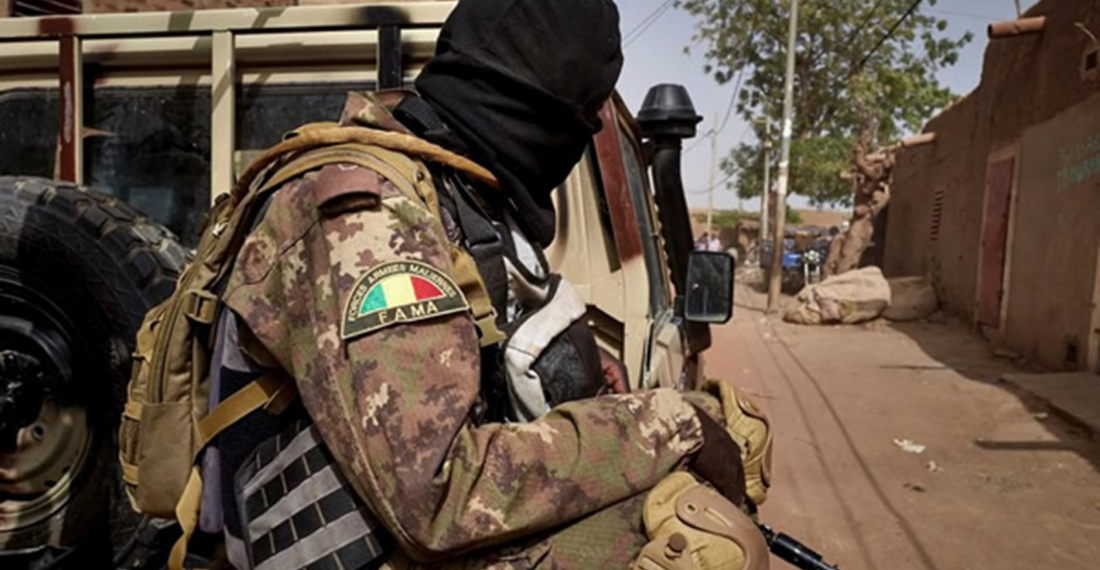
At least 27 dead in jihadist attack on Malian military base

A jihadist attack on a Malian army base in the centre of the country killed at least 27 soldiers and wounded 33 others on Friday, 4 March, according to the government. Following the deadliest attack in Mali for several months, a three-day national mourning period starting Saturday was announced by the government.

Three days after the attack on this military base in the rural town of Mondoro, numerous Malian soldiers are still reported missing.

The Malian army is said to have finally regained control of the military camp in the town of Mondoro, killing more than 70 terrorists. The importance of this camp stems from its equipment, as it contains armoured vehicles and various weapons.

The organisation of this jihadist operation is considered a classic pattern in the Sahel, but nevertheless described as "complex" in the official communiqué of the Malian army. The attackers, allegedly affiliated to Al-Qaeda or Islamic State, launched the attack from both the north and east of the town of Mondoro, as the military camp is located to the east of the town. Dozens of jihadists, some on motorbikes and others in booby-trapped vehicles, fired on the camp before the Malian air force intervened.

The Mondoro military base, located near the Malian border with Burkina Faso, had already been the target of a rebel attack, when 50 soldiers were killed at nearby Boulkessi camp in September 2019.

Mali and the Sahel region has been battling with an Islamist insurgency since al-Qaeda jihadists occupied northern Mali in 2012, forcing Bamako to seek help from former colonial power France to fend off the jihadist threat.

The military duo initially succeeded in pushing the terrorist threat out of the country in 2013, before the jihadists regrouped and took over parts of Mali, while expanding into Niger and Burkina Faso.

The terrorist threat has thus had a direct impact on the civilian population. According to the UN, internal displacement has increased tenfold since 2013, from 217,000 to a staggering 2.1 million by late 2021. Indeed, last year alone, armed groups carried out more than 800 deadly attacks.

France, Mali's main military ally for almost 10 years, announced last month that it would withdraw its forces from Mali after ties deteriorated following Paris' criticism of the military coup and the military's unwillingness to return the country to civilian rule.

Moreover, France and its European allies have protested against the presence of the Russian paramilitary group Wagner in Mali, presented by the West as “mercenaries”. Mali, which pays the Wagner group 10 million euros a month for its anti-terrorist assistance, considers the Russians as "instructors".

Tensions between the two blocs persist and have intensified since ECOWAS – the Economic Community of West African States - imposed heavy sanctions on the Malian government for delaying the transition plan.

 
Sources: CommonSpace.eu with RFI (Île-de-France), Reuters (London), Al Jazeera (Doha) and other media outlets
Picture: Mali: the army counter-attacks after the Mondoro attack; Twitter: @LeJDAfrique

Related articles

Editor's choice
News
Borrell tells the European Parliament that the situation in Afghanistan was critical, but the EU will remain engaged

Borrell tells the European Parliament that the situation in Afghanistan was critical, but the EU will remain engaged

Borrell underlined that the European Union will make every effort to support the peace process and to remain a committed partner to the Afghan people. "Of course, we will have to take into account the evolving situation, but disengagement is not an option.  We are clear on that: there is no alternative to a negotiated political settlement, through inclusive peace talks.
Editor's choice
News
Germany accuses Russia of cyberattacks and disinformation campaign

Germany accuses Russia of cyberattacks and disinformation campaign

The German government holds Russia responsible for a cyberattack on German air traffic control, and for targeted disinformation campaigns before the last federal election. According to the German Foreign Office in Berlin, the incidents could be clearly attributed to the Russian military intelligence service, the GRU. In response, the Russian ambassador to Berlin was summoned to the Foreign Ministry. "We have been observing a massive increase in threatening hybrid activities by Russia for some time now," a spokesperson for the Foreign Ministry stated. These range from disinformation campaigns and espionage to cyberattacks and sabotage attempts. The aim is to divide society, sow distrust, and undermine confidence in democratic institutions. The spokesperson added that with these actions, Russia is "very concretely threatening our security, not only through its war of aggression against Ukraine, but also here in Germany."  The Foreign Ministry spokesperson explained that the cyberattack on air traffic control in August 2024 was clearly attributed to the hacker collective "APT28," known as "Fancy Bear," and to the responsibility of the Russian military intelligence service, the GRU. Furthermore, it could now be "conclusively stated" that Russia had attempted "to influence and destabilize both the last Federal election and the ongoing internal affairs of the Federal Republic of Germany." There was "absolutely irrefutable evidence" for this". The so-called "Storm 1516" campaign, which has been running since 2024, is allegedly backed by "reliable information" that the Moscow-based think tank "Center for Geopolitical Expertise" is behind it. The Center is also said to be supported by Russian military intelligence. Its primary aim is to influence democratic elections in the West. (Click the image to read more).

Popular

Editor's choice
News
Germany accuses Russia of cyberattacks and disinformation campaign

Germany accuses Russia of cyberattacks and disinformation campaign

The German government holds Russia responsible for a cyberattack on German air traffic control, and for targeted disinformation campaigns before the last federal election. According to the German Foreign Office in Berlin, the incidents could be clearly attributed to the Russian military intelligence service, the GRU. In response, the Russian ambassador to Berlin was summoned to the Foreign Ministry. "We have been observing a massive increase in threatening hybrid activities by Russia for some time now," a spokesperson for the Foreign Ministry stated. These range from disinformation campaigns and espionage to cyberattacks and sabotage attempts. The aim is to divide society, sow distrust, and undermine confidence in democratic institutions. The spokesperson added that with these actions, Russia is "very concretely threatening our security, not only through its war of aggression against Ukraine, but also here in Germany."  The Foreign Ministry spokesperson explained that the cyberattack on air traffic control in August 2024 was clearly attributed to the hacker collective "APT28," known as "Fancy Bear," and to the responsibility of the Russian military intelligence service, the GRU. Furthermore, it could now be "conclusively stated" that Russia had attempted "to influence and destabilize both the last Federal election and the ongoing internal affairs of the Federal Republic of Germany." There was "absolutely irrefutable evidence" for this". The so-called "Storm 1516" campaign, which has been running since 2024, is allegedly backed by "reliable information" that the Moscow-based think tank "Center for Geopolitical Expertise" is behind it. The Center is also said to be supported by Russian military intelligence. Its primary aim is to influence democratic elections in the West. (Click the image to read more).

