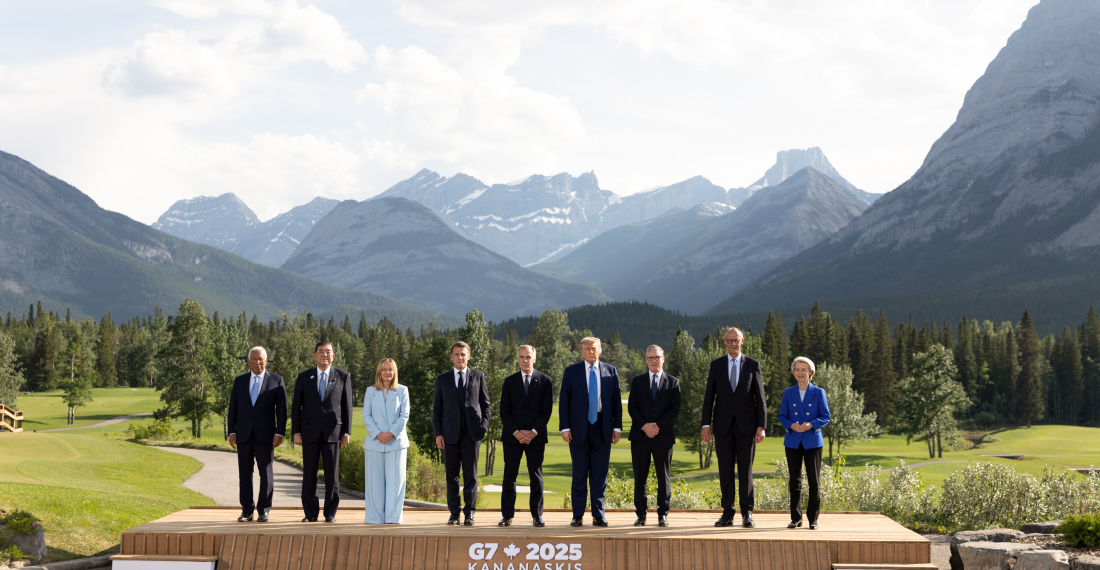
The G7 summit, a gathering of major world leaders meeting at Kananaskis, in the Canadian Rockies, has concluded with a joint leaders statement urging a "de-escalation of hostilities in the Middle East, including a ceasefire in Gaza". It stopped short of calling for a ceasefire between Israel and Iran. The leaders' statement, published as US President Trump left Canada, said Israel had a right to defend itself, and that Iran was a source of terror that should not have a nuclear weapon. According to the BBC, its call for a resolution of the crisis that led to a broader de-escalation of hostilities in the Middle East amounted to a diplomatic compromise that preserved G7 unity but watered down the statement's impact.
Presidnet Trump earlier urged Iranians to "immediately evacuate Tehran". This, the BBC reported, triggered speculation that US forces might join Israel's attacks - something denied by American officials. As he left, Trump told reporters: "I have to be back early for obvious reasons." He later wrote again on Truth Social, lambasting another G7 attendee, President Emmanuel Macron of France. Trump said his "publicity seeking" counterpart mistakenly suggested he was working on a ceasefire.
"Wrong! He has no idea why I am now on my way to Washington, but it certainly has nothing to do with a Cease Fire," Trump wrote. "Much bigger than that. Whether purposely or not, Emmanuel always gets it wrong. Stay Tuned!"
G7 leaders had said they understood Trump's need to leave early. "If the United States can achieve a ceasefire, that's a very good thing," said Macron. According to the BBC, reports circulated that Trump had instructed the White House National Security Council to meet upon his return. US Defence Secretary Pete Hegseth has announced the "deployment of additional capabilities" to the Middle East to enhance the Pentagon's "defensive posture", despite US officials' denial that they were about to join the Israeli offensive.
Trump's press secretary, Karoline Leavitt, was at pains to emphasise that Trump had "a great day" at the summit, saying much was accomplished, including a trade deal between the US and UK. She did not elaborate on his departure other than to say it was because of "what's going on in the Middle East". Trump's exit means he will miss in-person meetings with Ukrainian President Volodymyr Zelensky and Mexican President Claudia Sheinbaum that were scheduled for Tuesday, the final day of the summit.
In the same social media post, Trump suggested that Iran should have signed a deal that he put forward during the most recent talks over Iran's nuclear programme. "Simply stated, IRAN CAN NOT HAVE A NUCLEAR WEAPON," he wrote. "I said it over and over again!" Shortly after the post, the BBC reports, in the early hours of Tuesday, Iranian media reported explosions and heavy air defence fire in Tehran.
Hours before, Israel targeted Iran's state broadcaster, forcing a presenter to flee mid-broadcast. In Israel, air raid sirens wailed in Tel Aviv and an explosion was heard as Iranian missiles targeted the country again.
The BBC reported that there were signs of division earlier at the G7 Summit over conflicts between Russia and Ukraine and between Israel and Iran. Trump had been planning to reject the statement on the Israel-Iran conflict, according to the BBC's US partner CBS News. But the leaders ultimately agreed their statement, released on Monday night local time, which said they "reiterate our support for the security of Israel".
"Iran is the principal source of regional instability and terror. We have been consistently clear that Iran can never have a nuclear weapon," the statement added.
Trump also said at the summit earlier that it had been a "big mistake" for the former G8 to expel Russia from the group in 2014 after it annexed Crimea. "Putin speaks to me," said the US president. "He doesn't speak to anybody else... he's not a happy person about it."
But there was some progress as President Trump formally signed off a UK-US trade deal removing some trade barriers between the two countries. Trump told reporters the UK was "very well protected" from future import taxes. "You know why? Because I like them."
Monday also saw a bilateral between Canadian Prime Minister Mark Carney and Trump, after which Carney said a trade deal might be struck between the two countries within 30 days to resolve tit-for-tat import taxes. This marks the second time that Trump had left the G7 summit early, the BBC reports. In 2018, at a summit in Quebec, he exited the gathering to meet North Korea's leader Kim Jong Un.
Israel has claimed control of Iranian airspace since launching its air war last Thursday with a surprise attack that it says has killed many top military commanders and atomic scientists. However, according to a BBC report, Israel does not appear to have achieved its goal of destroying Iran's nuclear development programme.
Military analysts told the BBC that only the US has the bombers and bunker-busting bombs that can penetrate the deepest of Iranian nuclear facilities, especially that of Fordow. Israeli strikes have killed at least 224 people in Iran, according to the Iranian health ministry. In Israel, the government said at least 24 people had died.