Leaders of Armenia and Azerbaijan meet in Abu Dhabi to finalise peace agreement

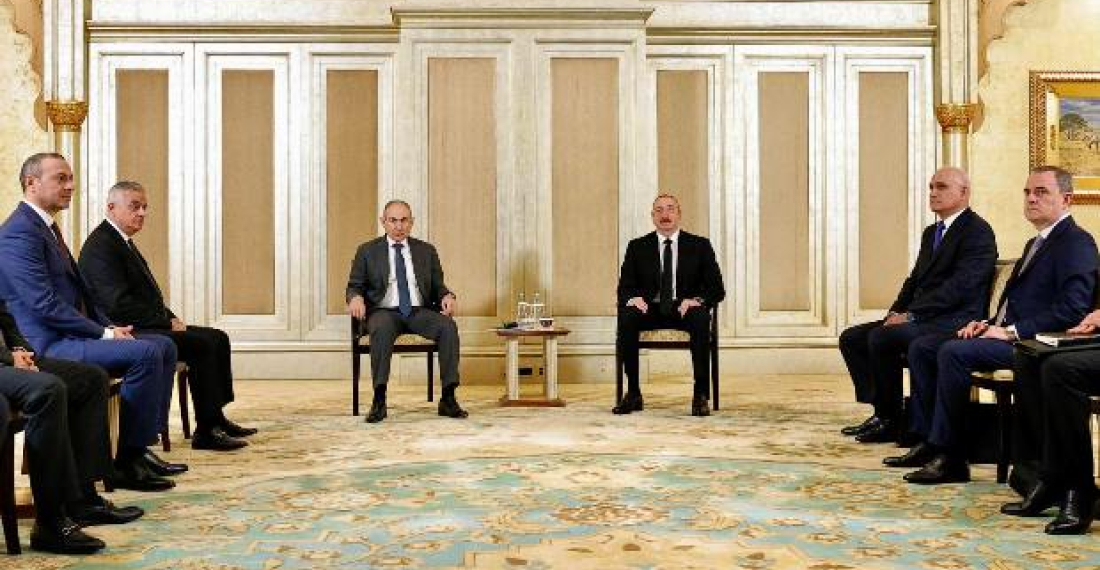
Armenian Prime Minister Nikol Pashinyan and Azerbaijani President Ilham Aliyev are meeting on Thursday 10 July in Abu Dhabi, United Arab Emirates, to discuss the next steps in finalising the peace agreement, their offices have confirmed to international news agencies. This is the first formal bilateral meeting between the leaders of Armenia and Azerbaijan since they agreed on the draft text of the peace agreement, following nearly four decades of conflict. The results of this meeting will shape the future of the South Caucasus and how the two countries can live peacefully next to each other after decades of conflict.

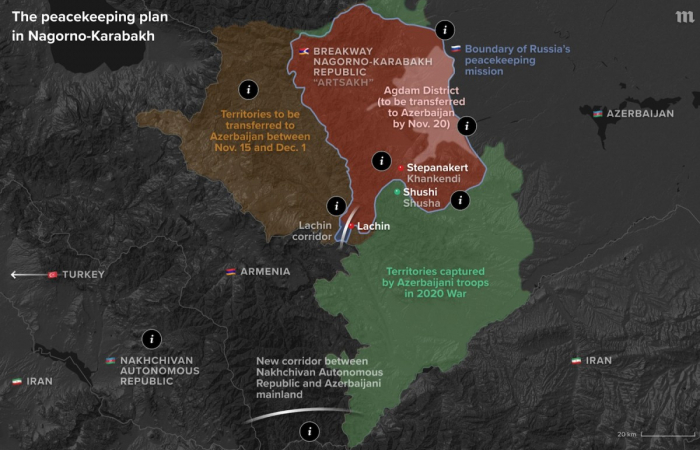
The two countries have fought a series of wars since the late 1980s when Nagorno-Karabakh, a region in Azerbaijan that had a mostly ethnic-Armenian population at the time, broke away from Azerbaijan with support from Armenia. Peace talks began after Azerbaijan recaptured Karabakh in a lightning offensive in September 2023, prompting a huge exodus of almost all of the territory’s 100,000 Armenians, who fled to Armenia.

Despite the peace talks, the timeline for sealing a deal remains uncertain. Ceasefire violations along the heavily militarised 1,000km shared border surged soon after the draft deal was announced, though there have been no reported violations recently.

In a potential stumbling block to a deal, Azerbaijan has said it wants Armenia to change its constitution, which it says makes implicit claims to Azerbaijani territory. Yerevan denies this, but Pashinyan has repeatedly stressed in recent months, most recently this week, that the country’s founding charter needs to be updated. Azerbaijan also asked for a transport corridor through Armenia, linking the bulk of its territory to Nakhchivan, an Azerbaijani enclave that borders Baku’s ally, Turkiye.

Pashinyan and Aliyev’s last encounter was in May, on the sidelines of the European Political Community summit in Tirana, Albania. In June, Pashinyan made a rare visit to Istanbul to hold talks with Turkish President Recep Tayyip Erdogan, a meeting Armenia described as a historic step towards regional peace.

This week, United States Secretary of State Marco Rubio expressed hope for a swift peace deal between the Caucasus neighbours.

The outbreak of hostilities between the two countries in the late 1980s prompted mass expulsions of hundreds of thousands of mostly Muslim Azeris from Armenia, and Armenians, who are Christian in their majority, from Azerbaijan.

The Russian Federation will be looking with interest on developments in Abu Dhabi. While busy with the military operation in Ukraine, Moscow has been gradually losing its influence in the South Caucasus, a region formerly part of the Soviet Union. Yerevan and Baku are making history by agreeing on the text of a peace accord and normalising their relations without Russian participation. 

Richard Giragosian, Founding Director of the Regional Studies Centre (RSC), an independent think tank in Yerevan, told Euronews that “with Russia overwhelmed by its invasion of Ukraine, this development is very much at the exclusion of Russia. Giragosian told Euronews that Armenia felt Russia did not step in to support them in 2020, during the six-week escalation in Karabakh and now that the region is "no longer the instrument of leverage for Russia”, he said, "Moscow will inevitably look for another way of keeping its influence over the South Caucasus". 

Moscow has been trying to repair the cooperation with its former ally. Russian Foreign Minister Sergey Lavrov visited Yerevan on 20 May, signalling the Kremlin’s intent to stabilise and reinforce ties with Armenia.

Fifteen individuals, including two archbishops from the Apostolic Church, were arrested in Armenia at the end of June on the accusations of plotting a coup.  Prime Minister Pashinyan said that law enforcement had foiled a large-scale and sinister plan by a "criminal oligarchic clergy" to destabilise the Republic of Armenia and seize power.

A few days before these arrests, Armenian authorities detained Samvel Karapetyan, a Russian billionaire of Armenian origin who controls the operator of Armenia’s national power grid, who also has political ambitions. Before his arrest, Karapetyan expressed his support and backing for the church, saying that “a small group of people who have forgotten the thousand-year history of Armenia and the church” were attacking the religious institution. 

Armenia, as well as other Russian neighbours, have already drawn their conclusions, Giragosian told Euronews.  “Armenia's future is much more in the West, and what we see is Armenia reasserting independence, strengthening sovereignty at the expense of years of over-dependence on Russia.”

In early 2025, the Armenian parliament adopted a bill aimed at starting the process of joining the European Union, a step that Moscow would certainly not approve.

Moscow losing its influence in the region with Azerbaijan and Armenia distancing themselves from their former ally will leave a dangerous vacuum of power, Giragosian said. “Azerbaijan is quite correct, as is Armenia, in rejecting any mediating role for Russia but there may be concerns about how Russia may seek to regain that lost influence in the South Caucasus”. 

Source: commonspace.eu with Al Jazeera, Euronewa and agencies. Photo: Armenian Prime Minister Nikol Pashinyan and Azerbaijani President Ilham Aliyev meeting on Thursday 10 July in Abu Dhabi, United Arab Emirates. source: Armenian Foreign Ministry

Related articles

Editor's choice
News
Borrell tells the European Parliament that the situation in Afghanistan was critical, but the EU will remain engaged

Borrell tells the European Parliament that the situation in Afghanistan was critical, but the EU will remain engaged

Borrell underlined that the European Union will make every effort to support the peace process and to remain a committed partner to the Afghan people. "Of course, we will have to take into account the evolving situation, but disengagement is not an option.  We are clear on that: there is no alternative to a negotiated political settlement, through inclusive peace talks.
Editor's choice
News
NATO Chief says war is on Europe's doorstep, and warns against complacency

NATO Chief says war is on Europe's doorstep, and warns against complacency

Russia could attack a Nato country within the next five years, the Secretary General of NATO, Mark Rutte, said in a stark new warning. "Nato's own defences can hold for now," Rutte warned in Berlin, but conflict was "next door" to Europe and he feared "too many are quietly complacent, and too many don't feel the urgency, too many believe that time is on our side. "Russia is already escalating its covert campaign against our societies," Rutte said in a speech in Germany. "We must be prepared for the scale of war our grandparents or great-grandparents endured." Earlier this month, Russia's President Vladimir Putin said his country was not planning to go to war with Europe, but it was ready "right now" if Europe wanted to - or started a war. But similar reassurances were given by Moscow in 2022, just before 200,000 Russian troops crossed the border and invaded Ukraine. Putin has accused European countries of hindering US efforts to bring peace in Ukraine - a reference to the role Ukraine's European allies have recently played in trying to change a US peace plan to end the war, whose initial draft was seen as favouring Russia. But Putin was not sincere, Nato's secretary-general said in the German capital, Berlin. Supporting Ukraine, he added, was a guarantee for European security. "Just imagine if Putin got his way; Ukraine under the boot of Russian occupation, his forces pressing against a longer border with Nato, and the significantly increased risk of an armed attack against us." Russia's economy has been on a war footing for more than three years now - its factories churn out ever more supplies of drones, missiles and artillery shells. According to a recent report by the Kiel Institute for the World Economy, Russia has been producing each month around 150 tanks, 550 infantry fighting vehicles, 120 Lancet drones and more than 50 artillery pieces. The UK, and most of its Western allies, are simply not anywhere near this point. Analysts say it would take years for Western Europe's factories to come close to matching Russia's mass-production of weapons. "Allied defence spending and production must rise rapidly, our armed forces must have what they need to keep us safe," the Nato chief said.

Popular

Editor's choice
News
NATO Chief says war is on Europe's doorstep, and warns against complacency

NATO Chief says war is on Europe's doorstep, and warns against complacency

Russia could attack a Nato country within the next five years, the Secretary General of NATO, Mark Rutte, said in a stark new warning. "Nato's own defences can hold for now," Rutte warned in Berlin, but conflict was "next door" to Europe and he feared "too many are quietly complacent, and too many don't feel the urgency, too many believe that time is on our side. "Russia is already escalating its covert campaign against our societies," Rutte said in a speech in Germany. "We must be prepared for the scale of war our grandparents or great-grandparents endured." Earlier this month, Russia's President Vladimir Putin said his country was not planning to go to war with Europe, but it was ready "right now" if Europe wanted to - or started a war. But similar reassurances were given by Moscow in 2022, just before 200,000 Russian troops crossed the border and invaded Ukraine. Putin has accused European countries of hindering US efforts to bring peace in Ukraine - a reference to the role Ukraine's European allies have recently played in trying to change a US peace plan to end the war, whose initial draft was seen as favouring Russia. But Putin was not sincere, Nato's secretary-general said in the German capital, Berlin. Supporting Ukraine, he added, was a guarantee for European security. "Just imagine if Putin got his way; Ukraine under the boot of Russian occupation, his forces pressing against a longer border with Nato, and the significantly increased risk of an armed attack against us." Russia's economy has been on a war footing for more than three years now - its factories churn out ever more supplies of drones, missiles and artillery shells. According to a recent report by the Kiel Institute for the World Economy, Russia has been producing each month around 150 tanks, 550 infantry fighting vehicles, 120 Lancet drones and more than 50 artillery pieces. The UK, and most of its Western allies, are simply not anywhere near this point. Analysts say it would take years for Western Europe's factories to come close to matching Russia's mass-production of weapons. "Allied defence spending and production must rise rapidly, our armed forces must have what they need to keep us safe," the Nato chief said.