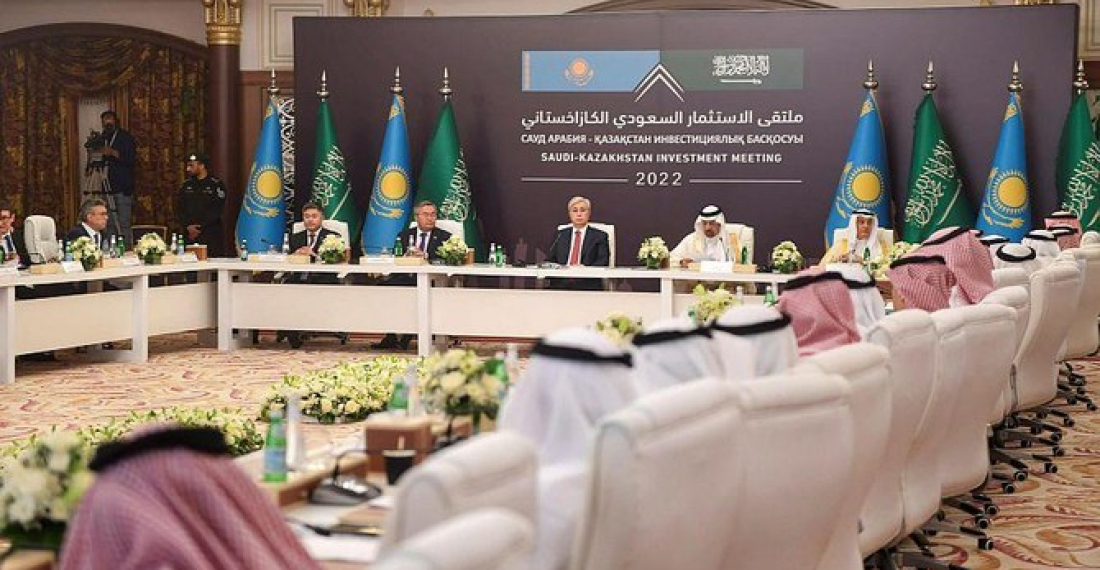
Kazakh president, Kassym Jomart Tokayev, on Sunday (24 July) concluded an official visit to Saudi Arabia during which he sought to strengthen relations with the Kingdom and other Gulf countries
Saudi Arabia and Kazakhstan will enhance mutual trade and investment in several sectors, according to a joint statement carried by the Saudi Press Agency at the end of the visit.
This cooperation includes areas related to petrochemicals, renewable energy, mining, agriculture, tourism, transport and logistics. Other agreements cover information technology, digital transformation, financial services and space, SPA reported.
During his visit President Kassym-Jomart Tokayev held wide-ranging talks with Saudi Crown Prince Mohammed bin Salman.
The two countries signed several agreements and memoranda of cooperation in sports, media, medicine and finance. The also agreed to enhance cooperation in higher education, research and innovation.
To boost trade and tourism, the countries agreed to allow direct mutual flights and create multiple additional shipping lines. Saudi Arabia praised Kazakhstan for exempting Saudi citizens from its visa requirements.
On climate change, they agreed to abide by the principles of the Framework Convention on Climate and the Paris Agreement, and to focus on reducing emissions.
There was mutual support for the Kingdom’s Green Saudi Arabia and Green Middle East initiatives, as well as Kazakhstan’s Green Bridge Partnership Program.
On energy, there was praise for the efforts of the OPEC+ nations to stabilize the global oil market. They stated that all participating countries should adhere to the OPEC+ agreements that would assist producers and consumers, and support world economic growth.
On defence, security and political levels, discussions were held on ways to ensure the safety and sovereignty of the two nations.
With regard to the crisis in Yemen, the two sides supported international and regional efforts to reach a comprehensive political solution for that country, based on the Gulf initiative, the Yemeni National Dialogue, and the UN Security Council Resolution 2216 of 2015.
At the end of the visit, Tokayev invited King Salman to participate in the seventh Congress of Leaders of World and Traditional Religions, which will be held on Sept. 14 and 15 this year, as well as the sixth Conference on Interaction and Confidence Building Measures in Asia, which will be held on Oct. 12 and 13 in the Kazakh capital, Nur-Sultan.
King Salman thanked Tokayev for these two invitations.