


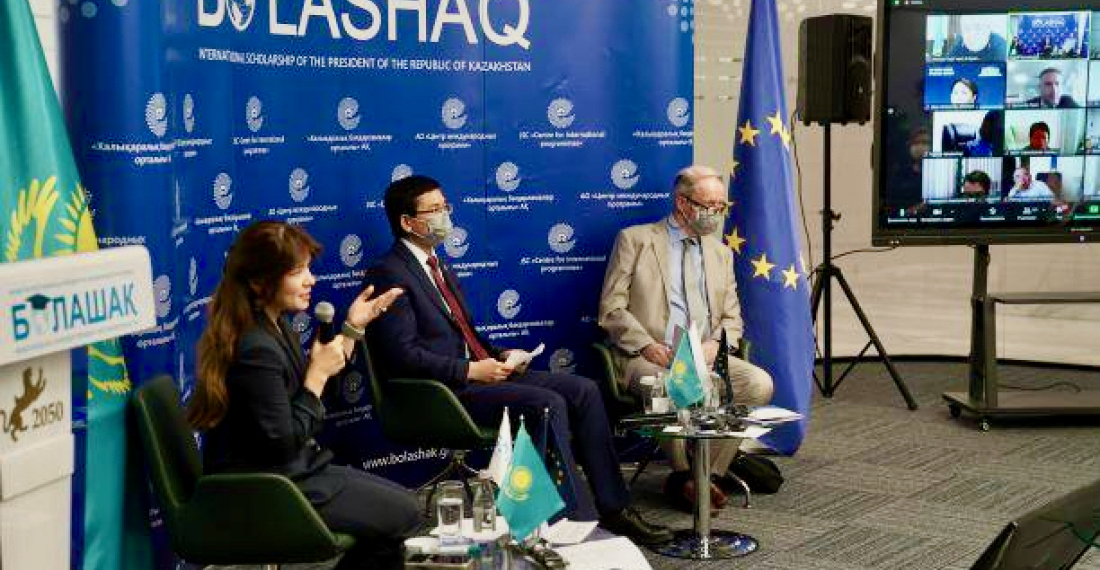
Kazakhstan and the European Union strengthen partnership in education

Last Wednesday (30 June), the Ministry of Education and Science of the Republic of Kazakhstan, the Delegation of the European Union to Kazakhstan and “The Centre for International Programs” JSC held the first Kazakh-European Partnership Forum on education.

The Forum was attended by the Minister of Education and Science of Kazakhstan, Askhat Aimagambetov, the Ambassador of the European Union to Kazakhstan, Sven-Olov Carlsson, Ambassador-at-Large of the Ministry of Foreign Affairs Kazakhstan, Alexey Volkov, diplomatic personnel from 16 EU member states, and more than 60 representatives of Kazakhstan and European universities, and experts from academic community.

“Internationalisation has been the cornerstone of many national education reforms over the past four decades as a strategy for improving the quality of education and science. Kazakhstan also sees internationalisation as an important process, and the growing level of mobility of students and teachers, number of international programs and cooperation between universities at regional and global levels serve as a proof thereof”, said Askhat Aimagambetov.

The participants discussed global trends in the development of higher education in the face of new challenges, as well as the issues of expanding internationalisation, and identified vectors for the further development of academic cooperation between universities of the Republic of Kazakhstan and the European Union.

“The EU welcomes the initiative of the Ministry of Education and Science of Kazakhstan and Centre for International Programmes to attract the attention to current status quo of the presence of  EU educational institutions in Kazakhstan’s foreign education programmes such as International Scholarship Programme Bolashaq. With a great potential of educational system of European Union Member States’ it is important for European Union and Kazakhstan to cooperate and look for a new directions of collaboration” – EU Ambassador to Kazakhstan Sven-Olov Carlsson.

The EU ambassador also noted that in the space of 27 years of “Bolashak” international program implementation, more than 11,000 highly qualified specialists have been trained, who now contribute to the development of the country. The “Bolashak” scholarship is awarded to study at the world’s leading universities included into the List of Recommended Universities, which this year includes 207 leading universities in the world, 59 of which are located in 14 European countries” - noted Ainur Karbozova.
source: commonspace.eu with the European External Action Service

Related articles

Editor's choice
News
Borrell tells the European Parliament that the situation in Afghanistan was critical, but the EU will remain engaged

Borrell tells the European Parliament that the situation in Afghanistan was critical, but the EU will remain engaged

Borrell underlined that the European Union will make every effort to support the peace process and to remain a committed partner to the Afghan people. "Of course, we will have to take into account the evolving situation, but disengagement is not an option.  We are clear on that: there is no alternative to a negotiated political settlement, through inclusive peace talks.
Editor's choice
News
NATO Chief says war is on Europe's doorstep, and warns against complacency

NATO Chief says war is on Europe's doorstep, and warns against complacency

Russia could attack a Nato country within the next five years, the Secretary General of NATO, Mark Rutte, said in a stark new warning. "Nato's own defences can hold for now," Rutte warned in Berlin, but conflict was "next door" to Europe and he feared "too many are quietly complacent, and too many don't feel the urgency, too many believe that time is on our side. "Russia is already escalating its covert campaign against our societies," Rutte said in a speech in Germany. "We must be prepared for the scale of war our grandparents or great-grandparents endured." Earlier this month, Russia's President Vladimir Putin said his country was not planning to go to war with Europe, but it was ready "right now" if Europe wanted to - or started a war. But similar reassurances were given by Moscow in 2022, just before 200,000 Russian troops crossed the border and invaded Ukraine. Putin has accused European countries of hindering US efforts to bring peace in Ukraine - a reference to the role Ukraine's European allies have recently played in trying to change a US peace plan to end the war, whose initial draft was seen as favouring Russia. But Putin was not sincere, Nato's secretary-general said in the German capital, Berlin. Supporting Ukraine, he added, was a guarantee for European security. "Just imagine if Putin got his way; Ukraine under the boot of Russian occupation, his forces pressing against a longer border with Nato, and the significantly increased risk of an armed attack against us." Russia's economy has been on a war footing for more than three years now - its factories churn out ever more supplies of drones, missiles and artillery shells. According to a recent report by the Kiel Institute for the World Economy, Russia has been producing each month around 150 tanks, 550 infantry fighting vehicles, 120 Lancet drones and more than 50 artillery pieces. The UK, and most of its Western allies, are simply not anywhere near this point. Analysts say it would take years for Western Europe's factories to come close to matching Russia's mass-production of weapons. "Allied defence spending and production must rise rapidly, our armed forces must have what they need to keep us safe," the Nato chief said.

Popular

Editor's choice
News
NATO Chief says war is on Europe's doorstep, and warns against complacency

NATO Chief says war is on Europe's doorstep, and warns against complacency

Russia could attack a Nato country within the next five years, the Secretary General of NATO, Mark Rutte, said in a stark new warning. "Nato's own defences can hold for now," Rutte warned in Berlin, but conflict was "next door" to Europe and he feared "too many are quietly complacent, and too many don't feel the urgency, too many believe that time is on our side. "Russia is already escalating its covert campaign against our societies," Rutte said in a speech in Germany. "We must be prepared for the scale of war our grandparents or great-grandparents endured." Earlier this month, Russia's President Vladimir Putin said his country was not planning to go to war with Europe, but it was ready "right now" if Europe wanted to - or started a war. But similar reassurances were given by Moscow in 2022, just before 200,000 Russian troops crossed the border and invaded Ukraine. Putin has accused European countries of hindering US efforts to bring peace in Ukraine - a reference to the role Ukraine's European allies have recently played in trying to change a US peace plan to end the war, whose initial draft was seen as favouring Russia. But Putin was not sincere, Nato's secretary-general said in the German capital, Berlin. Supporting Ukraine, he added, was a guarantee for European security. "Just imagine if Putin got his way; Ukraine under the boot of Russian occupation, his forces pressing against a longer border with Nato, and the significantly increased risk of an armed attack against us." Russia's economy has been on a war footing for more than three years now - its factories churn out ever more supplies of drones, missiles and artillery shells. According to a recent report by the Kiel Institute for the World Economy, Russia has been producing each month around 150 tanks, 550 infantry fighting vehicles, 120 Lancet drones and more than 50 artillery pieces. The UK, and most of its Western allies, are simply not anywhere near this point. Analysts say it would take years for Western Europe's factories to come close to matching Russia's mass-production of weapons. "Allied defence spending and production must rise rapidly, our armed forces must have what they need to keep us safe," the Nato chief said.

