Georgia’s new defence minister announces priorities. Prime Minister says role should not be ‘politicised’

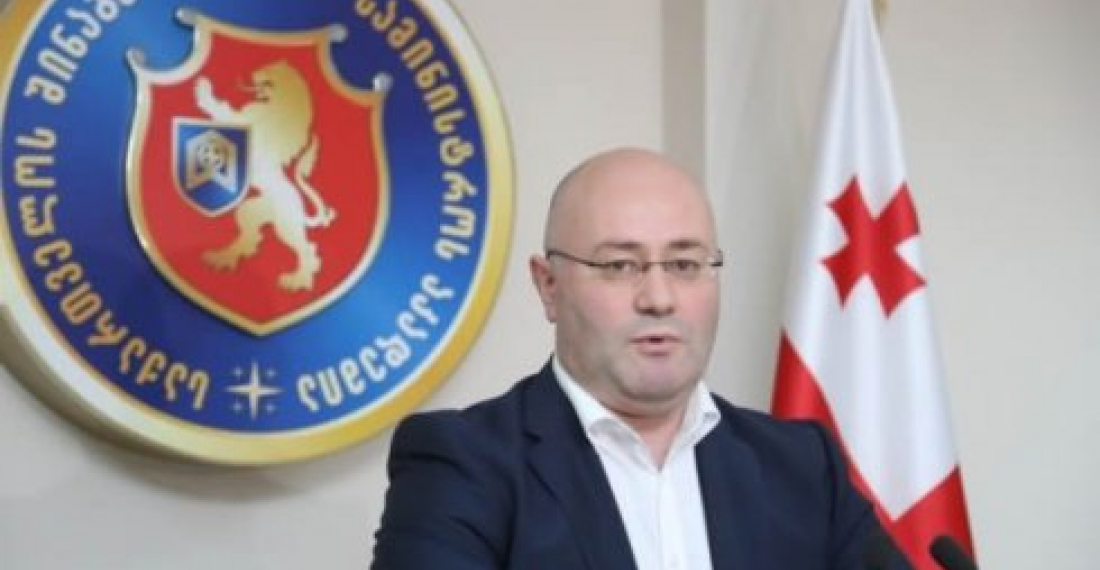
Georgia’s new defence minister Levan Izoria outlined his priorities on Tuesday, at a meeting with top military officials in Tbilisi. Prime Minister Georgi Kvirikashvili, also present, said it is important that the role not be politicized. 

Izoria priorities will be securing peace within Georgia, actively participating in NATO’s mission in Afghanistan in partnership with the United States, and improving Georgia’s self-defence capacity with the help of NATO, he said at the Ministry of Defence. 

He also said he wants to pursue “sober policy”. “First, [this] implies securing peace and security, and second, deterring threats and risks through sustainable development of our defense capabilities and integration to the Euro-Atlantic structures.”

A memorandum on boosting military capacity was signed with the United States earlier this month, with US Secretary of State John Kerry present.

Izoria replaces Tina Khidasheli, who stepped down so she can represent the Republican Party in Georgia’s upcoming legislative elections. The party is running separate from its former coalition partners, Georgian Dream. Khidasheli criticised the appointment of Izoria, a former deputy head of the State Security Service.

“It is a wrong message to our partners abroad, as well as internally, when at first Irakli Alasania, a political figure, was replaced by a security official [Mindia Janelidze] as defence minister and then Khidasheli was replaced again by a security [official]… It indicates on a very negative trend," she said.

However, Prime Minister Kvirikashvili reassured journalists that the role would not be politicised. “The MoD should be maximally distanced from any kind of political confrontation and in general political confrontation should be over in the country."

"I’m sure we will be able to implement very important reforms at the Ministry and I think nobody doubts that the agency needs to be reformed and strengthened," he said at the Tuesday meeting.

Georgia’s legislative elections will take place on October 8. As well as Izoria replacing Khidasheli, Ketevan Tsikhelashvili has replaced Paata Zakareishvili as State Minister for Reconciliation and Civic Equality.

SOURCE: commonspace.eu and agencies

PHOTO: Levan Izoria
Related articles

Editor's choice
News
Women emerge favourite to lead United Nations from next year, after straw-poll of UN Security Council members

Women emerge favourite to lead United Nations from next year, after straw-poll of UN Security Council members

​ Two women have emerged as favourite to lead the United Nations as Secretary-General from 1 January 2027, when the term of the present incumbent, Antonio Gutteres, expires. A straw poll of the members of the UN Security Council, held on Thursday, 30 July showed that of the seven candidates, Rebecca Grynspan of Costa Rica and Carolyn Rodriguez-Birkett of Guyana received ten and nine positive endorsements respectively, by the 15 members UN Security Council Although the poll and its result are supposed to be secret, the result leaked within minutes, and was carried on world media outlets, such as Reuters. The result was as follows   Michelle Bachelet 6 encourage 5  discourage   4 no opinion María Fernanda Espinosa 5 2 8 Rafael Grossi 7 2 6 Rebeca Grynspan 10 1 4 Olara Otunnu 2 5 8 Carolyn Rodrigues-Birkett 9 2 4 Macky Sall 6 7 2   Article 97 of the UN Charter states that the “Secretary-General shall be appointed by the General Assembly upon the recommendation of the Security Council”. Straw polls are informal ballots used to determine the viability of Secretary-General candidates.  The seven current candidates are: Michelle Bachelet Jeria (Chile), who was nominated by Brazil, Chile, and Mexico on 2 February, with Chile withdrawing its nomination on 24 March; María Fernanda Espinosa Garcés (Ecuador), who was nominated by Antigua and Barbuda on 11 May; Rafael Mariano Grossi (Argentina), who was nominated by Argentina on 26 November 2025; Rebeca Grynspan Mayufis (Costa Rica), who was nominated by Costa Rica on 3 March; Olara Otunnu (Uganda), who was nominated by Uganda on 24 July; Carolyn Rodrigues Birkett (Guyana), who was nominated by Guyana on 15 June; and Macky Sall (Senegal), who was nominated by Burundi on 2 March. At Thursday's straw poll, there was no difference between the ballots presented to the five permanent members (P5) and the ten elected members (E10). Council members received one ballot per candidate, containing the candidate’s name followed by three options: “encouraged”, “discouraged”, and “no opinion expressed”.   It is ofcourse early days, and the straw poll is just an informal indication of the mood of the UN Security Council, but the strong showwing by the two womencandidates may be an indication that for the first time, the head of the UN can be a women. (click image to read more) ​

Popular

Editor's choice
Interview
Thursday Interview: Murad Muradov

Thursday Interview: Murad Muradov

Today, commonspace.eu starts a new regular weekly series. THURSDAY INTERVIEW, conducted by Lauri Nikulainen, will host  persons who are thinkers, opinion shapers, and implementors in their countries and spheres. We start the series with an interview with Murad Muradov, a leading person in Azerbaijan's think tank community. He is also the first co-chair of the Action Committee for a new Armenian-Azerbaijani Dialogue. Last September he made history by being the first Azerbaijani civil society activist to visit Armenia after the 44 day war, and the start of the peace process. Speaking about this visit Murad Muradov said: "My experience was largely positive. My negative expectations luckily didn’t play out. The discussions were respectful, the panel format bringing together experts from Armenia, Azerbaijan, and Turkey was particularly valuable during the NATO Rose-Roth Seminar in Yerevan, and media coverage, while varied in tone, remained largely constructive. Some media outlets though attempted to represent me as more of a government mouthpiece than an independent expert, which was totally misleading.  Overall, I see these initiatives as important steps in rebuilding trust and normalising professional engagement. The fact that soon a larger Azerbaijani civil society visits to Armenia followed, reinforces the sense that this process is moving in the right direction." (click the image to read the interview in full)