


Georgia isolates Azerbaijani speaking southern districts after coronavirus outbreak

Georgian military units and Ministry of Interior forces have isolated the mainly Azerbaijani speaking southern districts of Marneuli and Bolnisi following an outbreak of the coronavirus in the area, in a move with wide-ranging ramifications. 

Georgian prime minister Giorgi Gakharia made the announcement in a sombre late night press conference in the capital Tbilisi. The decision was taken after a woman was diagnosed positive with the virus. "[We] could not identify the source of infection case in Marneuli, [the virus] was contracted during the [death anniversary] rites, that was attended by dozens of people," said the Prime Minister, adding that "the situation remains quite hard; this is the challenge that we [previously] spoke about, meaning that [the country] moves to the stage of community transmission[s]", the prime minister was quoted as saying. Gakharia noted that freedom of movement will be restricted within the two municipalities except for grocery and pharmacy shopping and performing some agricultural works.

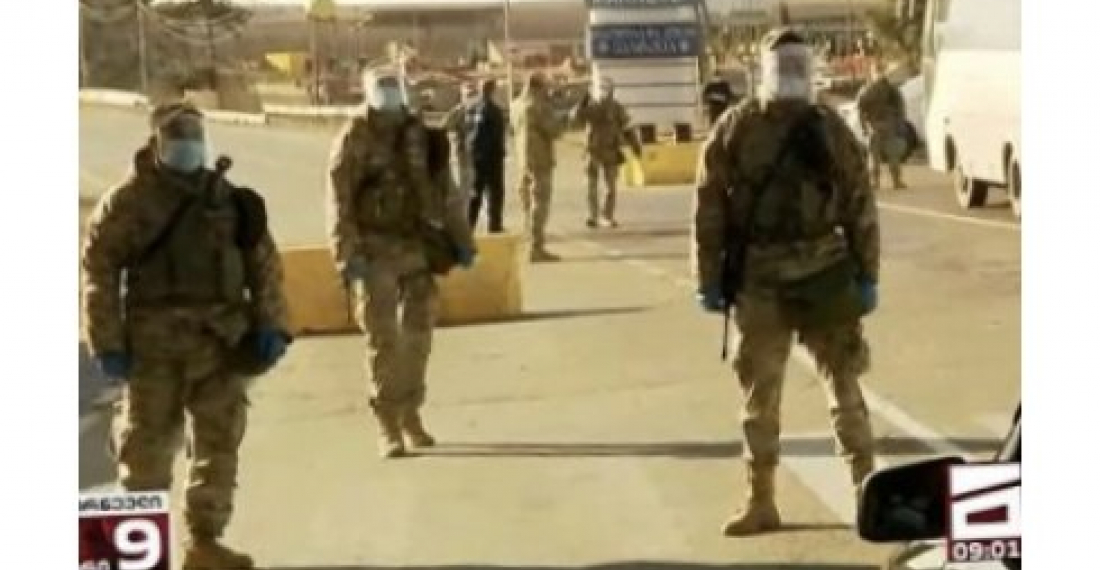
Elements of the Georgian army and ministry of interior forces took positions around the two districts shortly after the prime minister's speech. According to the latest Population Census of Georgia, conducted in 2014, Marneuli Municipality is home to 104,300 inhabitants, while Bolnisi Municipality is inhabited by 53,590 persons. The two municipalities are densely populated by Azerbaijani-speaking, and mainly Muslim, Georgians, who make up around 80% of the population of Marneuli district.

Commonspace.eu political editor said in a comment that these developments pose a very tricky challenge to the Georgian government since measures in minority areas inevitably need to be conducted with extra sensitivity. The very deployment of military units in the area could even by itself be considered a provocation, and enforcing a strict quarantine regime will not be simple or easy. The Georgian Government has appointed Sozar Subari as the Government co-ordinator for the operation in Marneuli and Bolnisi. A former Minister, and former Ombudsman of Georgia, Subari has the right skills to manage the community relationship that is going to be required in this difficult task at this difficult period. The Azerbaijani speaking population has close family and business ties with neighbouring Azerbaijan, and coronavirus and the closing of the border was already causing inconvenience and distress in the affected communities. Relations between Georgia and Azerbaijan are traditionally very good, and the two countries co-operate in various frameworks and are in some ways economically inter-dependent. However in recent years relations have been strained due to some border disputes. Georgia has also to balance its relations with Azerbaijan with those with its other neighbour Armenia. Unless properly managed, the coronavirus crisis can trigger political consequences. Neither Tbilisi, nor Baku, want or need this at the moment but the longer the coronavirus emergency lasts the more strain there will be on relations.

source: commonspace.eu

photo: Georgian soldiers operate a checkpoint outside Marneuli district to enforce a quarantine after an outbreak of coronavirus in the area (screen grab from TV Mtavari Arkhi)
Related articles

Editor's choice
News
Council of Europe launches new International Claims Commission for Ukraine

Council of Europe launches new International Claims Commission for Ukraine

Thirty-four countries and the European Union have signed a new convention establishing an International Claims Commission for Ukraine at a diplomatic conference co-hosted by the 46-nation Council of Europe and the Netherlands in the Hague. The diplomatic conference was attended by leaders and high-level representatives from over 50 states, including the President of Ukraine, Volodymyr Zelenskyy, the President of the Republic of Moldova, Maia Sandu, and the Prime Minister of the Netherlands, Dick Schoof.  “Today marks a major step forward in ensuring accountability for Ukraine. The International Claims Commission represents justice and hope for tens of thousands of victims—our determination that those who have suffered will not be forgotten. I call for quick ratifications so we can get the commission rapidly up and running for the people of Ukraine,” said Council of Europe Secretary General Alain Berset. Ukrainian President Volodymyr Zelenskyy said: “We expect that every mechanism for compensation from the Register of Damage and Claims Commission to the actual payments – will start working and receive strong and sufficient international support, so that people can truly feel that any kind of damage caused by the war can be compensated. This war, and Russia’s responsibility for it, MUST become a clear example – so that others learn not to choose aggression.” “Accountability is about creating the conditions for peace that endures. And therefore, accountability is a condition of security – today and for the future. But accountability is not only about Ukraine. And it is not only about one aggressor and one victim. Accountability is about Europe. About every country in Europe. It is about whether Europe, as a whole, is willing to defend its peace,” said Maia Sandu, President of the Republic of Moldova, which currently holds the Presidency of the Council of Europe’s Committee of Ministers. The Prime Minister of the Netherlands, Dick Schoof, said: “Every day Russia is deliberately bombarding homes, destroying businesses and damaging infrastructure in Ukraine. Russia must compensate Ukraine for the damage caused. That is why we have launched the International Claims Commission for Ukraine and we are honoured to host it.” The International Claims Commission will be the second part of a comprehensive compensation mechanism related to Russia’s war of aggression, building on the existing Register of Damage for Ukraine. The claims commission will be established within the framework of the Council of Europe and will also be open to other countries. The Register of Damage for Ukraine, created in 2023, collects and records compensation claims submitted by individuals, organisations and public bodies in Ukraine. Forty-four states and the European Union have so far joined the Register, which has already received 86,000 claims. The International Claims Commission will review, assess and decide upon claims submitted to the Register of Damage for Ukraine and determine the amount of compensation, if any, which is due in each case. The convention establishing the commission will enter into force once it has been ratified by 25 signatories, as long as sufficient funds have been secured to support its initial work.

Popular

