Georgia holds second round of presidential elections (Updated throughout the day)

Updated

Exit polls say Zurabishvili won the Georgian presidential election

An exit poll conducted by Edison Research has indicated that Salome Zurabishvili, the candidate supported by the ruling georgian Dream party has won the second round of the presidential election, securing 55% of the votes cast. Another exit poll, by Imedi TV show Zourabishvili leading with 58% of votes cast

Polling closed at 20.00 local time, and counting is expected to go throughout the night

--

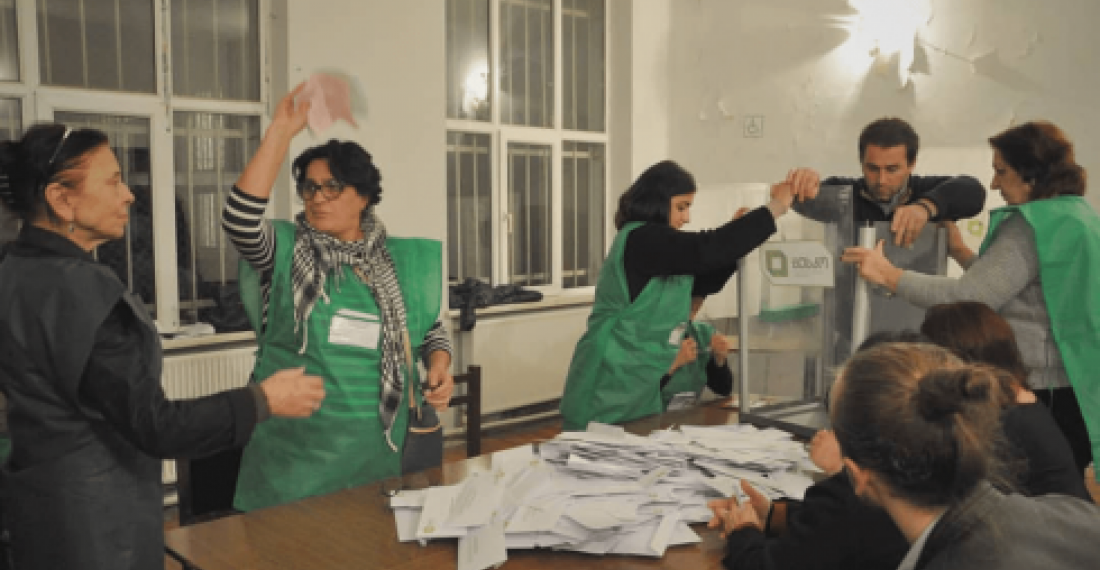
Voter participation in the second round of the Georgian presidential elections appears to be considerably higher than in the first round. Data released by the Central Elections Commission indicates that by 15.00 local time 38/8% of voters had cast their vote. This is considerably higher than the number of voters in the first round by the same time, which was 30.98%.

Commonspace.eu political editor said in a comment that after a bitterly fought election campaign the Georgian people are now having their say for the second time. During the election campaign ahead of the second round several commentators had mentioned that a high voter turnout in the second round would favour the pro government candidate, Salome Zurabishvili. Many supporters of the ruling Georgian Dream (GD) party had stayed away during the first vote on 28 October, resulting in a surprisingingly close result. According to these commentators many of those who stayedf away during the first round were enticed to cast their ballot in the second round by the stark choice between the GD candidate and the candidate of the United National Movement. This however is speculation, and it will be some hours yet before we know what the choice of the georgian people has been.


---

Preliminary figures released by the Georgian Central Elections Commission indicate a higher turnout than in the first round, with 19.6% voting by midday, about 3% higher.

Elections are taking place in Georgia on Wednesday (28 November) to choose the country's new president. In the first round of the elections held on 28 October none of the candidates won the necessary 50% of the votes cast. Voting has been taking place largely peacefully, with both government and opposition accusing each other of infringements.

President Giorgi Margvelashvili and prime minister Mamuka Bakhtadze both voted early, at the same time appealing to vioters to go and vote. "For some it is a difficult choice, but I want to call on every citizen of Georgia to come to the polls and make a choice", president Giorgi Margvelashvili said after he cast his vote.

"I would like to congratulate Georgian citizens on today's turnout, which I see at the polling station. I am glad and proud that the Georgian voters express their position so actively. For some it is a difficult choice, but I want to call on every citizen of Georgia to come to the polls and make a choice and play a decisive role in forming a government. Thank you for such turnout and I am sure this will continue throughout the day, which guarantees that the elections will be held at the high level and there will be fewer violations," Margvelashvili said.

In the meantime the central Elections Commission said all polling stations opened on time, at 08:00 am and the voting process is underway across Georgia. There are 3,703 polling stations, including 55 abroad. The total number of voters is 3,528,658. In the first two hours of polling 7.26% of voters cast their vote, slightly higher than at the same time in the first round.


related content on the first round of the elections: Georgia's presidential election (live blog)

After a bruising election campaign, considered amongst the most nasty in recent Georgian history, voters will choose between the candidate backed by the ruling Georgian Dream party, Salome Zurabishvili, and the candidate of the United National Movement, who is also backed by a number of other opposition parties, Grigol Vashadze. The two candidates came neck and neck in the first round, each securing around 38% of the votes cast.

related content: Georgian election goes to second round

Whilst the position of president is largely ceremonial the election has turned into a test of strenght and will between Georgia's current ruling party led by Bidhizina Ivanishvili, and the main opposition force that identifies with the country's former president, Mikheil Saakashvili.

source: commonspace.eu
Related articles

Editor's choice
News
Russia adds pressure on Armenia ahead of key elections; recalls Ambassador in Yerevan for consultations

Russia adds pressure on Armenia ahead of key elections; recalls Ambassador in Yerevan for consultations

Ahead of key parliamentary elections,scheduled to be held in Armenia on Sunday, 7 June, Russia continues to attempt to put pressure on the Armenian Government led by prime minister Nikol Pashinyan. On 30 May, Russia recalled its Ambassador to Yerevan for consultations. A terse statement, published on the website of the Russian Foreign Ministry, said, "The Ambassador of the Russian Federation to the Republic of Armenia , S.P. Kopyrkin, has been summoned to Moscow for consultations in connection with the steps taken by the Armenian leadership to move closer to the European Union, which are detrimental to cooperation within the EAEU." This followed a statement issued the day before, by the leaders of the Eurasian Economic Union (EAEU) that challenges the Armenian trajectory towards approximating to the European Union. Vladimir Putin is undertood to have personally pushed the other four EAEU leaders to issue the statement, which said: "Taking into account the significant risks to the economic security of the member states of the Eurasian Economic Union (hereinafter referred to as the Union) arising in connection with the preparation of the Republic of Armenia for accession to the European Union, as well as the need to prevent the associated damage to the member states of the Union: decided that the members of the Eurasian Intergovernmental Council from the Republic of Belarus, the Republic of Kazakhstan, the Kyrgyz Republic and the Russian Federation will report at the next meeting of the Supreme Eurasian Economic Council in December 2026 on the possible consequences of the suspension of the Treaty on the Eurasian Economic Union with respect to the Republic of Armenia. We share the position on the need to hold a national referendum in the Republic of Armenia as soon as possible on joining the European Union or continuing to be part of the Eurasian Economic Union."
Editor's choice
News
The leaders of the states of the Eurasian Economic Union issued a tough statement warning fellow-member state Armenia of the consequences of its desire to join the European Union.

The leaders of the states of the Eurasian Economic Union issued a tough statement warning fellow-member state Armenia of the consequences of its desire to join the European Union.

The leaders of the states of the Eurasian Economic Union (EEAS) issued a tough statement warning fellow-member state Armenia of the consequences of its desire to join the European Union. The stark, sharply worded,  warning, comes days before crucial parliamentary elections in Armenia, scheduled for 7 June. The full statement said, “We, the Presidents of the Republic of Belarus, the Republic of Kazakhstan, the Kyrgyz Republic and the Russian Federation, Taking into account the actions of the Republic of Armenia aimed at joining the European Union, including the approval in 2025 by the National Assembly of the Republic of Armenia and the signing by the President of the Republic of Armenia of the Law of the Republic of Armenia "On the Start of the Process of Accession of the Republic of Armenia to the European Union", as well as the confirmation by the European Union of the European aspirations of the Government of the Republic of Armenia, expressed in the joint declaration following the first Armenia-European Union summit, adopted on 5 May 2026, Taking into account the significant risks to the economic security of the member states of the Eurasian Economic Union (hereinafter referred to as the Union) arising in connection with the preparation of the Republic of Armenia for accession to the European Union, as well as the need to prevent the associated damage to the member states of the Union: decided that the members of the Eurasian Intergovernmental Council from the Republic of Belarus, the Republic of Kazakhstan, the Kyrgyz Republic and the Russian Federation will report at the next meeting of the Supreme Eurasian Economic Council in December 2026 on the possible consequences of the suspension of the Treaty on the Eurasian Economic Union with respect to the Republic of Armenia. We share the position on the need to hold a national referendum in the Republic of Armenia as soon as possible on joining the European Union or continuing to be part of the Eurasian Economic Union. Astana, May 29, 2026” A meeting of the Supreme Eurasian Economic Council was held in Astana, Kazakhstan, on May 29, 2026. The meeting of the Supreme Eurasian Economic Council in a restricted format was attended by Russian President Vladimir Putin, Belarusian President Alexander Lukashenko , Kazakh President Kassym-Jomart Tokayev , Kyrgyz President Sadyr Japarov , Armenian Deputy Prime Minister Mher Grigoryan, and Chairman of the Board of the Eurasian Economic Commission Bakytzhan Sagintayev. From the Russian side, the meeting was also attended by Deputy Prime Minister and member of the Council of the Eurasian Economic Commission Alexey Overchuk and Presidential Aide Yury Ushakov . The heads of delegations from EAEU observer states, including President of Uzbekistan Shavkat Mirziyoyev , Vice President of Cuba Salvador Valdés Mesa, Minister of Industry, Mines, and Trade of Iran Mohammad Atabak, and CIS Secretary General Sergei Lebedev, joined the expanded meeting . Following the meeting of the Supreme Eurasian Economic Council, a number of documents were signed .

Popular

Editor's choice
Interview
Thursday Interview: Murad Muradov

Thursday Interview: Murad Muradov

Today, commonspace.eu starts a new regular weekly series. THURSDAY INTERVIEW, conducted by Lauri Nikulainen, will host  persons who are thinkers, opinion shapers, and implementors in their countries and spheres. We start the series with an interview with Murad Muradov, a leading person in Azerbaijan's think tank community. He is also the first co-chair of the Action Committee for a new Armenian-Azerbaijani Dialogue. Last September he made history by being the first Azerbaijani civil society activist to visit Armenia after the 44 day war, and the start of the peace process. Speaking about this visit Murad Muradov said: "My experience was largely positive. My negative expectations luckily didn’t play out. The discussions were respectful, the panel format bringing together experts from Armenia, Azerbaijan, and Turkey was particularly valuable during the NATO Rose-Roth Seminar in Yerevan, and media coverage, while varied in tone, remained largely constructive. Some media outlets though attempted to represent me as more of a government mouthpiece than an independent expert, which was totally misleading.  Overall, I see these initiatives as important steps in rebuilding trust and normalising professional engagement. The fact that soon a larger Azerbaijani civil society visits to Armenia followed, reinforces the sense that this process is moving in the right direction." (click the image to read the interview in full)