


Gaza hospital struck twice by Israel killing journalists and rescuers

Israel struck one of the main hospitals in the Gaza strip on Monday 25 August and then hit the facility again as journalists and rescue workers rushed to the scene, killing at least 20 people and wounding many more, local health workers said. It was among the deadliest of multiple Israeli strikes that have hit both hospitals and journalists over the course of the 22-month war, Associated Press reported. The assault came as Israel plans to widen its offensive to heavily populated areas, vowing to destroy Hamas after its 7th October attack in 2023.

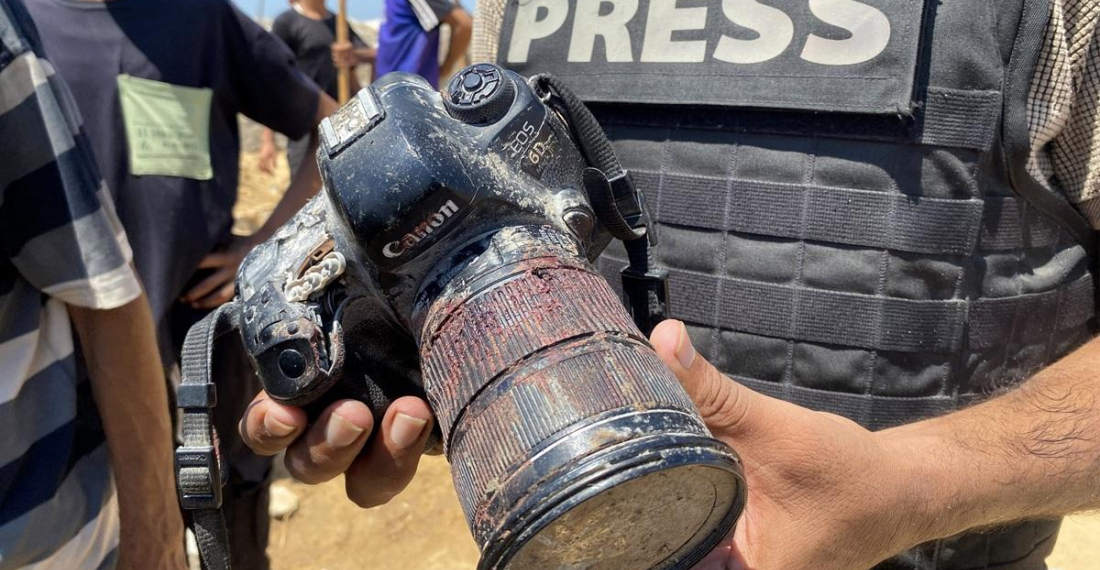
Among the dead were five journalists, including 33-year-old Mariam Dagga, a visual journalist  who worked for The Associated Press. The Reuters news agency said one of its reporters was killed in the initial strike as he operated a live television shot on an upper floor of Khan Younis’ Nasser Hospital. Other journalists, including Dagga, and rescue workers wearing orange emergency vests then raced up an external stairwell to reach the site, only to be hit by the second strike.

A video shot from below by pan-Arab channel Al Ghad showed their last moments as they climbed the stairs past damaged walls, followed by a boom and a huge plume of smoke from the strike.

Israeli Prime Minister Benjamin Netanyahu’s office called the strike a “tragic mishap” and said the military was investigating. He did not elaborate on the nature of the mistake.

Israeli media reported that troops fired two artillery shells, targeting what they suspected was a Hamas surveillance camera on the roof. Reporters from different outlets had regularly set up live TV shots at that location. The five journalists killed included journalists working for Al Jazeera, Reuters and Middle East Eye, a U.K.-based media outlet, most on a contractor or freelance basis.

Dagga regularly reported for multiple outlets from the hospital, including a recent story for the AP on doctors struggling to save children from starvation.

The AP and Reuters demanded an explanation in a joint letter  to Israeli authorities. “We are outraged that independent journalists were among the victims of this strike on the hospital, a location that is protected under international law,” it said. “These journalists were present in their professional capacity, doing critical work bearing witness.” They also noted that Israel has barred international journalists from entering Gaza since the start of the war, outside of visits organized by the military.

Zaher al-Waheidi, head of the records department at the Gaza Health Ministry, said the initial strike hit an upper floor housing operating rooms and doctors’ residences, killing at least two people. The second strike, hitting the stairwell, killed another 18. Around 80 people were wounded, including many in the hospital’s courtyard, al-Waheidi said. 

Brig. Gen. Effie Defrin, an Israeli military spokesman, said the army does not target civilians and had launched an internal investigation into the strikes. He accused Hamas of hiding among civilians but did not say whether Israel believed any militants were present during the strikes on the hospital.

Netanyahu’s statement said: “Israel deeply regrets the tragic mishap that occurred today at the Nasser Hospital in Gaza. Israel values the work of journalists, medical staff, and all civilians.”

Israel has killed 189 Palestinian journalists during its campaign in Gaza, including some who were directly targeted and others who were killed among other strike casualties, according to the Committee to Protect Journalists. More than 1,500 health workers have been killed, according to the U.N.

Israel’s “killing of journalists in Gaza continues while the world watches and fails to act firmly on the most horrific attacks the press has ever faced in recent history,” said Sara Qudah, CPJ regional director. The Foreign Press Association, which represents international media in Israel and the Palestinian territories, called on Israel “to halt its abhorrent practice of targeting journalists.”

The U.N. secretary-general, along with Britain, France and others, condemned the attack. When asked about the strike, U.S. President Donald Trump initially said he was not aware of it before offering: “I’m not happy about it. I don’t want to see it.”

Trump later said he thought there might be a “conclusive ending” in Gaza in the coming weeks, without elaborating. It was not clear if he was referring to Israel’s coming offensive or to long-running ceasefire talks. 

According to Associated Press, Israel has attacked hospitals multiple times throughout the war, asserting that Hamas embeds itself in and around the facilities, though Israeli officials rarely provide evidence. Hamas security personnel have been seen inside such facilities during the war, and parts of those sites have been off limits to the public.

The war began when Hamas-led militants abducted 251 people and killed around 1,200 people, mostly civilians, in the 2023 attack  Most of the hostages have been released in ceasefires or other deals, but 50 remain in Gaza, with around 20 believed to be alive.


Source: commonspace.eu with AP, Reuters and agencies. Photo: A journalist holds the blood-covered camera belonging to Palestinian photojournalist Mariam Dagga, a journalist who freelanced for AP since the start of the war and who was killed in an Israeli strike on Nasser hospital in Khan Yunis/AP.

Related articles

Editor's choice
News
Israeli parliament votes to bring back the death penalty, but only for Palestinians

Israeli parliament votes to bring back the death penalty, but only for Palestinians

srael’s parliament approved a bill on Monday that would allow the execution of Palestinians convicted on terror charges for deadly attacks, a move that has been criticized as discriminatory and immediately drew a court challenge. Sixty-two lawmakers, including Prime Minister Benjamin Netanyahu, voted in favor and 48 against the bill, championed by far-right National Security Minister Itamar Ben Gvir. There was one abstention and the rest of the lawmakers were not present. Ben Gvir in the run-up to the vote had worn a lapel pin in the shape of a noose, symbolising his support for the legislation. “We made history!!! We promised. We delivered,” he posted on X after the vote. The bill would make the death penalty the default punishment for Palestinians in the Israeli-occupied West Bank found guilty of intentionally carrying out deadly attacks deemed “acts of terrorism” by an Israeli military court. The bill says that the sentence may be reduced to life imprisonment under “special circumstances.” Palestinians in the West Bank are automatically tried in Israeli military courts. Meanwhile, under the bill, in Israeli criminal courts anyone “who intentionally causes the death of a person with the aim of harming an Israeli citizen or resident out of an intention to put an end to the existence of the State of Israel shall be sentenced to death or life imprisonment.” Criminal courts try Israeli nationals, including Palestinian citizens and residents of east Jerusalem. The bill sets the execution method as hanging, adding that it should be carried out within 90 days of the sentencing, with a possible postponement of up to 180 days. - ‘Parallel tracks’ - The bill appears to conflict with Israel’s Basic Laws, which prohibit arbitrary discrimination, and shortly after it was passed, a leading human rights group announced that it had filed a petition with the Supreme Court demanding the legislation’s annulment. “The law creates two parallel tracks, both designed to apply to Palestinians,” the Association for Civil Rights in Israel said in a statement. “In military courts — which have jurisdiction over West Bank Palestinians — it establishes a near-mandatory death sentence,” the rights group said. In civilian courts, the law’s stipulation that defendants must have acted “with the aim of negating the existence” of Israel “structurally excludes Jewish perpetrators,” the group added. The association argued the law should be annulled on both jurisdictional and constitutional grounds. During the debate in parliament, opposition lawmaker and former deputy Mossad director, Ram Ben Barak, expressed outrage at the legislation. “Do you understand what it means that there is one law for Arabs in Judea and Samaria, and a different law for the general public for which the State of Israel is responsible?” he asked fellow parliamentarians, using the Israeli name for the West Bank. “It says that Hamas has defeated us. It has defeated us because we have lost all our values.” - ‘Discriminatory application’ - Lawmaker Limor Son Har-Melech from Ben Gvir’s party, who years ago survived an attack by Palestinian militants in which her husband was killed, urged fellow parliamentarians to approve the bill. “For years, we endured a cruel cycle of terror, imprisonment, release in reckless deals, and the return of these human monsters to murder Jews again ... And today, my friends, this cycle has come full circle.” The Palestinian Authority condemned the law’s adoption, saying that “Israel has no sovereignty over Palestinian land.” “This law once again reveals the nature of the Israeli colonial system, which seeks to legitimize extrajudicial killing under legislative cover,” it added. In February, Amnesty International had urged Israeli lawmakers to reject the legislation, citing its “discriminatory application against Palestinians.” On Sunday, Britain, France, Germany and Italy expressed “deep concern” over the bill, which they said risked “undermining Israel’s commitments with regards to democratic principles.” While the death penalty exists for a small number of crimes in Israel, it has become a de facto abolitionist country — the Nazi Holocaust perpetrator Adolf Eichmann was the last person to be executed in 1962. Israel has occupied the West Bank since 1967 and violence there has soared since Hamas’s October 7, 2023 attack on Israel triggered the Gaza war. (read more by clicking the image above).

Popular

Editor's choice
Interview
Thursday Interview: Murad Muradov

Thursday Interview: Murad Muradov

Today, commonspace.eu starts a new regular weekly series. THURSDAY INTERVIEW, conducted by Lauri Nikulainen, will host  persons who are thinkers, opinion shapers, and implementors in their countries and spheres. We start the series with an interview with Murad Muradov, a leading person in Azerbaijan's think tank community. He is also the first co-chair of the Action Committee for a new Armenian-Azerbaijani Dialogue. Last September he made history by being the first Azerbaijani civil society activist to visit Armenia after the 44 day war, and the start of the peace process. Speaking about this visit Murad Muradov said: "My experience was largely positive. My negative expectations luckily didn’t play out. The discussions were respectful, the panel format bringing together experts from Armenia, Azerbaijan, and Turkey was particularly valuable during the NATO Rose-Roth Seminar in Yerevan, and media coverage, while varied in tone, remained largely constructive. Some media outlets though attempted to represent me as more of a government mouthpiece than an independent expert, which was totally misleading.  Overall, I see these initiatives as important steps in rebuilding trust and normalising professional engagement. The fact that soon a larger Azerbaijani civil society visits to Armenia followed, reinforces the sense that this process is moving in the right direction." (click the image to read the interview in full)

