


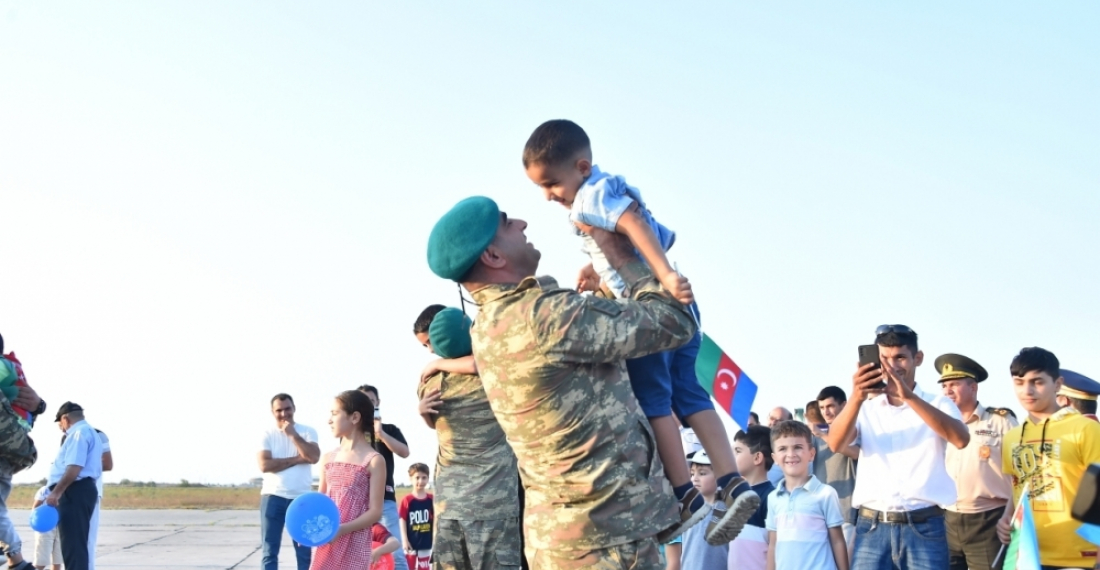
A contingent of 120 Azerbaijani soldiers returned to Baku from Afghanistan on Thursday - among the last soldiers of the international coalition to leave Kabul. The soldiers were, together with Turkish troops, responsible for the protection of Kabul airport until recently, when they were also joined by thousands of US and British troops. The last soldiers of the international coalition are expected to leave Afghanistan by 31 August.
Azerbaijan has been one of the countries that for many years participated in the operations of the international coalition. They operated as part of the larger Turkish contingent. Another South Caucasus country, Georgia also had a large contingent . It served as part of the larger German contingent and was based most of the time in the north of the country.
Both Georgia and Azerbaijan are members of NATO's Partnership for Peace program, and Georgia has been for a long time seeking NATO membership.
Georgia and Azerbaijan have also been playing an important role in the current massive evacuation from Afghanistan following the takeover of Kabul by the Taliban.
There has been praise for the role played by Georgia and Azerbaijan in this process. In a recent tweet, Luke Coffey from the US Heritage Foundation said that Azerbaijan and the Ganja corridor are the only strategically important air corridor to enter Afghanistan and the Central Asian region, bypassing Russia and Iran.
"NATO had only one choice for the withdrawal of two giant C-17 cargo planes bypassing the airspace of Russia and Iran: Azerbaijan and the Ganja corridor (one of the most strategic places in the Eurasian space)," L. Coffey wrote.
In order for these two NATO C-17s to bypass Russian and Iranian airspace there was only ONE option: Azerbaijan and the Ganja Gap. (One of the most strategic locations on the Eurasian landmass.) pic.twitter.com/dEbSxUxbT9
— Luke Coffey (@LukeDCoffey) August 26, 2021
The Government of Georgia on Friday (28 August) confirmed it was actively involved in assisting the evacuation processes from Afghanistan, including facilitating flights at Tbilisi airport and offering the temporary placement of international staff.
According to the August 26 statement, military cargo planes of the NATO Military Cargo Transportation Organization are currently stationed at Tbilisi airport, performing daily flights to Kabul. Up to 2,000 passengers have been transferred so far as evacuated people are flown from Kabul to Tbilisi in charter flights, the government said.
“A Regional Transit Hub has been established at Tbilisi International Airport and at the military base station of Georgian Defense Forces near the airport, with the engagement of Georgian, Norwegian, Swedish, and other member states of NATO through civilian and military personnel,” the statement added.
The Georgian Government statement also said that the Norwegian Armed Forces have set up a “Transit Healthcare Unit” at the military base station to help with the evacuation of a Norwegian Military Hospital of Kabul, if necessary. In a tweet the Norwegian Foreign Ministry expressed its appreciation:
This morning another plane landed at Oslo airport, carrying people who have been assisted in departing Kabul via Tbilisi. We appreciate the excellent cooperation with the Georgian authorities in facilitating these flights. @MFAgovge @SandAndresen pic.twitter.com/IV54O8j2oH
— Norway MFA (@NorwayMFA) August 24, 2021



