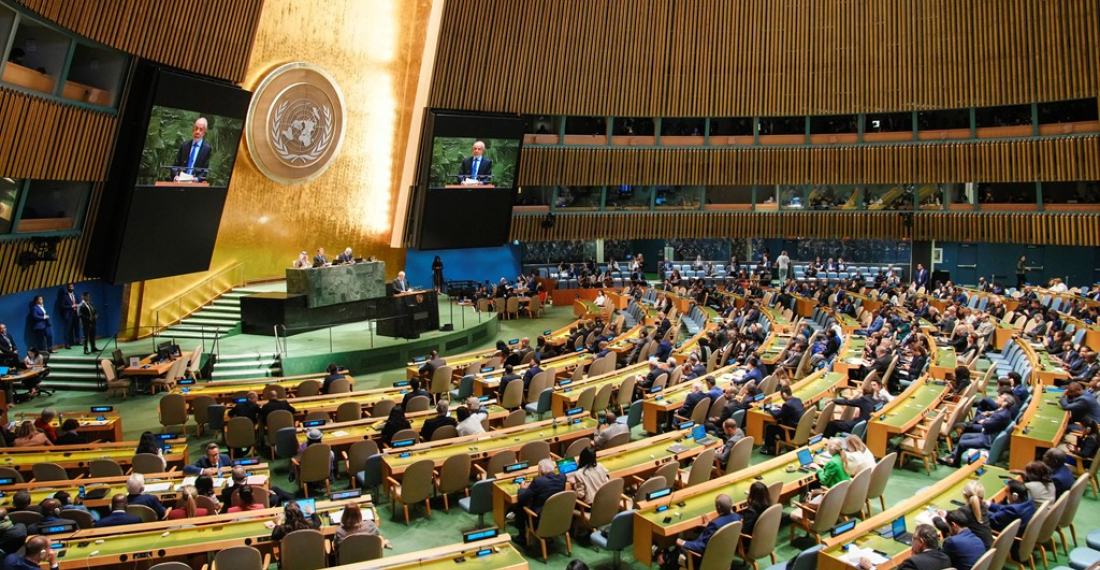
As Gaza continues to burn, France recognised Palestinian statehood on Monday 22 September at the start of a summit at the United Nations aimed at galvanising support for a two-state solution to the Middle East conflict. More nations are following, in defiance of Israel and the United States. French President Emmanuel Macron’s announcement in the U.N. General Assembly hall received loud applause from the more than 140 leaders in attendance. The Palestinian delegation, including its U.N. ambassador, Riyad Mansour, could be seen standing and applauding as the declaration was made. Palestinian president Mahmud Abbas was denied a visa by the US authorities forcing him to attend only virtually.
Leading the summit at the UN, President Macron said: "The time for peace has come, as we are just moments away from no longer being able to seize it. The time has come to free the 48 hostages held by Hamas. The time has come to stop the war, the bombings of Gaza, the massacres and the displacement."
The United Kingdom, Australia, Canada, Portugal, Belgium, Monaco, Malta, Andorra and Luxembourg also took the largely symbolic step of recognition on the eve of the summit called by France and Saudi Arabia, piling pressure on Israel as it intensifies its retaliatory war in Gaza that has killed tens of thousands of people.
U.N. secretary-general Antonio Guterres said “statehood for the Palestinians is a right, not a reward.” That appeared to push back against the Israeli government, which says recognising statehood rewards Hamas after its Oct. 7 attack that set off the war in Gaza two years ago.
Macron earlier said he would make the release of hostages taken by Hamas during its October 7, 2023, attack on Israel a precondition for opening a French embassy to the Palestinian state. Israel has repeatedly warned France against recognising a Palestinian state, with far-right members of Prime Minister Benjamin Netanyahu's government mulling annexation of the West Bank to make any state impossible.
Israel's ambassador to the United Nations, Danny Danon, warned, "We will take action." "It's easier to come here and give speeches, take pictures, feel like they are doing something. But they are not promoting peace. They are supporting terrorism," he told reporters.
The United States, Israel's crucial diplomatic and military supporter, had unsuccessfully urged its allies to drop the recognition plans, with President Donald Trump saying that a state can only come through negotiations. "Frankly, he believes it's a reward to Hamas," White House Press Secretary Karoline Leavitt said of recognising a Palestinian state. "So he believes these decisions are just more talk and not enough action from some of our friends and allies," she told reporters in Washington.
Germany, while more critical than Washington of Israel's actions in Gaza, also broke with France and the United Kingdom and will not recognise a Palestinian state. German Foreign Minister Johann Wadephul said that "a negotiated two-state solution is the path that can allow Israelis and Palestinians to live in peace, security and dignity."
Israel said it would skip an emergency UN Security Council meeting on Gaza Tuesday because of the Jewish New Year, calling the timing "regrettable." Netanyahu reiterated on Sunday his position that there would be no Palestinian state and vowed to accelerate the creation of new settlements. Two far-right Israeli ministers, Itamar Ben Gvir and Bezalel Smotrich, went further, calling for the annexation of the West Bank.
Macron had voiced exasperation at Israel's prolonged offensive as he decided to recognise a Palestinian state. Britain, which more than a century ago declared support for a Jewish homeland, held out the possibility of backing down on recognition of a Palestinian state if Israel agreed on a ceasefire in Gaza.
This historic step is unlikely to have much effect on the ground. "Unless backed up by concrete measures, recognising Palestine as a state risks becoming a distraction from the reality, which is an accelerating erasure of Palestinian life in their homeland," said the International Crisis Group's Israel-Palestine project director, Max Rodenbeck.
The October 7, 2023, Hamas attack on Israel resulted in the deaths of 1,219 Israelis, mostly civilians, according to official data. Israeli military operations since then have killed 65,062 Palestinians, mostly civilians, says the Hamas-run health ministry, figures the UN considers reliable.