France opens new consular agency in Goris; Ambassador says France will always remain on Armenian side

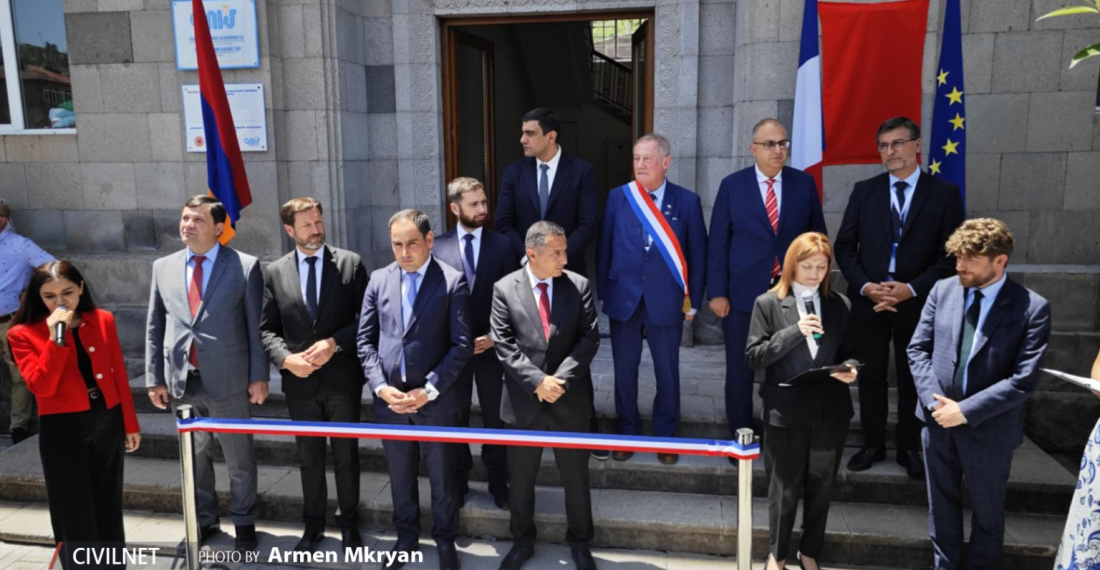
France opened an honorary consulate in the southern Armenian town of Goris on Monday (2 June).

The new consular agency is housed in a building adjacent to Goris Municipality and will be headed by Karmen Apunts, an Armenian national appointed as France’s Honorary Consul. While France initially announced plans in 2023 to establish a full consulate in Syunik, the mission now opened in Goris is a consular agency with largely symbolic functions.

French Ambassador to Armenia Olivier Decottignies attended the inauguration ceremony, along with Armenia’s Deputy Foreign Minister Vahan Kostanyan and Syunik Governor Robert Ghukasyan.

Speaking at the event, Ambassador Decottignies said that the cooperation between Armenia and France has taken on a strategic dimension in recent years. “What France and Armenia are building together is more than technical cooperation or friendship, it’s a real tool for influence, for supporting Armenia, and for acting in favour of peace,” he said.

The honorary consulate’s opening coincides with the 5th Armenia-France Decentralized Cooperation Conference, also taking place in Goris.

Goris has been home to a French cultural center since 2006 and is considered one of Armenia’s most Francophone cities, where French is widely taught in schools.

With the opening of the consular office on Monday, France has become the second country to have a diplomatic presence in Syunik, following Iran’s launch of a consulate in the provincial capital Kapan in October 2022. While Russia also announced its intention to open a consulate in the town in 2023, there has been no progress in this regard so far, with sources in diplomatic circles suggesting that it may be Armenia that is stalling the consulate’s launch.

The  Armenian news portal, CIVILNET, said that speaking at the conference, Ambassador Decottignies mentioned the French humanitarian aid to Syunik, the province that accommodated tens of thousands of Karabakh refugees following the September 2023 ethnic cleansing, and added that with the diplomatic mission now open in Goris it is obvious that “France, its state, its society, and its organizations, remain on Armenia’s side.”

source: commonspace.eu with CIVILNET (Yerevan)

photo: Opening of the French Consular Agency in Goris (picture courtesy of Civilnet, Yerevan)
Related articles

Editor's choice
News
Borrell tells the European Parliament that the situation in Afghanistan was critical, but the EU will remain engaged

Borrell tells the European Parliament that the situation in Afghanistan was critical, but the EU will remain engaged

Borrell underlined that the European Union will make every effort to support the peace process and to remain a committed partner to the Afghan people. "Of course, we will have to take into account the evolving situation, but disengagement is not an option.  We are clear on that: there is no alternative to a negotiated political settlement, through inclusive peace talks.
Editor's choice
News
NATO Chief says war is on Europe's doorstep, and warns against complacency

NATO Chief says war is on Europe's doorstep, and warns against complacency

Russia could attack a Nato country within the next five years, the Secretary General of NATO, Mark Rutte, said in a stark new warning. "Nato's own defences can hold for now," Rutte warned in Berlin, but conflict was "next door" to Europe and he feared "too many are quietly complacent, and too many don't feel the urgency, too many believe that time is on our side. "Russia is already escalating its covert campaign against our societies," Rutte said in a speech in Germany. "We must be prepared for the scale of war our grandparents or great-grandparents endured." Earlier this month, Russia's President Vladimir Putin said his country was not planning to go to war with Europe, but it was ready "right now" if Europe wanted to - or started a war. But similar reassurances were given by Moscow in 2022, just before 200,000 Russian troops crossed the border and invaded Ukraine. Putin has accused European countries of hindering US efforts to bring peace in Ukraine - a reference to the role Ukraine's European allies have recently played in trying to change a US peace plan to end the war, whose initial draft was seen as favouring Russia. But Putin was not sincere, Nato's secretary-general said in the German capital, Berlin. Supporting Ukraine, he added, was a guarantee for European security. "Just imagine if Putin got his way; Ukraine under the boot of Russian occupation, his forces pressing against a longer border with Nato, and the significantly increased risk of an armed attack against us." Russia's economy has been on a war footing for more than three years now - its factories churn out ever more supplies of drones, missiles and artillery shells. According to a recent report by the Kiel Institute for the World Economy, Russia has been producing each month around 150 tanks, 550 infantry fighting vehicles, 120 Lancet drones and more than 50 artillery pieces. The UK, and most of its Western allies, are simply not anywhere near this point. Analysts say it would take years for Western Europe's factories to come close to matching Russia's mass-production of weapons. "Allied defence spending and production must rise rapidly, our armed forces must have what they need to keep us safe," the Nato chief said.

Popular

Editor's choice
News
NATO Chief says war is on Europe's doorstep, and warns against complacency

NATO Chief says war is on Europe's doorstep, and warns against complacency

Russia could attack a Nato country within the next five years, the Secretary General of NATO, Mark Rutte, said in a stark new warning. "Nato's own defences can hold for now," Rutte warned in Berlin, but conflict was "next door" to Europe and he feared "too many are quietly complacent, and too many don't feel the urgency, too many believe that time is on our side. "Russia is already escalating its covert campaign against our societies," Rutte said in a speech in Germany. "We must be prepared for the scale of war our grandparents or great-grandparents endured." Earlier this month, Russia's President Vladimir Putin said his country was not planning to go to war with Europe, but it was ready "right now" if Europe wanted to - or started a war. But similar reassurances were given by Moscow in 2022, just before 200,000 Russian troops crossed the border and invaded Ukraine. Putin has accused European countries of hindering US efforts to bring peace in Ukraine - a reference to the role Ukraine's European allies have recently played in trying to change a US peace plan to end the war, whose initial draft was seen as favouring Russia. But Putin was not sincere, Nato's secretary-general said in the German capital, Berlin. Supporting Ukraine, he added, was a guarantee for European security. "Just imagine if Putin got his way; Ukraine under the boot of Russian occupation, his forces pressing against a longer border with Nato, and the significantly increased risk of an armed attack against us." Russia's economy has been on a war footing for more than three years now - its factories churn out ever more supplies of drones, missiles and artillery shells. According to a recent report by the Kiel Institute for the World Economy, Russia has been producing each month around 150 tanks, 550 infantry fighting vehicles, 120 Lancet drones and more than 50 artillery pieces. The UK, and most of its Western allies, are simply not anywhere near this point. Analysts say it would take years for Western Europe's factories to come close to matching Russia's mass-production of weapons. "Allied defence spending and production must rise rapidly, our armed forces must have what they need to keep us safe," the Nato chief said.