France likely to reduce Barkhane forces in Sahel

France will reconsider its military strategy in the Sahel and will likely reduce the number of troops deployed as part of Operation Barkhane after significant military successes in 2020, the country's defence minister said.

Responding to a question about the 600 additional soldiers brought in to reinforce the 4,500-strong Barkhane troops last year, Florence Parly told the daily newspaper Le Parisien in an interview published Monday, "We will most likely have to adjust this device: a reinforcement by definition is temporary."

"At this very moment, we are working on the evolutions of the Barkhane force in the coming months."

A decision will be made at the next joint summit of France and the G5 Sahel, the West African regional counterterror force, which includes Burkina Faso, Mali, Mauritania, Niger and Chad. The summit will be held in February in N'djamena, the capital of Chad, and will be attended by President Emmanuel Macron and military leaders, she said.

The French minister said that in the coming months the Takuba force, a special joint force of European and American troops, will be fully operational in the region and ready to fight alongside the Malian armed forces, in particular in Menaka, an active sector for al-Qaida and its affiliated groups, where the recent attacks took place.

Parly noted the major military successes achieved by Barkhane forces last year, neutralizing several senior members of al-Qaida, Daesh and affiliated terror groups in the Grand Sahara, an area bordering Mali, Burkina Faso and Niger, by attacking and disrupting their supply chains.

But in the wake of two recent attacks that left five French soldiers dead, she conceded that security remains an issue due to the "pernicious methods of guerrilla warfare" adopted by terrorist groups.

She ruled out any negotiations with terror groups "which murder indiscriminately and have blood on their hands," but expressed willingness to engage with those who have "laid down their arms and who are not motivated by a radical and criminal ideology," under the 2015 framework of Algiers agreement for peace and reconciliation which is yet to be implemented.

Since the launch of Operation Barkhane in 2013, 49 French soldiers have died.

Last week, five French soldiers were killed and others injured in two separate incidents after their armoured vehicle hit an improvised explosive device in Mali, according to the French minister of armed forces.

More than 5,000 French soldiers are deployed under Operation Barkhane which is led by France alongside the G5 Sahel countries to fight against terrorist groups in the region, particularly al-Qaida in the Islamic Maghreb and Daesh in the Greater Sahara.

Source: commonspace.eu with Le Parisiene (Paris) and Daily Sabah (Ankara). 

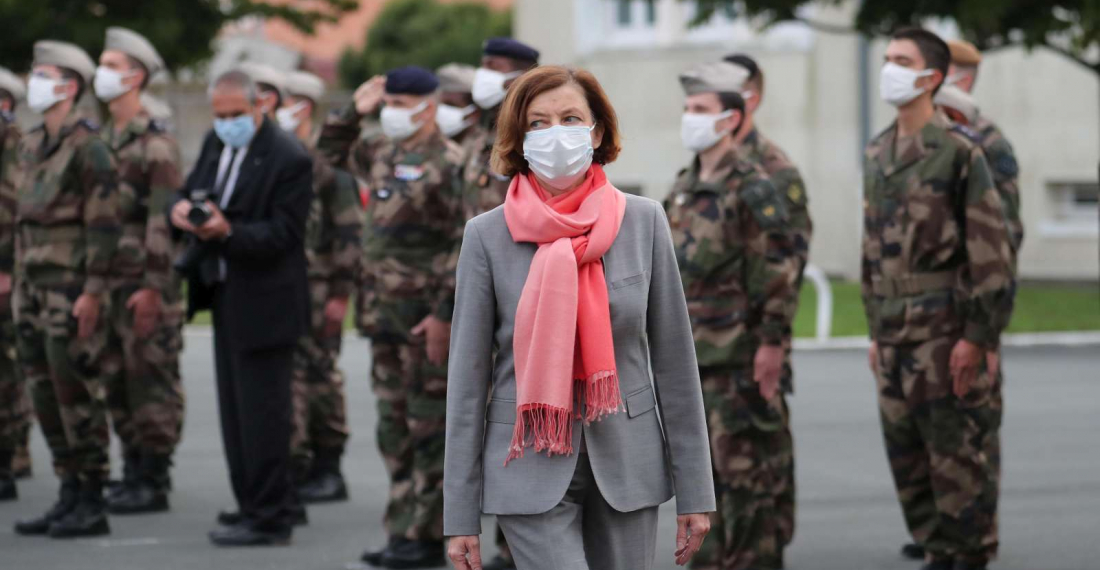
Photo: French Defence Minister, Florence Parly. 
Related articles

Editor's choice
News
Thousands join Pope on his last day in Cameroon, his second stop on his African tour

Thousands join Pope on his last day in Cameroon, his second stop on his African tour

More than 120,000 people joined Pope Leo XIV in Cameroon for an open-air Mass on Friday (17 April), the biggest crowd so far during his 11-day Africa tour. Arriving in the economic city of Douala on Friday, the Pope reiterated his message of peace after visiting the country's Anglophone region hit by a decade-long rebellion the day before. He later warned of the dangers of artificial intelligence (AI), which he said was leading to the spread of "polarisation, conflict, fear and violence". Jubliant crowds welcomed the Pope as he arrived at the Japoma Stadium. Standing in his vehicle - known as the Popemobile - the pontiff waved at the droves of people waiting for his entrance. Some worshippers camped outside the premises on Thursday night in a bid to get a prime spot for the pontiff's address, with some having been there for more than 24 hours By Friday, tens of thousands of people of all ages, including several from the priesthood, braved the heat to participate in the occasion. “Do not give in to distrust and discouragement,” he said. “Reject every form of abuse or violence, which deceives by promising easy gains but hardens the heart and makes it insensitive. Do not forget that your people are even richer than this land, for your treasure lies in your values: faith, family, hospitality, and work.” Pope Leo invited African youth to follow the vocation that God sets out for them, so that they may be protagonists of their own future. “Do not let yourselves be corrupted by temptations that waste your energies and do not serve the progress of society,” he said.
Editor's choice
News
Russian attacks on Kyiv and other Ukrainian cities highlights need of strengthening European resolve

Russian attacks on Kyiv and other Ukrainian cities highlights need of strengthening European resolve

Ukrainian President Volodymyr Zelensky condemned the attack, writing on X that it proved that US and European sanctions against Russia should not be weakened. Russia launched more than 700 drones and missiles at Ukraine in multiple waves overnight from Wednesday to Thursday, killing at least 18 people in what local officials said was the deadliest attack in months. Ukraine's air force said on Thursday morning that Russia had launched 659 drones and 44 cruise and ballistic missiles in the prior 24 hours. It said that 636 drones and 31 missiles had been shot down - but there had been direct hits in 26 locations. (click picture to read more)

Popular

Editor's choice
Interview
Thursday Interview: Murad Muradov

Thursday Interview: Murad Muradov

Today, commonspace.eu starts a new regular weekly series. THURSDAY INTERVIEW, conducted by Lauri Nikulainen, will host  persons who are thinkers, opinion shapers, and implementors in their countries and spheres. We start the series with an interview with Murad Muradov, a leading person in Azerbaijan's think tank community. He is also the first co-chair of the Action Committee for a new Armenian-Azerbaijani Dialogue. Last September he made history by being the first Azerbaijani civil society activist to visit Armenia after the 44 day war, and the start of the peace process. Speaking about this visit Murad Muradov said: "My experience was largely positive. My negative expectations luckily didn’t play out. The discussions were respectful, the panel format bringing together experts from Armenia, Azerbaijan, and Turkey was particularly valuable during the NATO Rose-Roth Seminar in Yerevan, and media coverage, while varied in tone, remained largely constructive. Some media outlets though attempted to represent me as more of a government mouthpiece than an independent expert, which was totally misleading.  Overall, I see these initiatives as important steps in rebuilding trust and normalising professional engagement. The fact that soon a larger Azerbaijani civil society visits to Armenia followed, reinforces the sense that this process is moving in the right direction." (click the image to read the interview in full)