


Explosions At Brussels (updated)

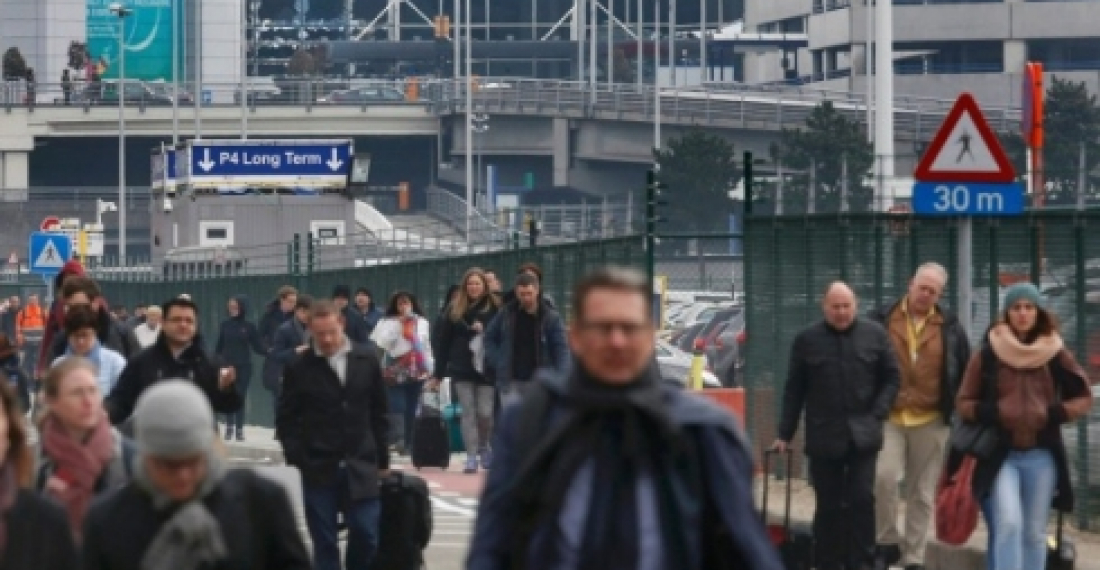
Dozens of people have been killed and injured. after two explosions ripped through Zaventem Airport in Brussels.

Shots were fired and Arabic shouted before the blasts, according to Belgian news agency Belga, as there were fresh reports of an explosion at Maalbeek metro station in the city.

The country's public broadcaster RTBF said there were up to 10 people dead and a further 30 wounded.According to reports the suspected terror attack centred on an American Airlines desk in a departure hall at around 8am.

Airport spokeswoman Anke Fransen said: "There were two blasts in the departure hall. First aid team are in place for help."

The attack comes as the Belgian capital is on high alert following the dramatic arrest of Paris attacks suspect Salah Abdeslam in the city last Friday.


Ten Dead In Brussels Metro Station Blast

At least 10 people have been killed after a rush-hour explosion at a metro station close to EU buildings in Brussels.

Passengers are evacuated from trains in tunnels after an "enormous explosion" at Maalbeek station in the heart of the city.

The latest updates from Brussels after multiple explosions amid reports dozens of people have been killed and injured.


Islamic State has claimed responsibility for the two bomb attacks in Brussels, a news agency affiliated with the group said.

AMAQ agency said:

"Islamic State fighters carried out a series of bombings with explosive belts and devices on Tuesday, targeting an airport and a central metro station in the centre of the Belgian capital Brussels."


source: agencies
 

Related articles

Editor's choice
News
Washington to invest in Armenia’s nuclear energy sector

Washington to invest in Armenia’s nuclear energy sector

US Vice President JD Vance announced a $9 billion U.S. investment in Armenia’s nuclear energy sector during a visit to Yerevan, saying the two countries had completed negotiations on a civil nuclear cooperation framework that will enable joint projects, including the use of US small modular reactor technology. Vance said the initiative aims to strengthen Armenia’s energy security while creating jobs in the United States. At a joint briefing with Prime Minister Nikol Pashinyan, Vance also confirmed that Washington had approved the sale of V-BAT drones to Armenia in a deal worth $11 million. The US vice president voiced support for Pashinyan ahead of Armenia’s parliamentary elections, scheduled for June 7, describing him as a partner capable of building long-term cooperation with Washington. Vance also commented on the implementation of the "Trump Route for International Peace and Prosperity" project, which, in his opinion, will radically change the entire South Caucasus, open "a new world for international trade, transit and energy flows, and provide unprecedented connectivity between Armenia and neighboring countries." US Vice President Vance visited Armenia on Monday (9 February)>, where he held talks with prime minister Nikol Pashinyan. On Tuesday he is expected to go to Baku to meet President Ilham Aliyev.

Popular

Editor's choice
Interview
Thursday Interview: Murad Muradov

Thursday Interview: Murad Muradov

Today, commonspace.eu starts a new regular weekly series. THURSDAY INTERVIEW, conducted by Lauri Nikulainen, will host  persons who are thinkers, opinion shapers, and implementors in their countries and spheres. We start the series with an interview with Murad Muradov, a leading person in Azerbaijan's think tank community. He is also the first co-chair of the Action Committee for a new Armenian-Azerbaijani Dialogue. Last September he made history by being the first Azerbaijani civil society activist to visit Armenia after the 44 day war, and the start of the peace process. Speaking about this visit Murad Muradov said: "My experience was largely positive. My negative expectations luckily didn’t play out. The discussions were respectful, the panel format bringing together experts from Armenia, Azerbaijan, and Turkey was particularly valuable during the NATO Rose-Roth Seminar in Yerevan, and media coverage, while varied in tone, remained largely constructive. Some media outlets though attempted to represent me as more of a government mouthpiece than an independent expert, which was totally misleading.  Overall, I see these initiatives as important steps in rebuilding trust and normalising professional engagement. The fact that soon a larger Azerbaijani civil society visits to Armenia followed, reinforces the sense that this process is moving in the right direction." (click the image to read the interview in full)


