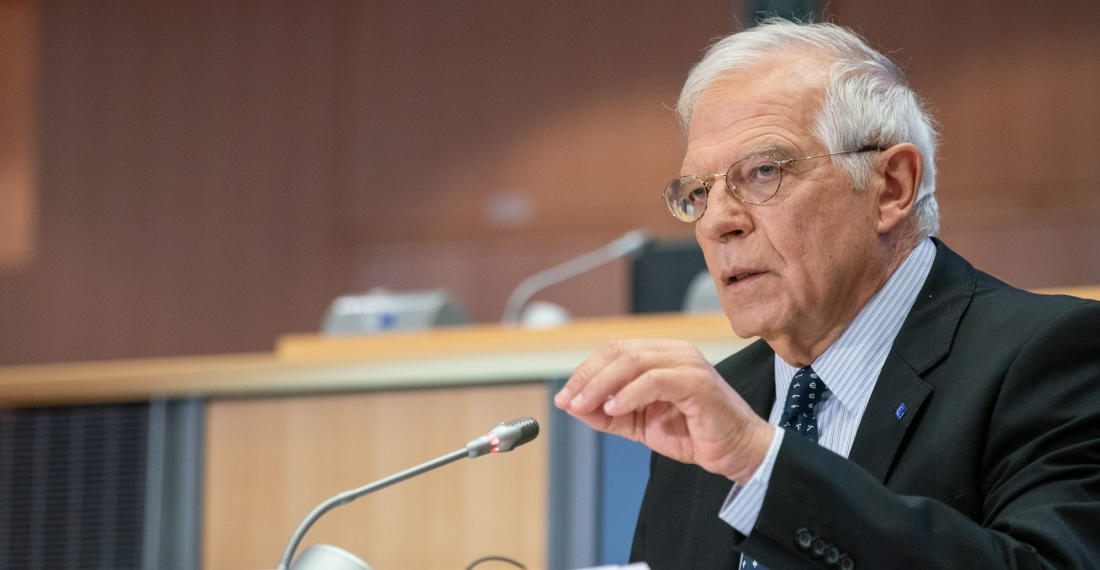
The European Union has issued a statement declaring its position regarding the current situation in and around Nagorno-Karabakh. A statement issued on behalf of the EU by High Representative Josep Borrell welcomes the end of hostilities as a result of the Russian brokered deal with Armenia and Azerbaijan. The statement makes no reference to the Russian military force deployed as part of the deal, but calls for “the full and prompt withdrawal of all foreign fighters from the region.” It also reiterates “its full support to the international format of the OSCE Minsk Group led by its Co-Chairs and to the Personal Representative of the OSCE Chairperson-in-Office” in the pursuit of a negotiated, comprehensive and sustainable settlement of the conflict, including on the status of Nagorno-Karabakh”.
The full statement reads
The European Union welcomes the cessation of hostilities in and around Nagorno-Karabakh following the Russia-brokered ceasefire of 9 November agreed between Armenia and Azerbaijan. The EU calls on all parties to continue to strictly respect the ceasefire to prevent further loss of life.
The EU urges all regional actors to refrain from any actions or rhetoric that could jeopardise the ceasefire. The EU also calls for the full and prompt withdrawal of all foreign fighters from the region.
The EU will follow closely the implementation of the provisions of the ceasefire, especially with regard to its monitoring mechanism.
The cessation of hostilities is only a first step to end the long-standing Nagorno-Karabakh conflict. The EU considers that efforts must be renewed for a negotiated, comprehensive and sustainable settlement of the conflict, including on the status of Nagorno-Karabakh. The EU therefore reiterates its full support to the international format of the OSCE Minsk Group led by its Co-Chairs and to the Personal Representative of the OSCE Chairperson-in-Office to pursue this objective. The EU stands ready to effectively contribute in the shaping of a durable and comprehensive settlement of the conflict, including where possible through support for stabilisation, post conflict rehabilitation and confidence building measures.
The EU recalls its firm opposition against the use of force, in particular the use of cluster ammunitions and incendiary weapons, as a mean to settle disputes. The EU stresses that international humanitarian law must be respected and calls on the parties to implement the agreements on the exchange of prisoners of war and the repatriation of human remains reached within the OSCE Minsk Group Co-Chairs format on 30 October in Geneva. The EU underlines the importance of guaranteeing humanitarian access and the best possible conditions for the voluntary, safe, dignified and sustainable return of the displaced populations in and around Nagorno-Karabakh. It underlines the importance of preserving and restoring the cultural and religious heritage in and around Nagorno-Karabakh. Any war crimes that may have been committed must be investigated.
The European Union and its Member States are already providing significant humanitarian assistance to address the immediate needs of the civilian populations affected by the conflict and stand ready to provide further assistance.