


EU and Turkmenistan held annual Human Rights Dialogue meeting

The European Union and Turkmenistan held the thirteenth round of their annual Human Rights Dialogue on Tuesday (6 July). The meeting took place by videoconference due to the restrictions imposed by the COVID-19 pandemic. The deputy minister of foreign affairs, Vepa Hajiyev, led the Turkmen delegation; the delegation of the European Union was led by acting head of the Central Asia Division of the European External Action Service, Philippe van Amersfoort.

The dialogue allowed for an open exchange on a wide range of issues, with a particular focus on the repercussions of the pandemic on human rights. The parties exchanged views on the rule of law, the legal framework for the protection of human rights in Turkmenistan as well as its implementation, the situation of civil society, fundamental freedoms, conditions in detention and torture prevention, cooperation with international bodies, in particular UN special procedures, as well as individual cases of human rights concern.

The head of the Organization for Security and Co-operation in Europe's Centre in Ashgabat, Ambassador John McGregor, and the head of the office of the United Nations High Commissioner for Human Rights in Bishkek, Ryszard Komenda, were invited to provide an update on their co-operation with Turkmenistan. The EU welcomed the country’s willingness to co-operate in human rights matters. However, the EU stressed that some aspects of national legislation and some of the key international commitments of Turkmenistan have to be fully implemented and monitored. The EU insisted in particular on the importance of strengthening co-operation with the UN to efficiently tackle enforced disappearances in detention. The EU also urged Turkmenistan to ratify key international convention and protocols such as the Rome Statute of the International Criminal Court and the Optional Protocol of the Convention against Torture. The EU underlined the need for concrete improvements in human rights, also in view of the ratification of the Partnership and Cooperation Agreement with the EU signed in May 1998. The EU insisted on the need to guarantee unhindered monitoring of detention facilities by independent monitors and encouraged close co-operation with the International Committee of the Red Cross.

The Turkmen delegation emphasised contacts underway to organise visits by the UN Working Group on Enforced Disappearances and the UNSR on Cultural Rights. The Turkmen side signalled its readiness to organise visits of diplomats to detention centres, once the epidemiological conditions allow.

The EU informed about its major human rights related policy initiatives such as the new EU Action Plan on Human Rights and Democracy 2021-2024 and the EU Global Human Rights Sanctions Regime adopted by the Council in December 2020, which signals the EU’s strong determination to stand united for human rights. Turkmenistan informed about its National Human Rights Action Plan (2021-2025) and reiterated its intention to co-operate with international organisations, including the UN, ILO and OSCE.

Turkmenistan announced that the 2020 activity report of the Ombudsperson’s office had been made public. The EU emphasised the importance of the full independence of the Ombudsperson's office and the importance of her engagement with the Turkmen authorities on all human rights issues, including enforced disappearances.

The EU welcomed the involvement of some civil society organisations in consultation with the government, but raised its persistent concerns about the situation of human rights defenders, civil society organisations, and journalists. The EU called on Turkmenistan to bring its legislation and practices in line with international human rights standards in areas such as freedom of expression, freedom of peaceful assembly and freedom of association. The EU urged Turkmenistan to remove unnecessary restrictions to access to the Internet. The EU emphasised the important contribution that an independent civil society and journalists can make to socio-economic resilience in times of crisis, and encouraged the government to set up a dialogue with independent civil society organisations and create the necessary conditions for them to operate without undue interference or restrictions.

The EU stressed the importance of fully eliminating forced labour and underlined its zero tolerance policy on child labour. Turkmenistan informed about measures taken and envisaged to address these issues, including through co-operation with the International Labour Organization.

 

source: commonspace.eu with the European External Action Service
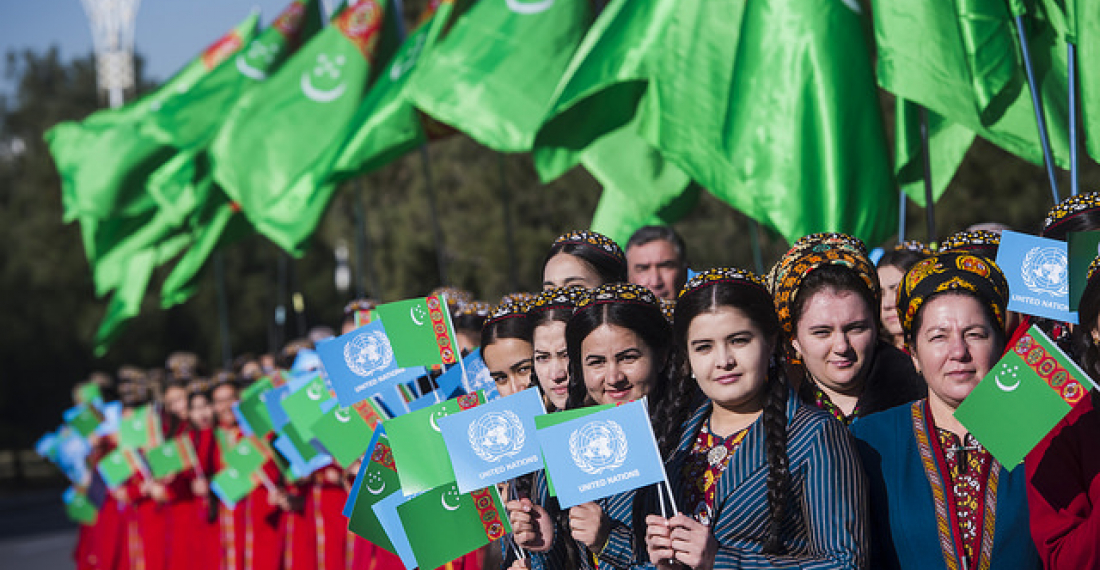
photo: People in Turkmenistan at official event to open new UN House (United Nations)

Related articles

Editor's choice
News
Borrell tells the European Parliament that the situation in Afghanistan was critical, but the EU will remain engaged

Borrell tells the European Parliament that the situation in Afghanistan was critical, but the EU will remain engaged

Borrell underlined that the European Union will make every effort to support the peace process and to remain a committed partner to the Afghan people. "Of course, we will have to take into account the evolving situation, but disengagement is not an option.  We are clear on that: there is no alternative to a negotiated political settlement, through inclusive peace talks.
Editor's choice
News
NATO Chief says war is on Europe's doorstep, and warns against complacency

NATO Chief says war is on Europe's doorstep, and warns against complacency

Russia could attack a Nato country within the next five years, the Secretary General of NATO, Mark Rutte, said in a stark new warning. "Nato's own defences can hold for now," Rutte warned in Berlin, but conflict was "next door" to Europe and he feared "too many are quietly complacent, and too many don't feel the urgency, too many believe that time is on our side. "Russia is already escalating its covert campaign against our societies," Rutte said in a speech in Germany. "We must be prepared for the scale of war our grandparents or great-grandparents endured." Earlier this month, Russia's President Vladimir Putin said his country was not planning to go to war with Europe, but it was ready "right now" if Europe wanted to - or started a war. But similar reassurances were given by Moscow in 2022, just before 200,000 Russian troops crossed the border and invaded Ukraine. Putin has accused European countries of hindering US efforts to bring peace in Ukraine - a reference to the role Ukraine's European allies have recently played in trying to change a US peace plan to end the war, whose initial draft was seen as favouring Russia. But Putin was not sincere, Nato's secretary-general said in the German capital, Berlin. Supporting Ukraine, he added, was a guarantee for European security. "Just imagine if Putin got his way; Ukraine under the boot of Russian occupation, his forces pressing against a longer border with Nato, and the significantly increased risk of an armed attack against us." Russia's economy has been on a war footing for more than three years now - its factories churn out ever more supplies of drones, missiles and artillery shells. According to a recent report by the Kiel Institute for the World Economy, Russia has been producing each month around 150 tanks, 550 infantry fighting vehicles, 120 Lancet drones and more than 50 artillery pieces. The UK, and most of its Western allies, are simply not anywhere near this point. Analysts say it would take years for Western Europe's factories to come close to matching Russia's mass-production of weapons. "Allied defence spending and production must rise rapidly, our armed forces must have what they need to keep us safe," the Nato chief said.

Popular

Editor's choice
News
NATO Chief says war is on Europe's doorstep, and warns against complacency

NATO Chief says war is on Europe's doorstep, and warns against complacency

Russia could attack a Nato country within the next five years, the Secretary General of NATO, Mark Rutte, said in a stark new warning. "Nato's own defences can hold for now," Rutte warned in Berlin, but conflict was "next door" to Europe and he feared "too many are quietly complacent, and too many don't feel the urgency, too many believe that time is on our side. "Russia is already escalating its covert campaign against our societies," Rutte said in a speech in Germany. "We must be prepared for the scale of war our grandparents or great-grandparents endured." Earlier this month, Russia's President Vladimir Putin said his country was not planning to go to war with Europe, but it was ready "right now" if Europe wanted to - or started a war. But similar reassurances were given by Moscow in 2022, just before 200,000 Russian troops crossed the border and invaded Ukraine. Putin has accused European countries of hindering US efforts to bring peace in Ukraine - a reference to the role Ukraine's European allies have recently played in trying to change a US peace plan to end the war, whose initial draft was seen as favouring Russia. But Putin was not sincere, Nato's secretary-general said in the German capital, Berlin. Supporting Ukraine, he added, was a guarantee for European security. "Just imagine if Putin got his way; Ukraine under the boot of Russian occupation, his forces pressing against a longer border with Nato, and the significantly increased risk of an armed attack against us." Russia's economy has been on a war footing for more than three years now - its factories churn out ever more supplies of drones, missiles and artillery shells. According to a recent report by the Kiel Institute for the World Economy, Russia has been producing each month around 150 tanks, 550 infantry fighting vehicles, 120 Lancet drones and more than 50 artillery pieces. The UK, and most of its Western allies, are simply not anywhere near this point. Analysts say it would take years for Western Europe's factories to come close to matching Russia's mass-production of weapons. "Allied defence spending and production must rise rapidly, our armed forces must have what they need to keep us safe," the Nato chief said.

