


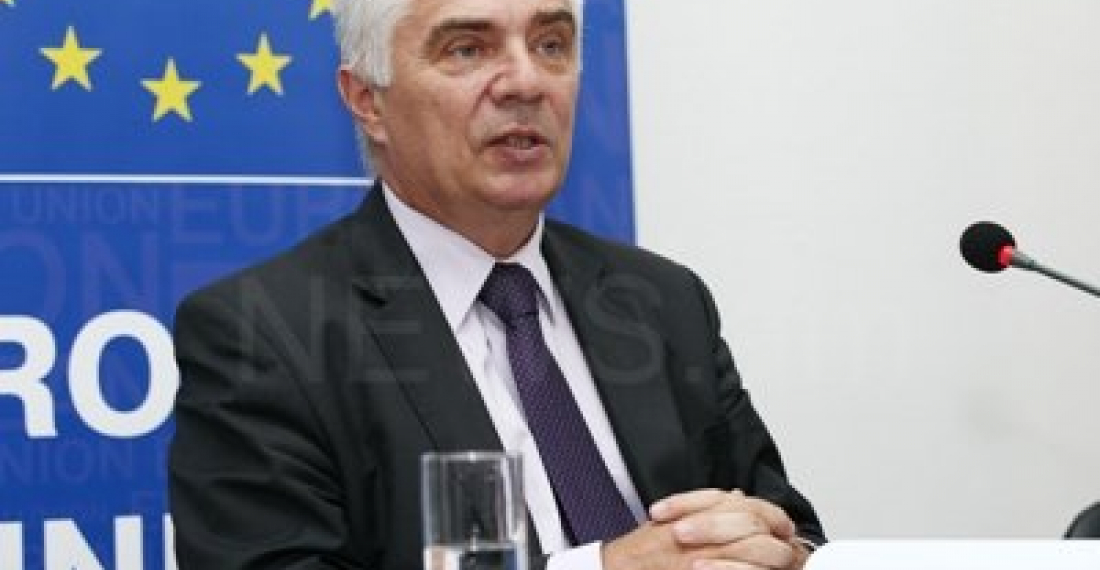
"The EU and Armenia are close to finalising negotiations on a new framework agreement, but there are still open issues"

The Head of the European Union Delegation to Armenia, Piotr Switalski, gave a positive assessment of relations between the European Union and Armenia when he spoke on Tuesday at the Media Centre in Yerevan. Switalski said that 2016 was a busy, but successful year for EU-Armenia relations. "We expect the momentum in the relations to be maintained and taken to a new level in 2017, as we bring the new framework agreement [between the EU and Armenia], to a successful conclusion".

The head of the EU Delegation said that in 2016 the European Union transferred 62 million euros in development assistance to Armenia and signed contracts for a further 50 million euros.

Switalski said that the EU has five priorities in its dealings with Armenia: (a) a successful implementation of the Election project, leading to good elections in April; (b) improving the business climate; (c) co-operation in the fight against corruption; (d) implementation of the human rights support contract which has clear commitments; (e) strengthening the independence of the judiciary based on the fact that the EU has already allocated 50 million euros for judicial reform.

Switalski said that the discussions on the new framework agreement "are very advanced and the negotiators are very close to conclusion of the agreement, and if everything goes well the finalisation of the negotiations will be a major event in 2017". The EU diplomat said that there are still some open issues, "but we have no reason to believe that they cannot be overcome". He highlighted what he called the new circumstances that emerged after 2013 among these still open issues. He added that from its side the EU sees "a sincere effort and a constructive approach from the Armenian side".  

The Head of the EU Delegation to Armenia also said that the two sides are also finalising two other agreements: the first will define the partnership priorities of the two sides and state them into a politically binding document; the second document will be the single support framework which will outline the development priorities that the two sides identify for working together until 2020.

Switalski said that the EU attached great importance to the forthcoming parliamentary elections in April. "Good, fair, just and transparent elections will help boost relations, open new possibilities of co-operation and create a good climate for the future".  He added, "the European Union has invested a lot - both in terms of money as well as political support so we have a deep and clear interest in the success of the elections". However Ambassador Switalski emphasised that the EU was interested in the clean nature of the election process, not the particular issues or personalities. He said that there were two areas of particular importance - the prevention of political corruption [vote-buying], and the use of administrative resources. He said that there was already a good legal framework but these now had to work in practice. "I am looking forward to the good conduct of the elections".

You can listen to a podcast of the press conference here

source: commonspace.eu

photo: Ambassador Piotr Switalski, Head of the EU delegation to Armenia speaking to journalists at the press centre in Yerevan on 24 January 2017.

Related articles

Editor's choice
News
Council of Europe launches new International Claims Commission for Ukraine

Council of Europe launches new International Claims Commission for Ukraine

Thirty-four countries and the European Union have signed a new convention establishing an International Claims Commission for Ukraine at a diplomatic conference co-hosted by the 46-nation Council of Europe and the Netherlands in the Hague. The diplomatic conference was attended by leaders and high-level representatives from over 50 states, including the President of Ukraine, Volodymyr Zelenskyy, the President of the Republic of Moldova, Maia Sandu, and the Prime Minister of the Netherlands, Dick Schoof.  “Today marks a major step forward in ensuring accountability for Ukraine. The International Claims Commission represents justice and hope for tens of thousands of victims—our determination that those who have suffered will not be forgotten. I call for quick ratifications so we can get the commission rapidly up and running for the people of Ukraine,” said Council of Europe Secretary General Alain Berset. Ukrainian President Volodymyr Zelenskyy said: “We expect that every mechanism for compensation from the Register of Damage and Claims Commission to the actual payments – will start working and receive strong and sufficient international support, so that people can truly feel that any kind of damage caused by the war can be compensated. This war, and Russia’s responsibility for it, MUST become a clear example – so that others learn not to choose aggression.” “Accountability is about creating the conditions for peace that endures. And therefore, accountability is a condition of security – today and for the future. But accountability is not only about Ukraine. And it is not only about one aggressor and one victim. Accountability is about Europe. About every country in Europe. It is about whether Europe, as a whole, is willing to defend its peace,” said Maia Sandu, President of the Republic of Moldova, which currently holds the Presidency of the Council of Europe’s Committee of Ministers. The Prime Minister of the Netherlands, Dick Schoof, said: “Every day Russia is deliberately bombarding homes, destroying businesses and damaging infrastructure in Ukraine. Russia must compensate Ukraine for the damage caused. That is why we have launched the International Claims Commission for Ukraine and we are honoured to host it.” The International Claims Commission will be the second part of a comprehensive compensation mechanism related to Russia’s war of aggression, building on the existing Register of Damage for Ukraine. The claims commission will be established within the framework of the Council of Europe and will also be open to other countries. The Register of Damage for Ukraine, created in 2023, collects and records compensation claims submitted by individuals, organisations and public bodies in Ukraine. Forty-four states and the European Union have so far joined the Register, which has already received 86,000 claims. The International Claims Commission will review, assess and decide upon claims submitted to the Register of Damage for Ukraine and determine the amount of compensation, if any, which is due in each case. The convention establishing the commission will enter into force once it has been ratified by 25 signatories, as long as sufficient funds have been secured to support its initial work.

Popular

Editor's choice
News
Council of Europe launches new International Claims Commission for Ukraine

Council of Europe launches new International Claims Commission for Ukraine

Thirty-four countries and the European Union have signed a new convention establishing an International Claims Commission for Ukraine at a diplomatic conference co-hosted by the 46-nation Council of Europe and the Netherlands in the Hague. The diplomatic conference was attended by leaders and high-level representatives from over 50 states, including the President of Ukraine, Volodymyr Zelenskyy, the President of the Republic of Moldova, Maia Sandu, and the Prime Minister of the Netherlands, Dick Schoof.  “Today marks a major step forward in ensuring accountability for Ukraine. The International Claims Commission represents justice and hope for tens of thousands of victims—our determination that those who have suffered will not be forgotten. I call for quick ratifications so we can get the commission rapidly up and running for the people of Ukraine,” said Council of Europe Secretary General Alain Berset. Ukrainian President Volodymyr Zelenskyy said: “We expect that every mechanism for compensation from the Register of Damage and Claims Commission to the actual payments – will start working and receive strong and sufficient international support, so that people can truly feel that any kind of damage caused by the war can be compensated. This war, and Russia’s responsibility for it, MUST become a clear example – so that others learn not to choose aggression.” “Accountability is about creating the conditions for peace that endures. And therefore, accountability is a condition of security – today and for the future. But accountability is not only about Ukraine. And it is not only about one aggressor and one victim. Accountability is about Europe. About every country in Europe. It is about whether Europe, as a whole, is willing to defend its peace,” said Maia Sandu, President of the Republic of Moldova, which currently holds the Presidency of the Council of Europe’s Committee of Ministers. The Prime Minister of the Netherlands, Dick Schoof, said: “Every day Russia is deliberately bombarding homes, destroying businesses and damaging infrastructure in Ukraine. Russia must compensate Ukraine for the damage caused. That is why we have launched the International Claims Commission for Ukraine and we are honoured to host it.” The International Claims Commission will be the second part of a comprehensive compensation mechanism related to Russia’s war of aggression, building on the existing Register of Damage for Ukraine. The claims commission will be established within the framework of the Council of Europe and will also be open to other countries. The Register of Damage for Ukraine, created in 2023, collects and records compensation claims submitted by individuals, organisations and public bodies in Ukraine. Forty-four states and the European Union have so far joined the Register, which has already received 86,000 claims. The International Claims Commission will review, assess and decide upon claims submitted to the Register of Damage for Ukraine and determine the amount of compensation, if any, which is due in each case. The convention establishing the commission will enter into force once it has been ratified by 25 signatories, as long as sufficient funds have been secured to support its initial work.

