Ethiopia expels seven UN officials accusing them of hindering aid

The Ethiopian Ministry of Foreign Affairs on Thursday (30 September) told seven senior UN officials to leave the country within the next 72 hours accusing them of 'meddling in internal affairs. The decision to expel came two days after the UN Humanitarian Chief, Martin Griffiths, warned of a government blockade of aid that would likely lead to a famine. Griffiths said that the blockade has been de-facto in place for three months 

The seven being expelled include the country heads of UNICEF and UN OCHA. The UN Secretary-General Antonio Guterres said he was "shocked" by the expulsions and added that the UN was engaging with the Ethiopian government with the expectation that the staff will be allowed back.  

International concerns about the Ethiopian government's interference with humanitarian work is not new, and both the US and the EU have considered a wide sanctions regime against Ethiopia. 

White House press secretary Jen Psaki told reporters on Thursday that the United States condemns the expulsions and will not hesitate to use sanctions against those who obstruct humanitarian efforts.

"We're deeply concerned that this action continues a pattern by the Ethiopian government of obstructing the delivery of food, medicine and other life-saving supplies to those most in need," she said.

Ethiopia continues to deny blocking aid and argues that aid organisations favour the anti-government Tigray front. Meanwhile, truck drivers entering Tigray say they are not being provided with enough fuel for a two-way journey and that they face logistical restrictions. Ethiopia has faced immense pressure from various humanitarian and international actors for its conduct in the Tigray crisis. 
 

Source: commonspace.eu with BBC (London) and Reuters (London). 
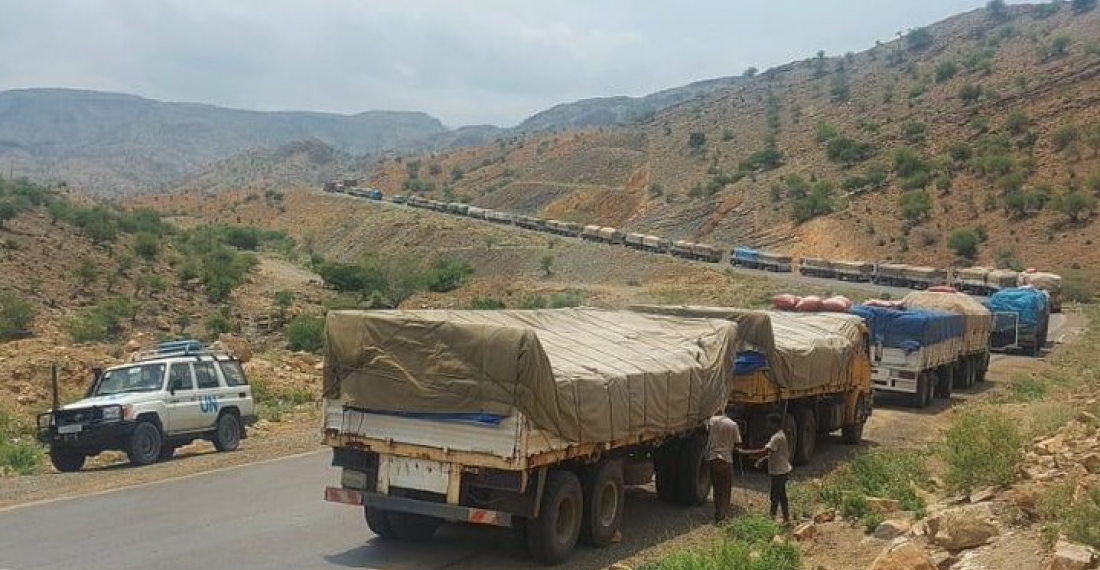
Picture: Aid trucks on the road leading into Tigray; Twitter: @UNEthiopia 

Related articles

Popular

Editor's choice
Interview
Thursday Interview: Murad Muradov

Thursday Interview: Murad Muradov

Today, commonspace.eu starts a new regular weekly series. THURSDAY INTERVIEW, conducted by Lauri Nikulainen, will host  persons who are thinkers, opinion shapers, and implementors in their countries and spheres. We start the series with an interview with Murad Muradov, a leading person in Azerbaijan's think tank community. He is also the first co-chair of the Action Committee for a new Armenian-Azerbaijani Dialogue. Last September he made history by being the first Azerbaijani civil society activist to visit Armenia after the 44 day war, and the start of the peace process. Speaking about this visit Murad Muradov said: "My experience was largely positive. My negative expectations luckily didn’t play out. The discussions were respectful, the panel format bringing together experts from Armenia, Azerbaijan, and Turkey was particularly valuable during the NATO Rose-Roth Seminar in Yerevan, and media coverage, while varied in tone, remained largely constructive. Some media outlets though attempted to represent me as more of a government mouthpiece than an independent expert, which was totally misleading.  Overall, I see these initiatives as important steps in rebuilding trust and normalising professional engagement. The fact that soon a larger Azerbaijani civil society visits to Armenia followed, reinforces the sense that this process is moving in the right direction." (click the image to read the interview in full)