Local elections were held in five regions of Armenia on Sunday, 18 September. Commonspace.eu Armenia correspondent, Vahagn Antonyan filed this report.
Elections for local self-governing bodies were held on Sunday in Armenia. People voted in 37 communities of Aragatsotn, Ararat, Armavir, Syunik, and Tavush regions. In 22 of the communities only community leaders will be elected, while 80 communities will vote for City Council members and the remaining 115 of the communities will vote both for community leaders and City Councils.
In these regions 647,393 people have the right to vote. According to the information provided by the Central Election Committee (CEC), the voter turnout at 14.00 was 166,747 or 25.76%. By 5 p.m. 247625 (38%) citizens took part in the local self-government elections. By close of vote, turnout was 49.42% or 319916 voters.
The elections are the first major test in the polls following the political crisis in the summer when armed men from a group called Sasna Tser occupied a police station in Erebuni demanding the resignation of the government. The crisis which ended after a two-week siege exposed serious problems within the Armenian political system. President Sargsyan, speaking the day after the crisis ended, promised serious reforms, and earlier this month a new Prime Minister was appointed.
A shadow of Erebuni hung over Sunday's elections. A Member of Sasna Tsrer, Arayik Khandoyan ran for the community leader's elections in his native village Tsakhkahovit, Aragatsotn region. Khandoyan was arrested for being part of the armed group that occupied the Police Station. The candidate's wife, who is also his proxy, arrived at the polling station wearing a shirt with her husband's photo on it. When the president of the electoral commission reprimanded the woman she agreed to wear other clothes on top of the shirt and then left the polling station. However, many other voters come to the polling station wearing shirts with image of the "Lone Wolf".
Organizations monitoring elections on Sunday reported numerous violations.
Despite the promise of the authorities "to change" the local self-government elections, nothing seemed much different from previous elections.
Since early morning there were reports of violations in the election process. The Citizen Observer Initiative, one of the groups monitoring the elections reported 16 violations in 4 polling stations by 9:30a.m.
According to the data provided by Transparency International, by 1:30 p.m. the most common violation has been the presence of more than 15 voters in the polling stations: it amounted to 15.4 percent of the total voting violations.
Other violations reported were related to the rights of the media representatives, the hindering of the process by a candidate proxy or electoral committee member, and failure to register these people in the register.
The Citizen Observer Initiative reported that during Sunday's elections CEC adopted a new practice for violating the rights of the monitoring organizations and the observers by refusing to accept complaints submitted in person and suggesting to put them in the CEC box in which case the acceptance of the complaints is not recorded.
Such a practice is not in line with the constitutional and legal obligations that ensure the legality of elections and it creates additional obstacles in recording violations, preventing fraud and holding people responsible.
According to the Citizen Observer Initiative the refusal of the CEC to accept the applications submitted in person is a proof that the authorities fail to show enough political will for the implementation of positive obligations in the fight against electoral violations.
The Citizen Observer initiative recorded and reported numerous violations also by 6:00 p.m.
The Ombudsman and his office also observe the election process, informs the Ombudsman's Office press service.
The Ombudsman's staff received reports of cases of hindering the activities of journalists and observers, violating the secrecy of voting, and directing voters.
There were also reports of pre-election tensions. On September 17, a criminal case was initiated in the department of particularly important cases of the Prosecutor General's Office based on the report of the city council candidate in Echmiadzin, Armavir region.
The General Prosecutor's Office informed that on September 18, 2016 a citizen of Ejmiatsin was arrested on suspicion of committing a criminal act, namely, "the kidnapping of a candidate by a group of persons by prior agreement and impeding the exercise of the latter's voting rights".
On September 16, 2016 at 11:30p.m. an incident took place in Ejmiatsin. Gunshots were fired in the direction of the car of the current mayor of Ejmiatsin, Karen Grigoryan. Karen Grigoryan is the son of the Member of the Parliament from the Republican Party, General Manvel Grigoryan. Karen Grigoryan was in the car at the time. One person was hospitalised in the brawl that followed.
source: This report was compiled by commonspace.eu Armenia correspondent Vahagn Antonyan
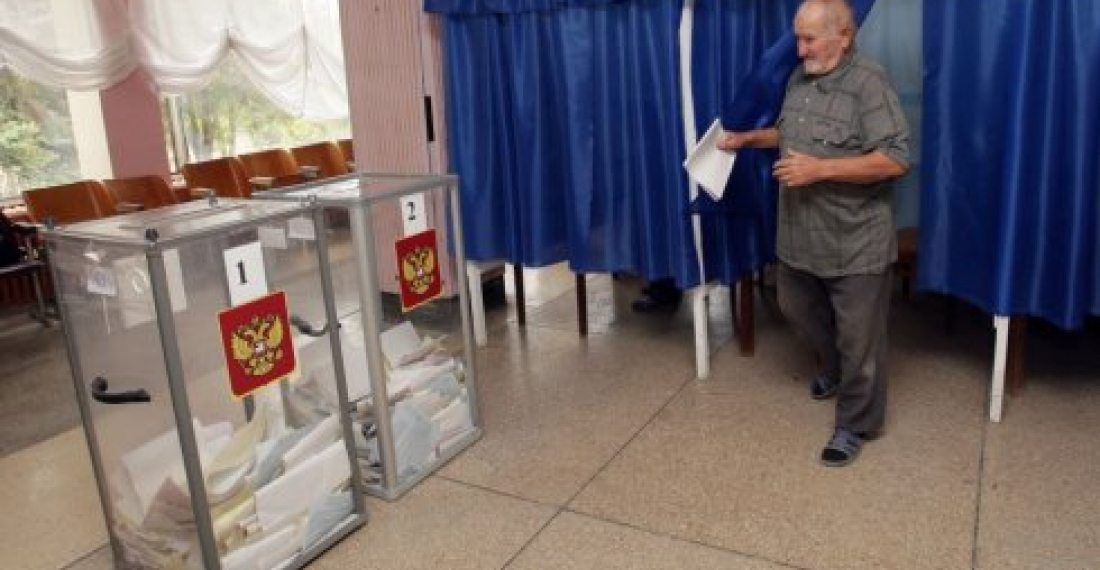
image: A voter casting his ballot in a previous election in Armenia (archive picture)